SHEIN’s Listing Countdown: Who Is the New “Price Setter” for Consumer Goods?
EX.IO Research | 24 August 2026
In 2008, in Nanjing, Shandong native Xu Yangtian and a few partners opened a cross-border online store selling wedding dresses. At the time, no one imagined that this small business would grow into a global fast-fashion leader.
Eighteen years later, on 24 August 2026, the company now known as SHEIN formally launched its Hong Kong IPO: stock code 00625, offer price range HK$47.60–49.50, board lot of 100 shares, approximate entry cost of HK$5,000, expected listing on 1 September, and maximum proceeds of approximately HK$13.9 billion.
These numbers may feel abstract. Put another way: in 2025, of every RMB 100 spent on fashion worldwide, RMB 1.9 went to SHEIN — giving it the third-largest global market share, behind only Nike and ZARA.
Yet strong market performance has not guaranteed a smooth listing path. SHEIN’s journey stands as one of the most classic examples of a difficult IPO process in recent years.
Three Years, Three Cities: A Valuation “Discount Journey”
SHEIN’s road to listing ranks among the most circuitous IPO stories of recent times.
First stop, New York. After its Series F financing in April 2022, SHEIN’s valuation surged to US$100 billion, making it the world’s third-largest unicorn behind ByteDance and SpaceX. In November 2023 the company confidentially filed with the U.S. SEC targeting a valuation of around US$90 billion. It then collided with three major obstacles: U.S.-China audit tensions, the loosening of the U.S. US$800 de minimis exemption, and supply-chain transparency controversies.
The first attempt stalled.
Second stop, London. In June 2024 SHEIN shifted its filing to London. In March 2025 it received FCA approval of its prospectus and stood one step from ringing the bell. A parliamentary hearing, however, left labour and wage questions unanswered, while the required Chinese mainland filing procedures failed to progress in parallel. The plan stalled again.
Third stop, Hong Kong. In mid-2025 SHEIN made a confidential filing with the Hong Kong Stock Exchange. After the six-month validity period expired, the prospectus lapsed. Valuation and destiny shrank in tandem: the 2023 Series D+ round valued the company at US$64 billion; by February 2025 shareholders were reportedly pressing for a valuation near US$30 billion; by this IPO the target had fallen to only US$26–27 billion — roughly a 73% discount from the peak.
The turning point arrived in 2026. In February the normally reclusive Xu Yangtian made a new commitment to invest more than RMB 10 billion in building an intelligent supply chain. Donald Tang, who had led the overseas listing effort, became a senior adviser, and Xu Yangtian personally took charge of the roadshow. Within the following month, on 10 July the China Securities Regulatory Commission issued the filing notice, on 26 July the company passed the Hong Kong Stock Exchange hearing, and on 24 August the IPO was formally launched.
Perhaps after circling the globe, the company discovered that the market that understands and is most willing to invest in this business is the one closest to the supply chain.
SHEIN in the Prospectus: Still “Fast,” but No Longer Cheap
SHEIN’s core capability is described in the prospectus as “Large-scale Automated Test and Repeat” (LATR): each new style is first ordered in batches of 100–200 units; successful items can be replenished in as little as five days. Inventory turnover in 2025 was only 36 days — far below the traditional fast-fashion range of 90–120 days. Approximately 7,500 contract manufacturers are connected to the same digital system. This is the weapon with which it has outperformed competitors over more than a decade.
Yet the prospectus also candidly records the company’s challenges. Revenue growth: from 2023 to 2025 revenue rose from US$32.1 billion to US$41.8 billion, but the growth rate fell year by year from 41.1% to 8%, and in the first quarter of 2026 it was only 1.1%. Operating costs and overseas results: fulfilment expenses as a percentage of revenue rose from 42.1% to 47.7%, while U.S. market revenue declined 14.3% year-on-year. For a company about to list, these figures are unflattering by any standard.
Global policy shifts have also become an important variable. The United States eliminated the US$800 de minimis exemption in 2025; the European Union abolished the €150 parcel exemption in July 2026 and imposed a €3 fee per item; the European Commission launched a formal investigation under the Digital Services Act in February. The era of low-price, duty-free direct shipping has ended, directly hitting SHEIN’s core growth engine.
SHEIN has not stood still. Its response to the changed external environment is a “reconfiguration” — moving from pure self-operated to a “self-operated + platform” model, including charging third-party merchants commissions of 10–20%. Under these measures, service revenue rose from 2.7% to 14.3% of total revenue, diversifying the growth path.
The Second Half of Going-Global Fast-Moving Consumer Goods: A Larger Game Begins
SHEIN has never been just one company. Behind it lies a RMB 2.84 trillion track — China’s cross-border e-commerce imports and exports in 2025 grew 4.8% year-on-year, with exports reaching RMB 2.27 trillion. Of export goods, 97.3% were consumer products, and apparel, footwear, bags and jewellery accessories accounted for 21.8%, firmly ranking first.
Looking across China’s going-global industries, the “Four Little Dragons” of e-commerce are collectively pivoting: Temu’s 2025 GMV is expected to reach US$90–95 billion, and together with SHEIN and AliExpress they are shifting from “full-managed low-price harvesting” to “semi-managed + overseas warehouses + brand co-building.” Three new industry normals have become clear: compliance costs are now permanent, trusted quality brands must be built, and light-asset direct shipping is giving way to local fulfilment. These shifts are becoming important drivers of standalone value for the relevant companies (or business units inside larger platforms).
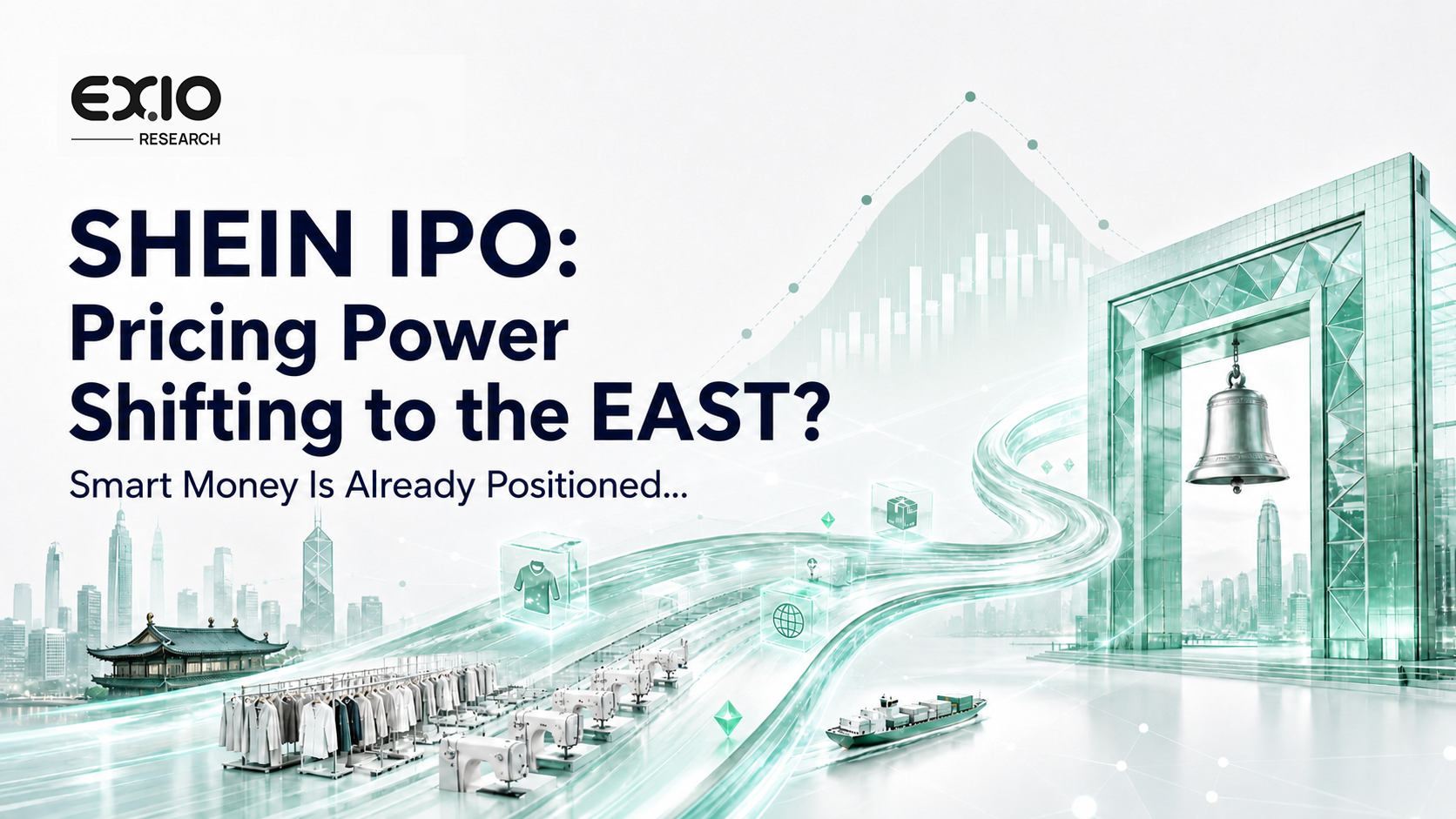
Smart money has already smelled the opportunity: the pricing power of a new market is gradually being taken by the vast markets and investors of the East.
Who Will Hold Pricing Power in the Global Consumer Goods Market?
In the end, SHEIN’s listing settling in Hong Kong serves as a metaphor: the first-generation story of Chinese supply-chain going global has been told — the era of relying on duty-free dividends and extreme low prices to claim territory has closed. The second half is a contest of brand, efficiency and compliance capability.
For investors, this track has formally moved from “storytelling” into the “look-at-the-statements” era: choose brands with moats, choose real efficiency, and avoid pure distribution plays without barriers. In Hong Kong — the IPO market most favoured by Chinese-concept companies — the first seven months of 2026 already saw roughly 100 IPOs raising US$35 billion, and now this year’s largest cross-border e-commerce IPO is being added. It is evident that pricing power for “Chinese supply chain + global market” assets is flowing back to Hong Kong.
Moreover, under the “Chinese supply chain + global market” environment, the value of infrastructure and related industries is becoming more prominent. As the entire sector directs capital expenditure toward overseas warehouses, local fulfilment, payments and compliance, the logistics, SaaS and service providers along the chain actually enjoy higher certainty. If related Chinese service providers ultimately choose to list in Hong Kong or on the Chinese mainland, then the pricing power — and stability — of essential and fast-moving consumer goods will be more closely tied to the major Eastern power.
There are points that still warrant attention: tariff and overseas regulatory policies remain uncertain; in SHEIN’s case, growth has slowed in recent years and the first quarter of 2026 recorded a book loss; lock-up expiry of cornerstone investors may bring liquidity pressure; and the continued weakness of the Hong Kong consumer sector style may affect post-listing performance.
Looking at the larger picture, however, Hong Kong capital this year has favoured hard technology (AI, semiconductors, etc.), while consumer stocks have been markedly cold — whether cheap or expensive is a matter of opinion (and it may also be another bottom-fishing opportunity, or perhaps not). Under a potential U.S. debt crisis, essential goods markets have a higher probability of remaining resilient. These are factors that markets should consider when allocating across a more diversified asset mix.
As SHEIN prepares to ring the bell in Hong Kong, the contest for pricing power in “Chinese supply chain + global market” assets has only just begun — and perhaps “smart money” has already positioned itself early in the equity of related companies and infrastructure, or has extended its reach in less visible places, ready to walk away with hundred-fold returns at the moment of listing (or after the lock-up period ends).
Reference
SHEIN Global Holdings Limited Global Offering Announcement (Chinese version, stock code 00625) https://www1.hkexnews.hk/listedco/listconews/sehk/2026/0824/2026082400010_c.pdf
SHEIN Global Holdings Limited Global Offering Announcement (English version) https://www1.hkexnews.hk/listedco/listconews/sehk/2026/0824/2026082400009.pdf
Related prospectus disclosure documents (containing financial data, fulfilment expense ratios, number of contract manufacturers, inventory turnover, etc.) https://www1.hkexnews.hk/listedco/listconews/sehk/2026/0824/2026082400019.pdf https://www1.hkexnews.hk/listedco/listconews/sehk/2026/0824/2026082400020_c.pdf
Hong Kong Stock Exchange new listing data (confirming offer price range, board lot of 100 shares, approximate entry cost of HK$4,999.92, listing on 1 September) https://content.etnet.com.hk/content/hkbea/eng/ipo.php
Bloomberg: “Shein Seeks Up to $1.8 Billion in Hong Kong IPO” (23 August 2026) https://www.bloomberg.com/news/articles/2026-08-23/shein-seeks-up-to-1-8-billion-in-long-awaited-hong-kong-ipo
Reuters: “Fast fashion giant Shein valued at up to $27 billion in Hong Kong IPO” (24 August 2026) https://www.reuters.com/business/retail-consumer/shein-launches-up-18-billion-hong-kong-ipo-2026-08-23/
South China Morning Post: “Shein seeks to raise up to US$1.76 billion in Hong Kong initial public offering” https://www.scmp.com/business/markets/article/3365001/shein-seeks-raise-us176-billion-hong-kong-initial-public-offering
Channel News Asia and other contemporaneous reports https://www.channelnewsasia.com/business/fast-fashion-giant-shein-launches-up-18-billion-hong-kong-ipo-6336556
Prospectus disclosure summaries and analysis (multiple articles citing original prospectus figures: 2023–2025 revenue from US$32.1 billion to US$41.8 billion, fulfilment expense ratio from 42.1% to 47.7%, Q1 2026 loss, U.S. revenue –14.3% YoY, etc.) https://chinesellers.substack.com/p/what-key-secrets-did-sheins-ipo-prospectus https://www.forbes.com/sites/drewbernstein/2026/07/28/shein-finally-files-the-numbers-behind-fast-fashions-longest-roadshow/
Reuters timeline of SHEIN’s listing journey (New York → London → Hong Kong) https://www.reuters.com/business/finance/sheins-pursuit-an-ipo-new-york-london-hong-kong-2025-05-28/ and subsequent update reports (including CSRC filing notice on 10 July 2026)
Reports on the U.S. de minimis cancellation and EU July 2026 policy impact https://qz.com/shein-quarterly-loss-tariffs-hong-kong-ipo-072726 https://www.reuters.com/legal/transactional/shein-reveals-key-financials-ahead-hong-kong-ipo-2026-07-26/
General Administration of Customs of China: 2025 China cross-border e-commerce import and export situation (RMB 2.84 trillion, +4.8%, exports RMB 2.27 trillion, consumer goods 97.3%, apparel/footwear/bags/jewellery 21.8%) http://www.customs.gov.cn/customs/2026-06/16/article_2026061616113889190.html
Hong Kong Stock Exchange and media statistics: approximately 104 new listings and fundraising of about HK$328.2 billion in the first seven months of 2026 https://www.etnet.com.hk/www/tc/news/news-article.php?section=special&newsid=20260807280 https://k.sina.cn/article_5953740931_162dee08306703sad0.html
Disclaimer
This material is provided for general market information and educational purposes only. It does not constitute investment advice, legal advice, compliance advice, product recommendation, or an offer or solicitation to buy or sell any financial product or virtual asset. Readers should seek independent professional advice where appropriate. The content may include third-party materials or views that do not represent the official position of this institution or its staff. Financial assets and related products can be highly volatile. Before making any investment decision, investors must conduct their own research (DYOR) and/or consult independent professional advisers and carefully consider the risks.