Completely Bidding Farewell to “Wild Growth”!
EX.IO Research | August 26, 2026
In August 2026, two seemingly unrelated pieces of news converged at the same point on the coordinates of history.
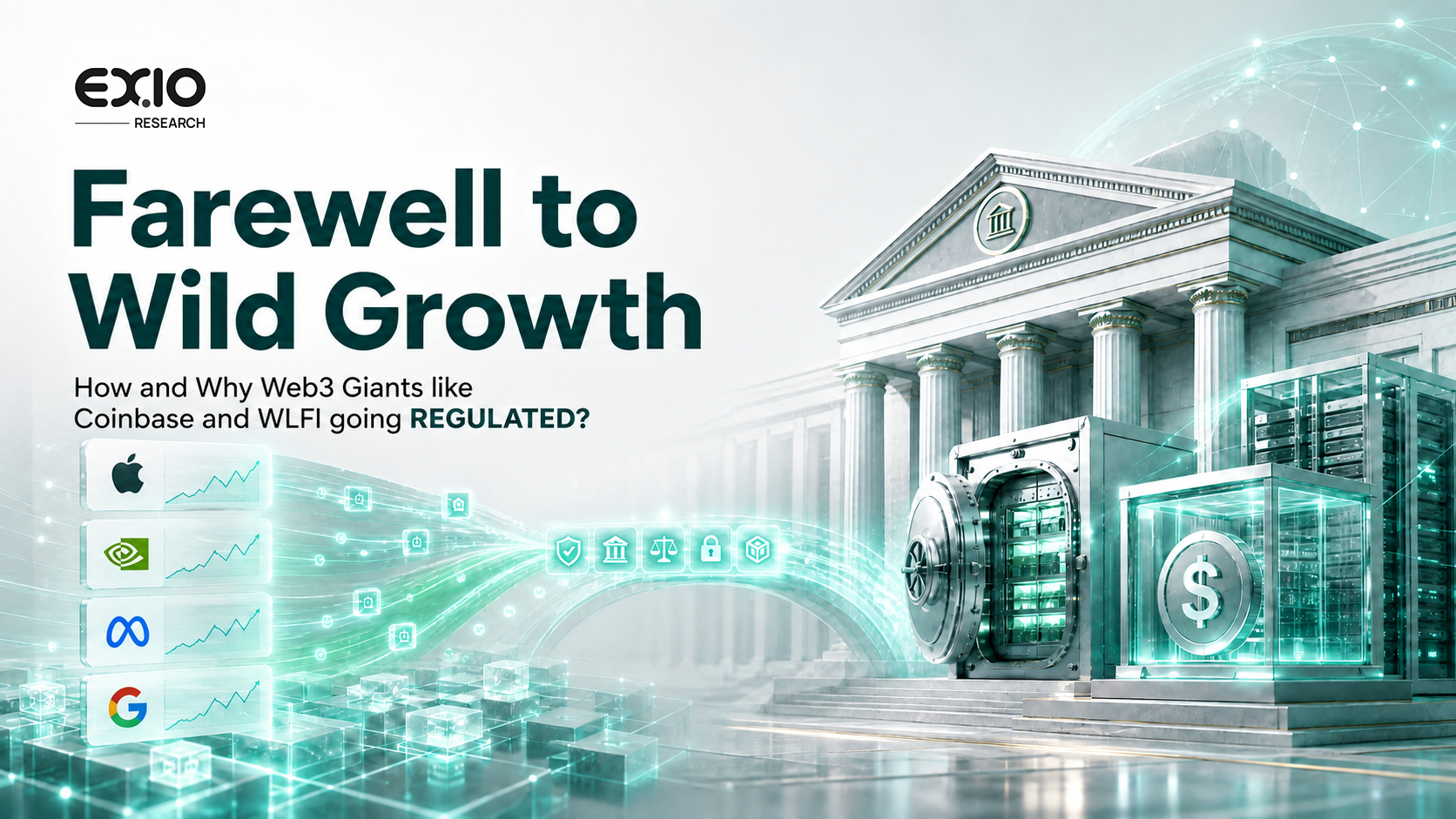
The first came from San Francisco. On August 24, Coinbase, the largest listed digital asset trading platform in the United States, announced that its tokenized U.S. equities had officially gone live natively on its own Layer 2 network, Base. The initial targets include Apple, NVIDIA, Meta, and Alphabet—four of the most influential technology giants globally. These tokens are issued under the B20 standard. Each is backed 1:1 by the underlying shares actually held by Alpaca, a licensed custodian regulated by the Abu Dhabi Global Market (ADGM), with a bankruptcy-remote structure protecting holders’ rights. Chainlink serves as the official oracle infrastructure, providing continuous price feeds for tokens such as NVDAc and AAPLc, enabling them to be used directly as collateral in DeFi lending markets and traded freely in 24/7 AMM pools.
The second came from Washington. On August 14, the U.S. Office of the Comptroller of the Currency (OCC) granted conditional approval to the national trust bank application of World Liberty Trust Company (WLTC), a subsidiary of World Liberty Financial, a company linked to the Trump family. This bank will specialize in stablecoin operations, handling the issuance, redemption, reserve asset management, and institutional-grade digital asset custody of the USD1 dollar stablecoin. Senator Elizabeth Warren stated bluntly that Trump had thus become the first U.S. president in history to “approve, operate, and oversee his own bank” while in office.
On one side is “U.S. equities on-chain”; on the other is “crypto companies obtaining bank charters.” The former represents the migration of traditional financial assets onto the blockchain; the latter represents on-chain native institutions moving closer to the traditional financial system. These two forces are advancing toward each other. The once towering wall between Web3 and traditional finance is rapidly dissolving in the summer of 2026.
From Concept to Reality: The “Compliance Trinity” for Tokenized U.S. Equities
Tokenized stocks are not a new concept. In the previous cycle, the market saw various “mirrored stock” experiments, most of which collapsed under the same three problems: who custodied the underlying assets, who provided reliable pricing, and under which legal framework they were issued.
Coinbase’s solution this time precisely offers an important reference answer to the “compliance trinity.”
First, the issuance framework is anchored in Abu Dhabi. ADGM is one of the international financial centers that has most actively embraced digital assets in recent years. Its regulatory framework provides a clear legal identity for tokenized securities. Choosing to issue under the ADGM framework means these tokens are not “synthetic assets” roaming in gray areas, but genuine equity certificates with clear legal basis.
Second, custody is entrusted to a licensed institution. As a regulated broker and custodian, Alpaca holds the underlying shares on a 1:1 basis and uses a bankruptcy-remote structure to ensure that even if problems arise in the issuance process, token holders’ ownership claims over the underlying shares remain valid. This transplants the core investor protection mechanisms of traditional securities markets intact into the on-chain world.
Third, pricing is provided by Chainlink. Without reliable, continuous price data, tokenized stocks can only sit as static assets in wallets. With institutional-grade oracles, they instantly become composable “financial Lego” in the DeFi world—collateralized borrowing, market-making for yield, and embedding into structured products all become possible.
Data confirms the acceleration of this trend. According to RWA.xyz statistics, the total market capitalization of tokenized stocks has reached approximately USD 2.48 billion, up 5.2% over the past 30 days; monthly transfer volume has risen to about USD 27.28 billion; and as of early August, the number of holders of such assets has exceeded 1 million.
In other jurisdictions, such as Hong Kong, the licensed digital asset trading platform EX.IO under this Group has, since April 2026, listed a series of compliant popular U.S. equity tokenization products. These products are issued by Anchored, a real-world asset (RWA) operating system, and are 1:1 fully backed tokenized products of real popular U.S. equities, currently open for subscription and redemption only to professional investors. In the initial stage, the underlying assets of the relevant tokens correspond to the “Magnificent Seven” including Apple Inc. (AAPL.US) and NVIDIA (NVDA.US), as well as popular blue-chip targets such as Broadcom (AVGO.US) and Walmart (WMT.US). Product features include fractional share purchases, minimum subscription amounts as low as USD 10 (for non-initial subscriptions), direct access to Nasdaq and NYSE liquidity, and institutional-grade security safeguards.
The on-chaining of U.S. equities is gradually and formally moving from concept to reality.
The Reverse Migration of Licenses? When Crypto Companies Become Banks
If Coinbase’s story is “assets moving on-chain,” World Liberty Financial’s story is “institutions moving into the system.”
The OCC’s conditional approval did not come easily. The application was submitted in early January this year and took 221 days to process, far exceeding the OCC’s usual 120-day window. What was granted is a “narrow charter”: WLTC will not take public deposits; its business focuses on the issuance and redemption of the USD1 stablecoin, reserve management, and institutional custody, and it must meet capital requirements set by the OCC. Upon approval, the issuance and custody of USD1 will be brought in-house from BitGo. This dollar stablecoin, which already has a circulation exceeding USD 4 billion, will now be subject to the same standards of examination under the federal banking law framework as traditional banks.
The controversy is equally significant. Approximately 38% of the company’s equity is held by Trump family-related entities (according to World Liberty Financial’s official website materials), with additional shareholding by UAE investors (according to The Wall Street Journal). Democratic Senator Elizabeth Warren has denounced this as “the most shameless act of self-dealing the financial system has ever seen” and announced plans to push legislation prohibiting the president and their family from owning banks. According to reports, as part of the approval conditions, indirect investors including Eric Trump, the president’s son, made “passive commitments”: not seeking board seats, not nominating directors, and not interfering in operations.
Yet setting aside the political noise, a deeper fact cannot be ignored: WLTC is not an isolated case. Over the past year, the OCC has successively granted trust bank charters or conditional approvals to crypto and fintech companies including Circle, Ripple, Paxos, and Coinbase. Since 2025, the OCC has received approximately 40 bank charter applications, many of which are related to crypto projects (according to OCC data). Banking associations and some lawmakers had previously publicly opposed this trend. The GENIUS Act passed last summer paved the legal path for stablecoin issuance. The “now or never” window is driving the entire industry to scramble for licenses.
As Zach Witkoff, co-founder of World Liberty Financial and designated Chairman of WLTC, put it: “We welcome continuous supervision by federal regulators for many years to come.”
A Two-Way Journey That Is Changing the Future Is Underway
In the view of EX.IO Research, these two pieces of news together outline the most important structural narrative of the digital asset industry in 2026: Web3 is collectively moving into compliance, while traditional finance is collectively moving on-chain.
This is a “two-way journey.” On one end, the stocks of Apple and NVIDIA circulate 24 hours a day on-chain in token form. Users in globally compliant jurisdictions (currently limited to eligible regions outside the United States) can gain exposure to U.S. equities and participate in DeFi without a brokerage account and without waiting for T+2 settlement. The trading hours, access barriers, and settlement frictions of traditional capital markets are being dismantled one by one by programmable infrastructure. On the other end, stablecoin issuers are voluntarily entering the “cage” of federal banking regulation, accepting capital requirements, on-site examinations, and fiduciary duties. The “permissionless” ethos once celebrated by the on-chain world is yielding to “licensed and trustworthy” at critical junctures.
This convergence is not about one swallowing the other, but the birth of a new financial operating system: legal frameworks define rights, licensed custody anchors trust, oracles transmit prices, and smart contracts execute efficiency. Abu Dhabi’s regulatory sandbox, Washington’s bank charters, Chainlink’s data pipelines, and Base’s settlement layer are different modules being assembled into the same blueprint.
For the Asian market, the signal is particularly clear. When U.S. equities can be compliantly put on-chain under the Abu Dhabi framework and stablecoins can be issued under federal U.S. licenses, the institutional competition among Hong Kong and other financial centers in the region on RWA tokenization and stablecoin regulation has entered deep waters. Future competitiveness will not depend on who is more “open,” but on who can first weld “compliance” and “on-chain efficiency” into seamless infrastructure.
A decade ago, the slogan of the crypto world was “unbank the banked.” A decade later, the largest crypto companies are lining up to apply for bank charters, and the stocks of the largest technology companies are being moved onto public blockchains.
The irony of history is this: Web3 did not disrupt traditional finance; it is mutually reconstructing it. When compliance becomes the entry ticket, licenses become the moat, and the blockchain becomes the settlement layer, the industry that once operated outside the system has finally, in the summer of 2026, collectively walked into the world it once sought to rewrite—and there, it has begun to write new rules.
Disclaimer
This article was prepared by EX.IO Research and is for general informational purposes only. It does not constitute any investment advice, offer, or solicitation. The EX.IO and its tokenized U.S. equity products mentioned in this article are businesses under this Group; readers should be aware of potential conflicts of interest. Digital asset prices are highly volatile, and investors may lose their entire principal. If investment decisions are to be made, please consult independent professional advice. The data and information in this article are sourced from public channels and are as of August 25, 2026.
Primary data sources: CoinDesk (2026-08-24, Coinbase debuts tokenized stocks on Base); Cryptonomist (2026-08-24, Chainlink powers tokenized stocks on Base as market hits $2.3B record); CNBC (2026-08-14, Trump family-backed crypto firm World Liberty gets conditional bank charter approval); American Banker (2026-08-17, Trump-linked crypto firm gets OCC nod for trust bank charter); Business Wire / OCC (2026-08-14, OCC Grants WLF Preliminary Conditional Approval); RWA.xyz (tokenized stock market data).