Standard Chartered’s USDC Pivot: Traditional Finance Opening the Institutional Gateway?
EXIO Research Institute’s Perspective: This is not an ordinary press release, but a silent rewrite of the rules of capital flow.
In early July, Standard Chartered did something big
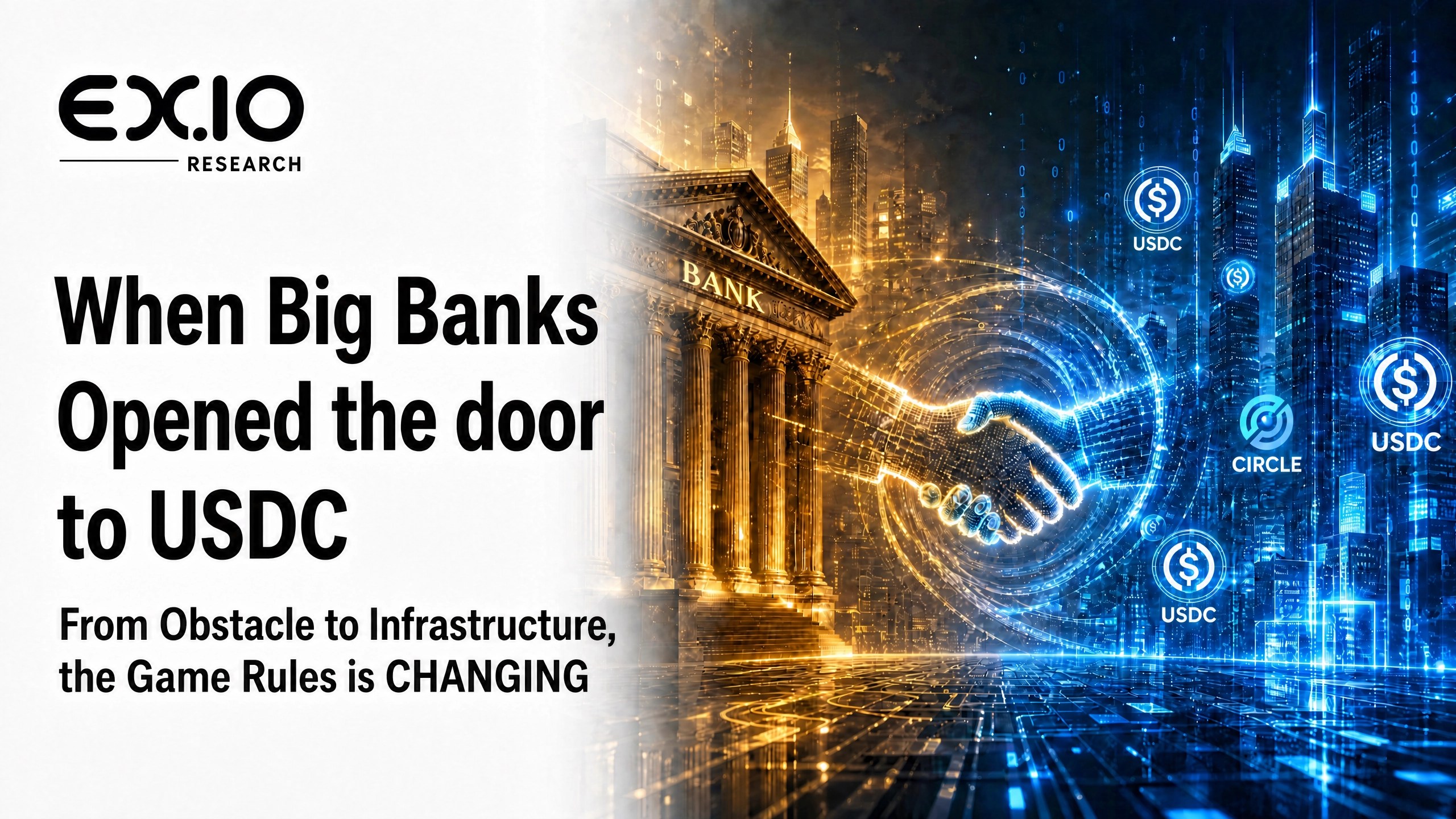
Standard Chartered Bank and Circle have jointly launched institutional-grade USDC minting and redemption services, first landing at the Dubai International Financial Centre (DIFC). On the surface, this is just an additional bank supporting stablecoins; However, from an industry trend perspective, this marks the official start of the traditional financial strategy shifting from “blocking” to “accessing” stablecoins. When a global systemically important bank (G-SIB) proactively “brings stablecoins in” to the door, the significance goes far beyond product launches—it means stablecoins are shifting from crypto industry infrastructure to financial services recognized and willing to provide by traditional finance.
Why should your wallet care?
In the past, banks had only one stance toward stablecoins: defense. Prevent it from competing in payment business, bypassing the clearing system, and threatening its century-old position as the financial hub. But now, one of the world’s largest banks has proactively ‘switched sides.’ This shift isn’t because the banks have changed their minds, but because the rules of the game have changed.
Three driving forces drove it all forward.
First, the regulatory framework is becoming clearer: the European MiCA regulatory transition period officially ended this July, and the U.S. GENIUS Act was signed into law last year, giving stablecoins a clear regulatory status. For banks, the greatest risk has never been innovation, but uncertainty. Second, the rapid expansion of application scenarios: stablecoins have long extended beyond crypto transactions to cross-border payments, international trade, and corporate fund management. According to Macquarie Group data, adjusted stablecoin transfers will reach about $11 trillion by 2025. Third, a shift in strategic thinking: rather than waiting for customers to bypass and use stablecoins, proactively include stablecoins in their product portfolio. Standard Chartered did not issue its own stablecoins, but instead leveraged its existing bank credit, institutional client resources, and global network to cooperate with Circle—asset-light, heavy-entry, and position-based, typical G-SIB strategies.
What truly changed was that the “last mile” of institutional entry was opened
For ordinary users, obtaining USDC is not difficult. The real difficulty lies with the institutions. A pension fund, insurance company, or multinational corporation would not transfer hundreds of millions of dollars on-chain just because of a wallet address. They must undergo strict internal approvals, risk control audits, compliance checks, and audit processes, with each step clearly defined and a complete business record. In the past, when institutions needed to complete minting, redemption, custody, and fund transfers, they often had to establish cooperative relationships with issuers, custodians, on-chain infrastructure, and trading platforms, making the process complex and costly.
The addition of banks changed everything. Standard Chartered offers a “one-stop” entry point: single account opening, single service process. The bank itself has a compliance framework, risk control system, and audit pathway trusted by institutional clients. More importantly, the bank’s brand endorsement reduces the difficulty of internal compliance approvals for institutions—’Standard Chartered has already accepted it, so why can’t we?’ This statement will become the strongest argument in the risk control committees of countless institutions.
From a market structure perspective, the true value of this collaboration lies not in technological innovation, but in the structural lowering of institutional entry barriers. What has changed is not USDC itself, but the way institutional funds enter the chain—from “multi-sided integration, independent operation” to “bank contracting, one-click entry.”
Compliance: From ‘Obstacle’ to ‘Accelerator’
Notably, compliance is undergoing a role reversal. In the past, stablecoins were long outside the regulatory framework, with banks and institutions afraid to enter them. Now, with the implementation of MiCA and the advancement of U.S. stablecoin legislation, banks are now providing a legal basis for participation. Standard Chartered chose the Dubai International Financial Centre as its launch site. DIFC itself is a highly regulated international financial zone, a highly symbolic choice—not to exploit loopholes in regulatory ambiguity, but to take the lead in the most regulated areas.
Compliance is not a shackle that restricts innovation, but rather a sieve that allows the “qualified” innovation — the qualified ones — to enter the institutional-level market. Whoever can first open the channel between banks and stablecoins under a compliant framework will seize the entry point for institutional funds. Standard Chartered, as the first G-SIB to offer such services, has already gained a first-mover advantage.
Conclusion: Stablecoins have not replaced banks; instead, they have entered banks
The collaboration between Standard Chartered and Circle appears to be an upgrade in institutional services, but in essence, it represents a strategic shift in traditional finance from “blocking” to “integration” for stablecoins. The far-reaching impact on the industry is already clear: the entry threshold for institutional-level markets has been significantly lowered, and more traditional capital will enter the chain in compliance with regulations; Banks are no longer “bystanders” in the crypto world, but are beginning to become “infrastructure providers”; The rules of the stablecoin game are shifting from “crypto-native” to “mainstream finance.”
As of July 2026, the circulating supply of USDC has exceeded 73 billion, and behind this figure is more and more institutional funds flowing on-chain through the “main door” of banks. Stablecoins have not replaced banks; instead, they have entered banks—and this may just be the beginning.
FAQ
Q: What are the specific details of the cooperation between Standard Chartered and Circle?
A: Standard Chartered Bank has partnered with Circle to launch institutional-grade USDC minting and redemption services. Eligible institutional clients do not need to open a separate Circle account to complete USDC minting and redemption through Standard Chartered. This service was first launched at the Dubai International Financial Centre (DIFC).
Q: Why is this collaboration considered so significant?
A: Standard Chartered is a member of the Global Systemically Important Bank (G-SIB) and is listed in Group 1 of the FSB’s 2025 list. This is the first G-SIB to offer such integrated services, marking the transition of stablecoins from crypto industry infrastructure to traditional financial services recognized by traditional finance.
Q: What does this mean for institutional investors?
A: Previously, institutions had to coordinate with issuers, custodians, trading platforms, and other parties to complete the minting and circulation of stablecoins, which was a complex process and costly. The bank’s entry provides a “one-stop” compliance gateway, significantly lowering the threshold for institutional funds to enter on-chain.
Q: What role does compliance play in this collaboration?
A: With the implementation of regulatory frameworks such as MiCA and the U.S. GENIUS ACT, the regulatory role of stablecoins has become increasingly clear. Compliance is no longer an obstacle, but rather a ‘passport’ and a competitive barrier for banks to participate in stablecoin services.
Reference notes
[1] Golden Finance. 〈Standard Chartered Integrates USDC with a Partnership Behind Stablecoin Game Change〉. Juheng Link, July 2, 2026.
[2] Bitget News. 〈Standard Chartered Bank and Circle Launch Institutional-Level USDC Minting and Redemption Service〉.
[3] CoinMarketCap.USDC Circulating Supply and Market Cap Data. July 2026.
[4] Financial Stability Board (FSB). 2025 List of Global Systemically Important Banks (G-SIBs). November 27, 2025.
[5] World Bank.Remittance Prices Worldwide, Q1 2025.
[6] Reports on the EU MiCA Regulatory Transition Period. Gate News/MEXC Crypto Pulse, July 2026.
[7] Related reports on the U.S. GENIUS ACT. NetEase/CCTV Finance, July 2025.
[8] Macquarie Stablecoin Transfer Volume Report. 2025.
Disclaimer
This material is prepared by EXIO Research Institute for general informational and research reference purposes only, and does not constitute any investment, financial, legal, or tax advice, nor does it constitute any solicitation, offer, or recommendation. EXIO Research Institute is a research platform under the EXIO Group. The content of this material reflects only the views of the research team and does not represent the official stance of EXIO Group or any of its subsidiaries.
The material may contain third-party information or viewpoints, and does not represent the official position of any organization or individual. Prices of virtual assets and related products may be highly volatile. Investors should make independent judgments based on their own financial situation, investment objectives, and risk tolerance, and conduct their own research (DYOR) and consult independent professional advisors before making any investment decisions.
This material is not applicable to residents of mainland China regions. The parties involved shall not be liable for any losses arising from the use or reliance on this material, except where applicable law cannot exclude or limit them.