$1.8 Billion for a “Core Pipe”: Mastercard’s Move Is Bigger Than You Think
EX.IO Research | 5 August 2026
Imagine this: It’s 4 p.m. on a Friday. A Hong Kong trading company needs to pay a supplier in South America. The bank says the wire transfer will take three business days, with correspondent bank fees and an FX spread on top—the money won’t arrive until next Wednesday. Across the street, another company opens a laptop and settles the same payment with stablecoins: seven minutes, a fraction of the cost, 24/7.
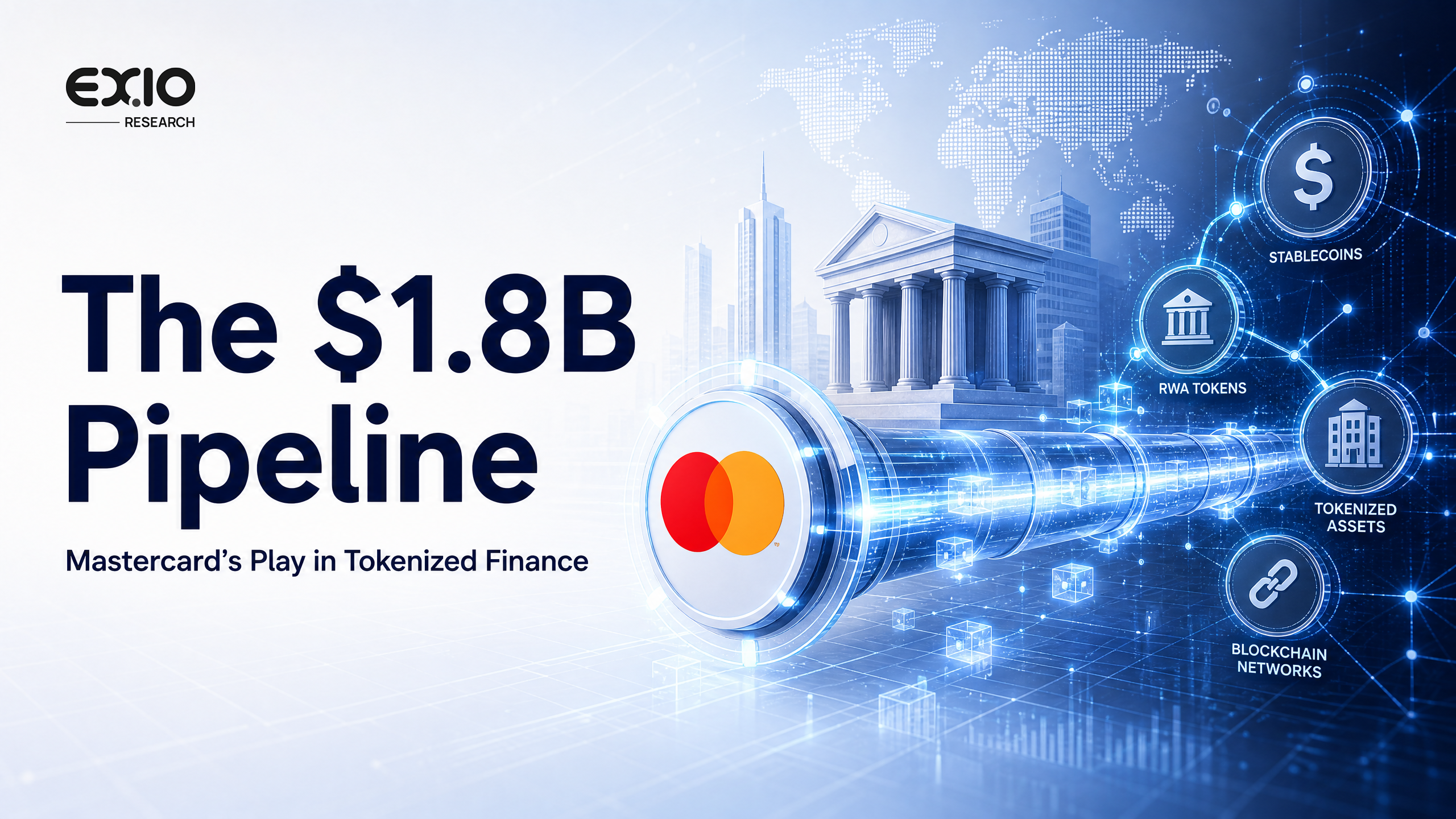
This is already everyday reality in 2026. When Mastercard—one of the world’s largest payment networks—is willing to pay up to $1.8 billion for a five-year-old London company, you should realise: this deal is not buying a company. It is buying a ticket that cannot be bypassed. The new water pipe of stablecoins has already been laid right up to the door of traditional finance.
A Twisting “Bride Race”
On 17 March 2026, Mastercard announced a definitive agreement to acquire stablecoin infrastructure company BVNK for up to $1.8 billion, including $300 million in contingent payments tied to performance, with closing expected by year-end. This may well be the largest stablecoin acquisition in history.
Who is BVNK? Founded in London in 2021, it specialises in enterprise-grade stablecoin payment infrastructure, processing over $30 billion in annual payment volume across more than 130 countries. The behind-the-scenes story is even more dramatic: In October 2025, Coinbase locked in exclusive talks at around $2 billion, only for negotiations to collapse in November. Mastercard then turned to another company, Zerohash, which also fell through in December. In January 2026, BVNK announced it would power stablecoin payments for Visa Direct—Visa’s $1.7 trillion real-time payment network. In February it secured an EU MiCA licence. Valuation soared. One month later, Mastercard moved decisively and sealed the deal.
The Giants Are Not Buying Coins—They’re Buying the “Core Pipe”
To understand the $1.8 billion price tag, first look at the size of the water. As of mid-2026, global stablecoin market capitalisation stood at roughly $310–320 billion. Adjusted on-chain transaction volume over the past year reached $9–10 trillion. Mastercard’s own estimate puts “payment-use” stablecoin volume at no less than $350 billion in 2025 alone. Citi’s base-case forecast sees $1.9 trillion by 2030; Standard Chartered expects $2 trillion by the end of 2028.
When the water rises, the old pipes may no longer be sufficient—or may simply be bypassed. That is why Stripe spent $1.1 billion on Bridge as early as 2024, PayPal launched its own PYUSD, Visa now has more than 160 stablecoin card programmes with related payment volume nearly doubling year-on-year. Dig deeper and AI agent payments have already begun: Visa has launched tools that allow AI to pay directly, Coinbase’s x402 protocol has processed over 100 million AI transactions, and Capital One spent $5.15 billion to acquire Brex to position itself in AI payments. When AI starts spending money on its own, the most suitable settlement currency is programmable, 24/7 stablecoins.
So rather than saying Mastercard is embracing innovation, it is more accurate to say it is defending itself—defending against the next generation of cross-border settlement that could bypass card networks entirely and build a parallel system. Buying an existing pipe is always faster than digging a new canal.
The $1.8 Billion Premium Is About More Than “Compliance”
Why is BVNK worth $1.8 billion—$700 million more than Bridge? Mastercard CEO Michael Miebach put it bluntly: they valued its stakeholder ecosystem, liquidity network, and those “hard-to-obtain licences.”
This is the industry code of 2026. The U.S. GENIUS Act took effect in July 2025, requiring 100% reserve backing and prohibiting interest payments to holders. The EU’s MiCA has entered full enforcement. BVNK secured its MiCA licence in February—the final missing piece. Regulatory clarity has turned “compliance” from a cost into an asset, and licences from a barrier into a moat.
The knock-on effect is equally revealing: after stablecoins were barred from paying interest, yield-seeking capital flooded into tokenised Treasury funds. These products grew from $11 billion to $16 billion in just five months. Mastercard’s press release explicitly stated that target use cases include “tokenised deposits and tokenised assets.” Stablecoins and RWAs (real-world asset tokenisation) are two sides of the same coin: one is “money on-chain,” the other is “assets on-chain.” The bridge connecting them must be built on the riverbed of regulation.
In Key Regions, Someone Has Already Been Quietly Laying Pipe
Shift the focus to Asia. Hong Kong’s script was written earlier. The Stablecoins Ordinance took effect in August 2025. On 10 April 2026 the Hong Kong Monetary Authority announced the first batch of stablecoin issuer licences—awarded to HSBC and to Anchorpoint Financial Technology (a joint venture of Standard Chartered Hong Kong, HKT and Animoca Brands)—making Hong Kong the world’s first major financial centre to achieve full-chain compliant regulation of fiat-referenced stablecoins.
What does this mean for the market? Licensed issuers exist on the issuance side; payment networks such as Mastercard are entering on the rails side. The decisive battleground now is the “last mile”—where investors and enterprises can compliantly exchange, custody and distribute these on-chain assets. The answer points to licensed Virtual Asset Trading Platforms (VATPs).
Public information shows: EX.IO received its SFC licence on 18 December 2024 and was among the first batch of VATPs approved under the “deemed licensed” regime. It is also the only VATP included in the Office for Attracting Strategic Enterprises (OASES) system. In January 2026, EX.IO received further SFC approval to conduct virtual asset over-the-counter (OTC) services under its existing licence framework, initially supporting BTC, ETH, USDT, USDC, USD and HKD. On the RWA side, EX.IO became the first VATP partner of tokenisation platform OpenEden in Hong Kong in February 2026, facilitating the listing of tokenised U.S. Treasuries (TBILL) and other products. Subsequently, K1, a supply-chain RWA token under Kaisa Capital, was also distributed and custodied by EX.IO—becoming the first supply-chain RWA completed on a licensed exchange in Hong Kong.
Place these facts side by side with Mastercard’s acquisition of BVNK and the picture becomes clear: Hong Kong is building the same architecture of “connecting on-chain and fiat, with compliance as the foundation”—only in Asia, this pipe was laid earlier.
Will the Water Eventually Flow into the Core Pipe?
Return to the image of “seven minutes versus three business days.” Giants are spending $1.8 billion on pipes not because the pipes themselves are valuable, but because they are certain the water will eventually flow in.
On Hong Kong’s chessboard, licensed issuers already exist for issuance, and licensed platforms are already operating the infrastructure for exchange, custody and distribution. So the next time you hear the words “stablecoin,” do not treat it merely as a crypto story. It is a generational handover of financial infrastructure—and those who understand the game have long been studying the blueprints of the pipes.

Reference
(1) Mastercard official press release: “Mastercard to Acquire BVNK to Connect On-Chain Payments and Fiat Rails,” 17 March 2026, investor.mastercard.com.
(2) Transaction timeline compiled from Fortune, Bloomberg and industry retrospective reports (October 2025 – March 2026).
(3) BVNK operating data (annual payment volume over $30 billion, coverage of 130+ countries) from public industry analysis (Odaily, June 2026).
(4) Stablecoin market capitalisation and transaction volume data from DefiLlama (June–July 2026, cited via Transak and CoinLaw); industry size forecasts cited from public research by Citi and Standard Chartered.
(5) Hong Kong’s first batch of stablecoin issuer licences based on HKMA announcement of 10 April 2026 and public reports.
(6) EX.IO-related facts sourced from Hong Kong SFC public information, Hong Kong Wen Wei Po (reports of 10 February and June 2026) and EX.IO official website (www.ex.io).
Disclaimer:
This article is prepared by EX.IO Research Institute for reference and general information purposes only. It does not constitute any investment advice, offer or solicitation. Virtual asset prices involve high market risk and volatility; the value of your investment may fall as well as rise and you may not recover the amount invested. Please refer to EX.IO’s Risk Disclosure Statement for further information. You are solely responsible for your investment decisions. Past performance is not a reliable indicator of future results. Public data cited in this article is believed to be accurate but completeness or timeliness is not guaranteed.