Lost 1 billion, but valued at 46.7 billion? The true value revelation of the Japanese crypto exchange’s “doomsday license.”
EXIO Research Institute | 2026-07-02
Some things are never written about value on the income statement.
In 2017, while the world was still debating whether “Bitcoin is a scam,” Yoshitaka Kitao, head of Japanese financial giant SBI Holdings, boldly declared at a small investor conference: the transformation brought by blockchain technology will be greater than the internet. At that time, XRP was priced below $0.3, and SBI’s investment in Ripple was seen by many traditional analysts as “not doing its proper business.” Eight years later, when Kitao bought a loss-making cryptocurrency exchange for 46.7 billion yen [1]—more than five times SBI’s entire crypto business profit last year [1]—the market finally began to understand: he was never buying a company, but a ticket into the future financial world.
Why is an exchange that “doesn’t make money” worth 46.7 billion?
Let’s first take a look at what the deal is about.
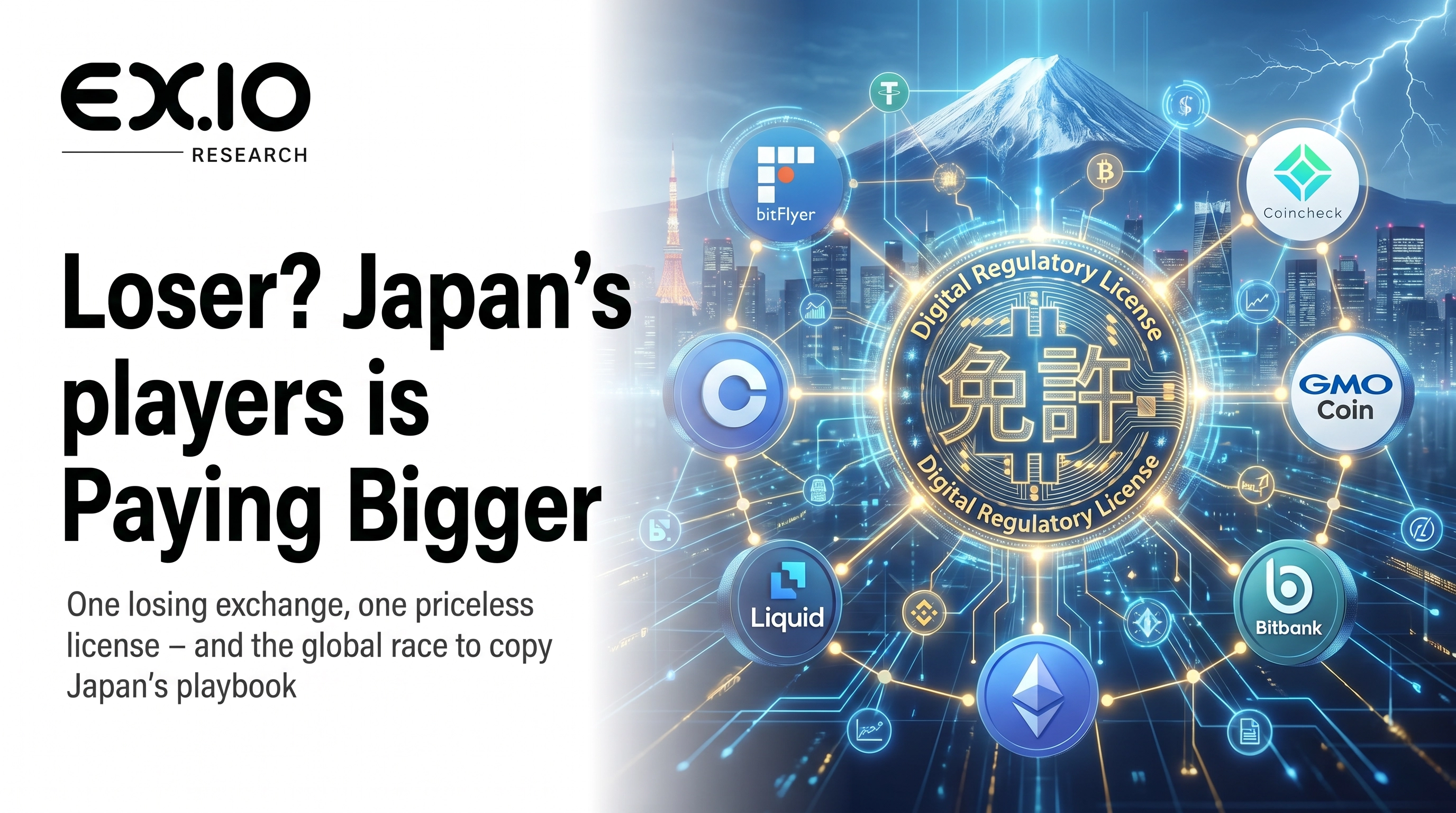
Bitbank, founded in 2014, is one of Japan’s oldest licensed exchanges, with zero hacking records, and ranks among the top in altcoin liquidity. Sounds good? But looking at the financial report is a completely different story: net sales for 2025 will be 5.82 billion yen [2], a year-on-year decrease of 27% [2], and operating profit will drop directly to a loss of 970 million yen [2]. For a company with declining revenue and turning from profit to loss, why would SBI pay 46.7 billion yen (about 289 million USD)[1] for a full acquisition?
Wall Street investment bank Architect Partners hit the nail on the head: SBI is buying a “franchise scale,” not profitability [7]. This statement is worth engraving in the heart of everyone who follows the crypto industry. In Japan, applying for a crypto exchange license from scratch requires years of rigorous scrutiny by the Financial Services Agency (FSA), irreplaceable compliance experience, and system security investments often reaching billions of yen. By 2026, there will be fewer than 30 licensed exchanges across Japan [3], of which about 90% are operating at a loss [3]. What does this mean? This means regulation has raised this threshold to a level that most players cannot cross.
SBI’s 46.7 billion yen isn’t for Bitbank’s 5.8 billion yen in annual revenue, but for the FSA registration license it took 12 years [4] to obtain, 960,000 compliant accounts [4], and a fully established fiat currency channel for yen. In a market with increasingly strict regulations, the scale of a licensed license is itself an independent strategic asset, and its value cannot be measured by short-term profits.
Under heavy regulation, licenses have become non-renewable resources
The timing of this acquisition was by no means a coincidence.
Just 14 days before SBI announced the acquisition [5], on June 11, 2026 [5], Japan’s House of Representatives passed an amendment to the Financial Instruments and Exchange Act, transferring crypto asset regulation from the Funds Settlement Act to the same level as stocks and bonds. Crypto assets have been officially reclassified as “financial products,” with insider trading bans, issuer information disclosure obligations, and significantly strengthened penalties—the maximum sentence for unlicensed operations has been directly raised from 3 years to 10 years [6], and the fine cap has soared from 3 million yen to 10 million yen [6].
Architect Partners predicts that with the implementation of this amendment, up to half of registered exchanges may eventually exit or merge[7]. In other words, the number of Japanese crypto exchanges may shrink further from fewer than 30 to around 15 [7]. Stock licenses are shifting from “business licenses” to “non-renewable resources.” You can open a new restaurant, but you can no longer open a compliant cryptocurrency exchange in Japan—the window of time has closed.
The approximately 8x revenue multiple paid by SBI [8] seems expensive, but the 9.7x revenue multiple when Coinbase acquired Deribit [8] is not far away. Global capital is voting with real money: in a market with clear regulation, the valuation logic of licensed platforms has been completely transformed. Not by profit, but by “scarcity.”
Global license scramble: 144 mergers and acquisitions in 2026, totaling $11.8 billion
Japanese scripts are not isolated cases. Looking globally, since 2026, the crypto industry has recorded 144 M&A deals totaling $11.8 billion [9], with banks, payment giants, and exchanges frantically buying up regulated digital asset businesses. Mastercard acquired stablecoin infrastructure provider BVNK for $1.8 billion [10], Bullish acquired Equiniti for $4.2 billion [11]—each saying the same thing: _buying licenses is faster, cheaper, and more controllable than building one.
This is a global “compliant arms race.” As the US legislates stablecoins through the GENIUS Act, the Hong Kong Securities and Futures Commission continues to deepen licensing for virtual asset trading platforms, and the Monetary Authority of Singapore tightens exchange licensing standards, the word “licensed” is shifting from a cost center to a value moat. For platforms that have already crossed the threshold and established compliance capabilities, regulation is not a constraint but the strongest defense.
Looking back at the Japanese market, SBI’s acquisition path is clear: absorbing TaoTao in 2020, taking over DMM Bitcoin client assets in 2024, acquiring BITPoint Japan for 12.75 billion yen in 2022 [12], and now acquiring Bitbank for 46.7 billion yen. Every step is a way to trade capital for time—while others are still waiting in line for licenses, SBI has already acquired Japan’s top three exchanges. The merged platform will manage approximately 1.1 trillion yen in assets and 2.92 million accounts[13], firmly securing Japan’s top position.
The other markets today are Japan’s yesterday
At this point in the story, you might ask: what does this have to do with us?
The relationship is: the Japanese market today is the tomorrow of other markets.
When Japan officially brought crypto assets into financial product regulation, when global traditional financial institutions shifted from wait-and-see to acquisitions, when the number of licenses shifted from “limited” to “scarce”—for example, the same logic is playing out in Hong Kong. Since the Hong Kong Securities and Futures Commission launched the licensing regime for virtual asset trading platforms in 2023, the “franchise value” of licensed platforms has been rapidly prominent. The stablecoin issuer licensing system has been implemented, spot crypto ETFs are already trading, and more compliant products are on the way.
In an era where regulation has pushed the industry from wild growth to meticulous cultivation, the real moat is not transaction volume or token listing speed, but compliance itself. Platforms that have already crossed the threshold and established compliance capabilities have instead gained the strongest moat. This is not a victory for traffic, but a victory for franchises.
In Hong Kong, although the market is relatively weak, licensed platforms operating are currently in a “franchise scale” value window similar to Japan’s SBI. Brand awareness, compliance accumulation, technical infrastructure, and user base—these are strategic assets that cannot be quickly replicated amid the wave of large-scale entry by traditional financial institutions. When licenses become a resource even scarcer than gold, those who get them early have already secured their ticket to the future financial world.
SBI’s 46.7 billion yen answer aligns with the logic of every platform holding fast in a market of regulatory clarity: compliance is not a cost, but a moat of long-term value.
And by the time more New Money or Old Money realizes this, the cheapest entry window may have already closed.
Note
[1] The 46.7 billion yen was the transaction price for SBI’s full acquisition of Bitbank, which at the exchange rate was about $289 million, roughly 5.3 times SBI’s crypto division’s net profit for fiscal year 2025.
[2] Bitbank’s net sales for fiscal year 2025 (ending March 2026) were 5.82 billion yen, down 27% year-on-year, with operating profit turning to a loss of 970 million yen (about $6 million).
[3] According to the FSA registry, as of June 2026, there are 28 licensed exchanges, with about 90% operating at a loss or in a marginal state.
[4] Bitbank, from its founding in 2014 to its acquisition, spans 12 years, with approximately 960,000 publicly disclosed registered accounts.
[5] The SBI acquisition announcement was released on June 25, 2026, exactly 14 days after Japan’s House of Representatives passed the amendment to the Financial Instruments and Exchange Act (June 11, 2026).
[6] The amendment raises the maximum sentence for operating a crypto asset trading business without a license from 3 years to 10 years, and increases the personal fine limit from 3 million yen to 10 million yen.
[7] A research report by Architect Partners predicts that under the new regulations, about half of registered exchanges will be forced to exit or be acquired, with only about 15 licensed institutions expected to remain in the end.
[8] The revenue multiple for this acquisition (transaction consideration / annual revenue) is about 8.0 times, while Coinbase’s previous acquisition of Deribit was about 9.7 times, serving as an industry reference.
[9] According to the Refinitiv and Crypto M&A databases, the global crypto industry completed 144 M&A deals in the first half of 2026, totaling $11.8 billion.
[10] Payments giant Mastercard acquired stablecoin infrastructure platform BVNK in May 2026 for $1.8 billion.
[11] In April 2026, Bullish acquired financial services provider Equiniti for $4.2 billion, expanding its compliant custody and trading business.
[12] SBI’s previous integration moves in Japan include: acquiring TaoTao in 2020, taking over DMM Bitcoin client assets in 2024, and acquiring BITPoint Japan (later renamed SBI VC Trade) for 12.75 billion yen in 2022.
[13] After acquiring Bitbank, SBI’s exchanges managed assets totaling about 1.1 trillion yen, with a total of 2.92 million accounts, ranking first in Japan.
Disclaimer:This material is for general informational and research reference purposes only and does not constitute any investment, financial, legal, or tax advice, nor does it constitute any solicitation, offer, or recommendation. The content of the materials may contain third-party information or opinions and do not represent the official position of any organization or individual. Prices of virtual assets and related products may be highly volatile. Investors should make independent judgments based on their financial situation, investment objectives, and risk tolerance, and conduct their own research (DYOR) and consult independent professional advisors before making any investment decisions. The parties involved shall not be liable for any losses arising from the use or reliance on this material, except where applicable law does not exempt or limit them.