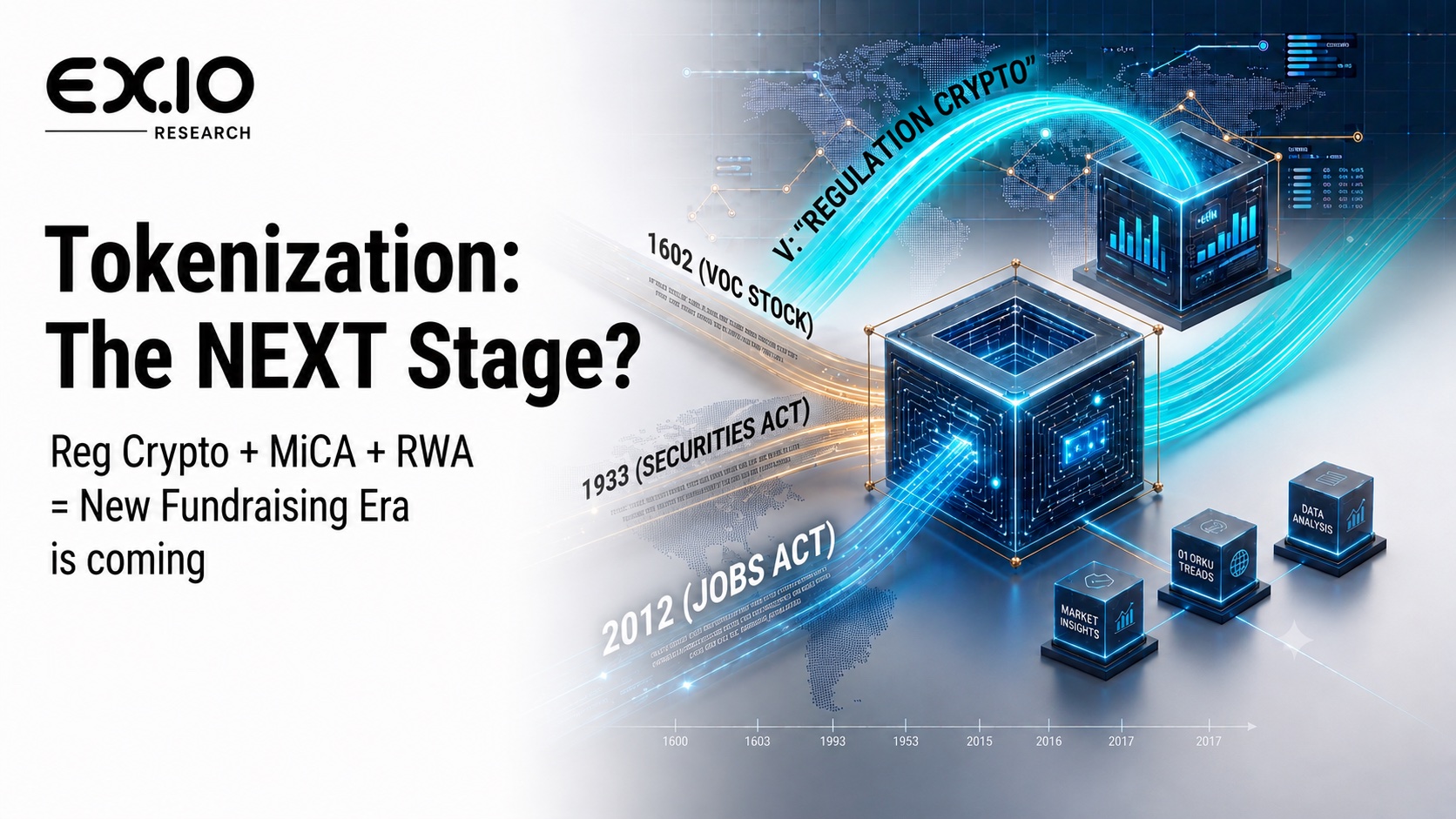
400 Years of Financing: From the Dutch East India Company to SEC Reg Crypto, Why Is Tokenization the Next Step?
EXIO Research Institute | 2026.07.08
On July 7, 2026, SEC Chairman Paul Atkins first mentioned crypto in the new year’s regulatory agenda—a rule called “Regulation Crypto” was put on the agenda (at the proposal stage, still under review by the White House Office of Information and Regulatory Affairs ORA). What it aims to do sounds technical: a set of temporary registration exemptions for startups “financing with crypto assets” with Safe Harbor.
But if you put it on a timeline spanning four hundred years, its weight suddenly changes.
Because of the question of “how humans raise funds,” in four hundred years, only four levels have truly been skipped, and each step repeats the same sequence: reducing financing friction further, then finding ways to restore investor trust. Reg Crypto is very likely the switch that was pressed on the fifth level jump.
1. Four Hundred Years of Financing: A History of Alternating “Reducing Friction and Building Trust.”
Every financial leap is, at its core, a “reinvention of trust.”
1602: The risk of a ship, how it becomes a piece of paper that can be turned
At the end of the sixteenth century, a spice voyage from Amsterdam to the East Indies could multiply profits several times over, but the risks were equally terrifying—an entire fleet could be caught in storms, pirates, or war at any moment. No businessman dares to bet their entire fortune on the return of a single ship. Early Dutch people pooled money using a “voorcompagnie” (per voyage): each voyage raised funds, the ship returned, profits were divided, and the company was dissolved on the spot. Money locked tightly in a voyage—want to exit? All they can do is wait for the boat to return.
In 1602, the Netherlands merged these scattered companies into the United East India Company (VOC) and granted it a 21-year monopoly charter for Asian trade. The truly revolutionary step is not monopoly, but rather: the capital raised this time is **’permanent’ **, and will no longer be dissolved with a single voyage; About 1,800 investors—ranging from wealthy businessmen to maids—subscribed for shares totaling approximately 6.4 million guilders; Moreover, these shares can be transferred.
To enable shares to be transferred, the Amsterdam Exchange took shape (VOC shares began trading in 1602, and a dedicated exchange building was completed in 1611), marking the first time a secondary market for stocks existed. A few years later, businessman Isaac le Maire even organized the first recorded “short selling in history.” From then on, if you want to exit, you don’t have to wait for the ship to return—just sell your shares to the next person.
Essence: VOC used “standardized, transferable certificates” to solve the millennia-old problem of “easy capital investment, hard exit” for the first time. Liquidity has become part of financing from this moment on.
1720: The First Bubble, and the First “Hit the Brakes”
Transferable shares have made money flow and allowed speculators to taste success for the first time. In 1720, the BritishSouth Sea Company and the French Mississippi Company (led by John Law) almost simultaneously soared their stock prices and then collapsed almost simultaneously, leaving countless people with nothing lost. The UK then enacted the Bubble Act, which strictly restricted the establishment of joint-stock companies for nearly a century.
Essence: A four-hundred-year law first emerges here—whenever friction eases and capital is released, speculation expands, and then a collapse forces society to rebuild its guardrails. Reducing friction and building trust, alternating like a pendulum.
1929–1934: After the Great Crash, “trust” was written into law for the first time
The pendulum reached its peak in 1920s America. Everyone borrows money to trade stocks (margin), while listed companies rarely disclose their true operations, leading to rampant manipulation, insider information, and pool-based operations. In October 1929, the bubble burst and the Great Depression arrived.
Congress then held Pecora hearings to expose Wall Street’s dark secrets. The result was two foundational laws: **the Securities Act of 1933** requiring any new securities issuance to be “fully disclosed,” registered, or exempted; The Securities Exchange Act of 1934 established the SEC to regulate the secondary market. The first SEC chairman was Joseph P. Kennedy, the father of the later President Kennedy.
Twelve years later, in 1946, the Supreme Court inv. W. J. Howey inscribed the famous Howey test on “what counts as a security”—a Florida Orange Orchard sale-leaseback contract ruled it an “investment contract.” (Remember this test: eighty years from now, it will fall straight to crypto tokens.) )
Essence: In this round, humanity is welding trust back into the system with “mandatory disclosure + a sustainable legal definition.” Financing has shifted from “buyer’s own responsibility” to “sellers must explain clearly.”
1982 / 2012: The rise of private equity and a re-buried old problem
After World War II, venture capital rose (in 1946, ARDC and Georges Doriot were called the “Father of VC”), and the private capital market grew larger. In 1982, the SEC institutionalized private placement exemptions under Reg D: for qualified investors, companies could raise funds without completing full registration. This channel gave rise to the later vast VC/PE and venture capital ecosystem.
After the 2008 financial crisis, the 2012 U.S. JOBS Act tried to open the door a bit further: Reg CF equity crowdfunding, Reg A+ “small IPO,” and liberalizing general fundraising to give more ordinary people the chance to invest in early-stage companies. The era of AngelList and Kickstarter has arrived.
But a paradox has quietly been planted: private equity and early-stage assets give you exposure to upward gains, but almost no liquidity—an early-stage investment often takes 6 to 10 years to exit through an IPO or M&A. The problem that VOC solved four hundred years ago—”money is easy to get in, hard to get out”—has returned intact in the corner of “early fundraising.”
Essence: The exemption mechanism lowered the financing threshold but failed to solve liquidity for early-stage assets. This is exactly the tough problem you’ll have to tackle next time you skip grades.
2017–2018: A premature revolution that “outperformed trust.”
In 2015, Ethereum and the ERC-20 standard made it possible for “anyone to issue a token in minutes.” In 2016, The DAO raised about $150 million worth of ETH, but was later drained by hackers for about $60 million, forcing a hard fork of Ethereum.
But no one hit the brakes. In 2017, the ICO frenzy erupted and continued into 2018: billions of dollars raised throughout the year, EOS raised about $4 billion over about a year (2017–18), and Telegram’s TON raised about $1.7 billion in a single round in 2018. Financing is pushed to the extreme with low friction—global, 7×24, no intermediaries, anyone can participate, and tokens can be traded on the secondary market immediately upon issuance.
The problem is, it skips the half of trust: no disclosure, no custody of funds, no clear boundaries of securities, scams and zeroing everywhere. In July 2017, the SEC released the “DAO Report,” applying the 1946 Howey test with crypto tokens — many tokens are essentially securities. Regulatory pressure has fallen, and the vast majority of projects have gone to zero in 2018.
Essence: ICOs proved one thing with a messy routine—the tokenization issuance “track” is real (its efficiency crushes tradition). What collapses is not the technology, but the missing half of trust. The track is right, but what’s missing is the rules.
2. Reg Crypto: Filling the gap in “tokenized fundraising.”
If ICOs are “tracked but ruleless,” then what is happening in 2026 is precisely rules catching up to the track.
What exactly has it changed? (Content Breakdown)
According to the proposal, Reg Crypto is roughly built on three pillars (the following are all proposed terms; the official release shall prevail):
- Temporary registration exemption: allows developers launching crypto investment contracts for the first time to temporarily do not need to complete full securities registration under certain conditions;
- Financing permits with a certain amount: legally fundraising within controlled scopes, rather than choosing between “either fully compliant IPO or gray ICO”;
- Safe Harbor: Provides legal certainty for transitional projects that are gradually stepping out of their “managerial role” and moving toward full decentralization.
Supporting this, the SEC released its first crypto asset taxonomy earlier this year (according to CoinDesk), clarifying what constitutes a security and what is not; and advancing the custody and trading pathways for tokenized securities. Together, these three aspects pave a complete compliance track for “on-chain primary issuance,” from issuance and custody to trading.
Returning to the 400-year framework: Reg Crypto for tokenized financing is roughly a combination of the 1933 Securities Act + Reg D—it not only supplements disclosure and investor protection but also leaves a breathing room for exemption for innovation.
Future Direction (Three Scenarios)
- Scenario A | Rules Implemented and Become Paradigms: Reg Crypto passed, combined with possible market structure legislation (CLARITY Act), institutionalized “compliant tokenized issuance” in the US, and the on-chain primary market gained the first major country-level legal foundation.
- Scenario B | Legislative deadlock, regulatory substitution: The Congressional Market Structure Act has been delayed, so the SEC has bridged the gap with rules, creating a transitional order dominated by regulatory rules rather than written law—moving faster but more easily repeated with government changes.
- Scenario C | Repetition and tightening: If a major collapse or political reversal occurs (pay-to-play criticism already appears in Congress, according to Cointelegraph, see Source 2), the boundaries of safe harbor may be narrowed.
Either way, the direction is clear: primary market issuance is shifting from the “privilege of a few intermediaries” to “a public channel with clear rules and accessible on-chain.”
What it leverages is the underlying logic of finance
This is not an ordinary new industry regulation; it touches on several underlying assumptions about capital formation itself:
- The boundaries of capital formation are changing: In the past, whether it could raise funds from the public was strictly controlled by geography, licenses, and intermediaries; Tokenization combined with a Reg Crypto-style framework turns it into “global access as long as it meets the rules.” The default boundaries of capital formation have expanded from “borders/a certain exchange” to “compliance + internet.”
- The timing of liquidity is changing: Traditional securities have liquidity that occurs “after listing”; Tokenization allows “issuance” and “liquidity” to happen simultaneously—the boundaries between primary and secondary levels begin to blur. This is the biggest impact for early-stage and pre-IPO assets with the most liquidity.
- Global regulation has entered the “groundbreaking” phase: the licensing and fixed income/securities tokenization paths of the US Reg Crypto, the EU MiCA, and Hong Kong’s fixed income/securities tokenization paths are essentially contests for rulemaking rights in the “next generation capital markets.” Whoever fixes the compliance track first is more likely to become a hub for tokenized capital.
- The role of intermediaries is being reshaped: exchanges, brokers, custodians, and auditing will not disappear, but the value focus will shift from “gatekeepers” to “trusted infrastructure providers”—whoever can provide a verifiable, compliant, and liquid issuance environment will redefine their position in the chain.
3. Why “RWA/tokenization” is the next step, not just another trend
Looking at the five skips together, the history of financing has been solving the same problem: how to reduce friction while encouraging more strangers to hand over money.
| Era | Reduced friction | Rebuilding mechanisms of trust |
| 1602 stocks | Exit/Liquidity | Standardized transferable certificates + exchanges |
| 1720 Foam → hit the brakes | (Over) speculation | Legislative restrictions and the return of guardrails |
| 1933 Securities Act | Information asymmetry | Mandatory disclosure + SEC + Howey definition |
| 1982/2012 Exemptions and crowdfunding | Financing thresholds / participation scope | Grading exemption system |
| 2017 ICO | Geography/mediation/speed | ❌ Missing → collapse |
| 2026 RWA + Reg Crypto | Geography/intermediary/speed and settlement /composability | ✅ Regulatory Framework Return (Reg Crypto / MiCA / Hong Kong System) |
The true value of tokenization is not in “trading coins,” but in the fact that, for the first time, it allows financing to simultaneously hold two things: ICO-level efficiency (global, programmable, composable, near real-time settlement) + securities law-level legality and protection. This is exactly the first time the two conditions required for every successful leap in the past four hundred years—reducing friction and building trust—have been implemented simultaneously on the same set of technologies.
What is even more noteworthy is the specific battlefield it points to. Looking back at this curve, the ones most illiquid and most deserving of the “next leap” are precisely the private/early-stage/pre-IPO assets—they have rising exposure but are locked in a 6–10 year exit cycle. Thus, a new direction began to be explored: making “issuance” closer to “liquidity“—attempting to turn the equity or revenue rights of early projects into compliant on-chain certificates, giving them some transferability from issuance to alleviate the years-long exit difficulties in the private market. (This is a market-level exploration; whether it can be realized depends on compliance, liquidity, and market conditions, and does not itself constitute any commitment.) )
Interestingly, the market pioneers saw this even earlier than regulators. Even before Reg Crypto was put into the spotlight, some had already judged based on RWA’s characteristics: pre-IPO and early-stage fundraising are the two most suitable stages for tokenization, and based on this, dedicated platforms were built to serve early-stage fundraising. The emergence of Reg Crypto is, in a sense, mutually confirmed by this market judgment.
In other words: this time, it may not be regulators leading the way and the market following behind; It is very likely that the market first grasped the next step in its financing history, and regulators subsequently added the rules.
4. EXIO Research’s Perspective
- Regulatory frameworks (US Reg Crypto, EU MiCA, Hong Kong licensed and fixed income/securities tokenization pathways) are simultaneously bridging legitimacy for “tokenized primary issuance,” marking the watershed from concept to infrastructure for RWAs.
- The focus of this round is shifting from “whether it can be issued” to “whether the trust infrastructure is in place”—disclosure, compliant issuance, verifiable assets, investor protection boundaries, are becoming thresholds for the tokenized primary market and market signals for observing the maturity of the sector.
- Early and pre-IPO assets may be the first to realize value in this round of tokenization: they are the least liquid, and are most likely to benefit from the exploration of “issuing liquidity closer to liquidity” (whether this can be realized still depends on compliance and market conditions).
- For Hong Kong, the institutional rhythm of local licensing + fixed income/securities tokenization is advancing alongside the US and Europe; Hong Kong’s regulatory framework is gradually becoming clearer, and it should be noted that relevant tokenized issuances must still comply with current SFC/HKMA requirements. This article does not constitute a conclusion of compliance for any jurisdiction.
Frequently Asked Questions (FAQ)
Q1: What is SEC “Regulation Crypto”? Regulation Crypto is a rule proposed by the U.S. Securities and Exchange Commission (SEC) in its 2026 regulatory agenda (still in the proposal stage and under review by the White House OIRA as of July 2026). At its core, it provides temporary registration exemptions, certain financing permits, and safe harbors for projects financing with crypto assets, aiming to establish clear rules for capital raising for crypto assets. The final content is subject to the SEC’s official release.
Q2: Why is RWA/tokenization considered the next step in fundraising? Looking back at four hundred years of financing, from the birth of the stock in 1602 to the ICO in 2017, each leap has swung between “reducing financing frictions” and “rebuilding investor trust.” ICOs have maximized friction but collapsed due to lack of trust infrastructure; Tokenization combined with regulatory frameworks like Reg Crypto and MiCA achieves both efficiency and legitimacy for the first time—making it more like a structural long-term trend rather than a short-term trend. This is a directional judgment based on historical laws and does not guarantee any returns.
Q3: What is pre-IPO / early-stage asset tokenization? Refers to representing equity and beneficial interests in early-stage or pre-IPO projects in compliant on-chain certificates (RWA), thereby exploring more flexible transfer and circulation arrangements under a regulated framework. Whether liquidity is available, as well as when and to what extent liquidity is available, depends on the specific product structure, investor qualifications, and applicable regulatory requirements, and there are no guarantees.
Q4: What impact does Reg Crypto have on Hong Kong and globally? The licensing and fixed income/securities tokenization paths of the US Reg Crypto, EU MiCA, and Hong Kong are forming a race for the “next generation of capital market rule-making power.” It may expand the boundaries of capital formation from “borders/single exchanges” to “compliance + internet,” and promote the role of intermediaries such as exchanges, brokers, and custodians from “gatekeepers” to “trusted infrastructure providers.”
Q5: When does Regulation Crypto take effect? As of July 2026, it is still in the proposal stage, under review by the White House Office of Information and Regulatory Affairs (OIRA), and has not yet been officially released. Relevant rules may change or may not be passed; actual progress is subject to the SEC’s official release.
Sources
- CoinDesk — U.S. SEC to propose crypto rule as soon as this month to ease startups, fundraising (2026-07-07): https://www.coindesk.com/policy/2026/07/07/u-s-sec-to-propose-crypto-rule-as-soon-as-this-month-to-ease-startups-fundraising
- Cointelegraph — SEC Crypto Rule Changes Are High on its 2026 Agenda (2026-07-07): https://cointelegraph.com/news/sec-crypto-rule-changes-2026-agenda
- SEC.gov — Chairman Paul Atkins, Statement on the 2026 Regulatory Agenda (2026-07-07): https://www.sec.gov/newsroom/speeches-statements/atkins-statement-2026-regulatory-agenda-070726
- SEC.gov — Atkins Remarks on Regulation of Crypto Assets (2026-03-17): https://www.sec.gov/newsroom/speeches-statements/atkins-remarks-regulation-crypto-assets-031726
- Reginfo.gov — Regulation Crypto rulemaking entry (RIN 3235-AN38): https://www.reginfo.gov/public/do/eAgendaViewRule?pubId=202510&RIN=3235-AN38
- Hong Kong Wen Wei Po — EXIO launches its first AI-driven RWA platform, Token Planet (2026-04-28):https://www.wenweipo.com/a/202604/28/AP69f09574e4b0b49ad1b8bfd7.html
免责声明:
本材料仅供一般信息及研究参考用途,不构成任何投资、财务、法律或税务意见,亦不构成任何招揽、要约或推荐。材料内容可能包含第三方资料或观点,均不代表任何机构或人士之官方立场。虚拟资产及相关产品价格可能高度波动,投资者应根据自身财务状况、投资目标及风险承受能力作出独立判断,并在作出任何投资决定前自行研究(DYOR)及咨询独立专业顾问。因使用或依赖本材料而产生的任何损失,相关各方概不承担责任,惟适用法律不得排除或限制者除外。