Global Crypto Regulatory Crackdown – Is the Compliance Window Closing?
EX.IO Research Institute | 2026-06-03
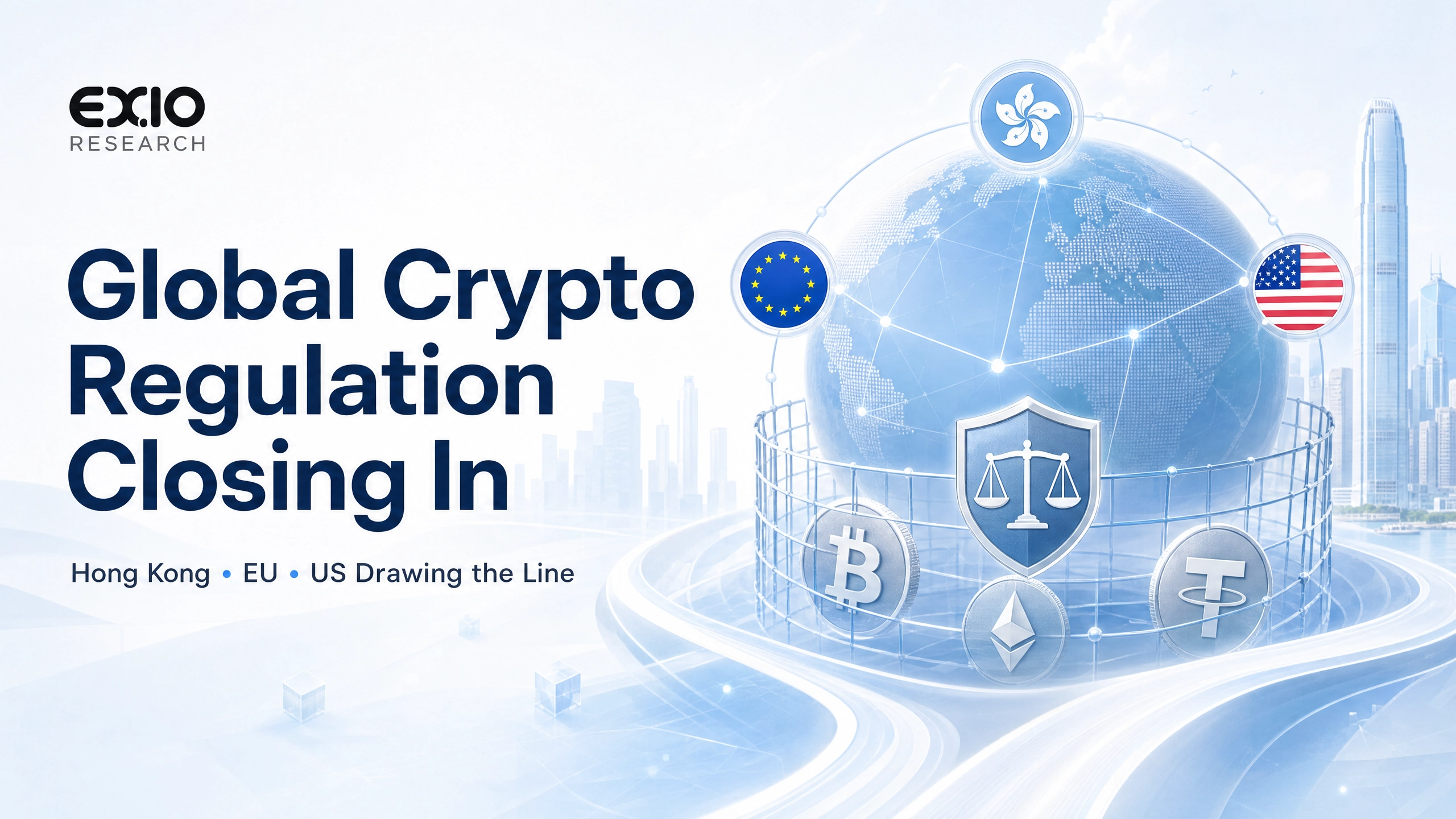
Global virtual asset regulation is transitioning from “rule-setting” to “survival of the fittest.” Hong Kong’s SFC has just delineated new boundaries for stablecoin services, the EU’s MiCA transition period is nearing its end, and the US CLARITY Act has cleared a key Senate committee. All three markets have simultaneously entered an “enforcement screening phase” — compliant players receive entry tickets, while latecomers risk being shut out.
I. Three Signals, One Direction
2024 to 2025 was the “legislative intensive period” for crypto regulation: Hong Kong’s Stablecoins Ordinance took effect [1], the EU’s MiCA became fully applicable [2], and the US passed its first federal stablecoin law, the GENIUS Act [3]. Entering 2026, the rules have been written; the question has become “who can comply.
Over the past two weeks, three independent regulatory developments have simultaneously emerged, all pointing to the same conclusion: major global markets are not “liberalizing” crypto but are undergoing a market restructuring based on licensing, products, custody, and client classification.
| Jurisdiction | Regulatory Action | Date | Core Impact |
| Hong Kong | SFC issues Relevant Stablecoin circular [4] | May 27 | Differentiated regulation for stablecoins vs. regular VAs |
| EU | MiCA transition period ends [2] | July 1 | Unlicensed platforms must cease services |
| US | CLARITY Act clears committee [5] | May 14 | SEC/CFTC jurisdictional division takes shape |
II. Hong Kong: Dual-Layer Stablecoin Regulation Takes Effect
2.1 What is a Relevant Stablecoin?
In its May 27 circular, the SFC defined the regulatory boundary for Relevant Stablecoin services by licensed Virtual Asset Trading Platforms (VATPs) and licensed corporations [4]. To meet this definition, a stablecoin must simultaneously satisfy two conditions: first, it must be a “specified stablecoin” under the Stablecoins Ordinance; second, it must be issued by an HKMA-licensed issuer with authorization.
On April 10, the HKMA granted the first batch of stablecoin issuer licenses to HSBC and Standard Chartered [6], meaning compliant stablecoins are already available in the market. This marks the formation of Hong Kong’s “dual-layer architecture”: the HKMA regulates issuance, while the SFC regulates trading and distribution.
2.2 Relaxation and Constraints Coexist
The SFC’s core message is differentiated treatment — Relevant Stablecoins have risk characteristics different from speculative assets like Bitcoin, being closer to payment instruments, so certain rules can be relaxed [7]:
| Dimension | Relevant Stablecoin | Regular VA |
| Retail Liquidity/Index Requirements | ❌ Not applicable | ✅ Applicable |
| VA Knowledge Assessment | Partially exemptible | Required |
| Exposure Limit | Not counted toward cap | Counted |
| Suitability | Still required when soliciting | Required |
| Stability/Redemption Disclosure | Must disclose | Product-dependent |
| Listing/Suspension/Removal | Written notice to SFC | Notice required |
However, “differentiation” does not mean “relaxation.” Platforms that solicit or recommend Relevant Stablecoins must still comply with suitability requirements and disclose stabilization mechanisms and redemption arrangements [4].
2.3 Hong Kong’s “Hidden Agenda”
This circular is not an isolated action. On April 20, the SFC announced a new regulatory framework to facilitate secondary market trading of tokenized SFC-authorized investment products (tokenized products) in Hong Kong, with the long-term goal of promoting local digital asset trading activity and supporting ecosystem growth [8]. Three policy threads weave together into a clear pathway: stablecoins as settlement infrastructure, tokenized securities as investment instruments, and VATPs as compliant distribution, custody, and trading channels — this is a complete closed loop of virtual asset regulation.
III. EU: MiCA “Final Exam” Countdown
If Hong Kong represents “fine layering,” the EU represents “compliance screening.” On April 17, ESMA confirmed that the MiCA transition period will end on July 1 [2]. After this date, entities without a CASP license providing services to EU clients will be operating illegally.
As of early May, only 210 CASPs have been authorized across 23 EU countries [9], with 86% having activated passporting mechanisms for cross-border services. Compared to the total number of VASPs previously registered in the EU, this is merely the tip of the iceberg (before MiCA took effect, member states operated their own VASP registration systems, with approximately 3,000–3,200 VASPs cumulatively registered across the EU). Progress varies significantly by country. Germany leads with 53 authorized entities [9], with strict approval processes and high paid-in capital requirements; Poland’s implementation bill has been vetoed twice by the president [10], risking a legal vacuum after July 1. The median processing time from application to license approval has already reached 6 to 9 months [9], meaning applicants in the second half of the year may not be able to operate legally until 2027.
IV. US: CLARITY Act Sprint to Legislation
US crypto regulation is shifting from “enforcement-driven” to “rule-driven.” On May 14, the Senate Banking Committee passed the CLARITY Act by a 15-to-9 vote [5], marking the first federal legislation attempting to clarify the jurisdictional division between the SEC and CFTC.
The bill’s core provisions include: SEC regulation of digital assets with investment contract characteristics, CFTC regulation of spot digital commodities; establishment of trading platform and custodian registration rules; and inclusion of a stablecoin regulatory framework [11].
The most intense debate centered on stablecoin yields. The final compromise prohibits “passive yields” based on idle balances but allows “activity rewards” tied to substantive activities such as payments and lending [12]. This draws a middle line between banking stability and crypto innovation.
However, the bill still faces hurdles before becoming law. A full Senate vote requires 60 votes to overcome a filibuster [13], with Polymarket predicting approximately a 73% probability of enactment in 2026 [5].
| Legislative Process | Timeline | Status |
| House Passage | July 2025 | ✅ 294-134 votes [11] |
| Senate Banking Committee | May 14, 2026 | ✅ 15-9 votes [5] |
| Full Senate Vote | Expected H2 2026 | ⏳ Requires 60 votes |
| Presidential Signature | White House target: July 4 | ⏳ Pending [5] |
V. Stablecoins Are Becoming “Financial Infrastructure”
The deep context for synchronized regulatory advancement across all three jurisdictions is the fundamental transformation of stablecoins’ role. In 2025, global stablecoin payment volume reached US$33 trillion [14], comparable to Visa and Mastercard’s combined annual processing volume; total market capitalization exceeded US$320 billion [3]. US Treasury Secretary Scott Bessent predicts it could reach US$3.7 trillion by 2030 [3].
Use cases are also expanding: approximately 67% is related to DeFi and trading, 15% to cross-border remittances, 10% as inflation hedges, and 5% for merchant payments [15]. Stablecoins are no longer merely “bridge currencies” for crypto users but have become the settlement layer between traditional finance and digital finance.
The regulatory paths of Hong Kong, the EU, and the US differ, but the direction is the same: integrating stablecoins into regulated financial infrastructure rather than allowing them to grow unchecked. This means that compliance capability will become the watershed for the next round of competition — not “who has the most products,” but “who completes compliant market access first.”
Conclusion
The global crypto market is undergoing a silent yet profound “access reshuffling.” Hong Kong’s dual-layer stablecoin framework, the EU’s license screening, and US market structure legislation together outline the contours of a new era: compliance is no longer a cost but the “entry permit” of the new era. For investors, understanding this paradigm shift will be a crucial prerequisite for evaluating the long-term value of platforms and assets (particularly asset security).
Disclaimer
This material is for general market information and educational purposes only. It does not constitute investment advice, legal advice, compliance advice, or product recommendations, nor does it constitute an offer or solicitation to buy or sell any financial product or virtual asset. Readers should seek independent professional advice where appropriate. This material contains third-party data or opinions, which do not represent the official position of this institution or its employees. Prices of financial assets and related products may be highly volatile. Investors should conduct their own research (DYOR) and/or consult independent professional advisors before making any investment decisions, and carefully consider the risks involved.
References
[1] Hong Kong Special Administrative Region Government. (2025). Stablecoins Ordinance. https://www.elegislation.gov.hk
[2] European Securities and Markets Authority (ESMA). (2026-04-17). “Statement on the end of the MiCA transition period”. https://www.esma.europa.eu
[3] Reuters. (2025-07-18). “Trump signs GENIUS Act, first US stablecoin law”. https://www.reuters.com
[4] Securities and Futures Commission of Hong Kong. (2026-05-27). “Circular: Virtual Asset Trading Platforms and Licensed Corporations Providing Relevant Stablecoin Services”. https://www.sfc.hk
[5] The Block. (2026-05-14). “Senate Banking Committee passes CLARITY Act 15-9”. https://www.theblock.co
[6] Hong Kong Monetary Authority. (2026-04-10). “HKMA grants first batch of stablecoin issuer licenses to two banks”. https://www.hkma.gov.hk
[7] Securities and Futures Commission of Hong Kong. (2026-05-27). “Relevant Stablecoin Services Regulatory Expectations”. https://www.sfc.hk
[8] Securities and Futures Commission of Hong Kong. (2026-04-20). “Circular: Secondary Market Trading of Tokenized Securities”. https://www.sfc.hk
[9] MiCA SCAN / Binar. (2026-05-04). “CASP Authorisation Tracker”. https://www.micascan.eu
[10] CoinDesk. (2026-05-01). “Poland’s MiCA legislation stalls as president returns bill to parliament”. https://www.coindesk.com
[11] U.S. Congress. (2025). “Digital Asset Market Clarity Act of 2025 (H.R.3633)”. https://www.congress.gov
[12] Coinbase. (2026-05-15). “Statement on stablecoin yield compromise”. https://www.coinbase.com
[13] CoinDesk. (2026-05-14). “CLARITY Act faces uphill battle in full Senate vote”. https://www.coindesk.com
[14] Visa. (2025-12-09). “Stablecoin: The emerging payments layer”. https://stablecoinmap.com/
[15] The Block. (2026-04). “Stablecoin activity breakdown: DeFi, remittances, and payments”. https://www.theblock.co