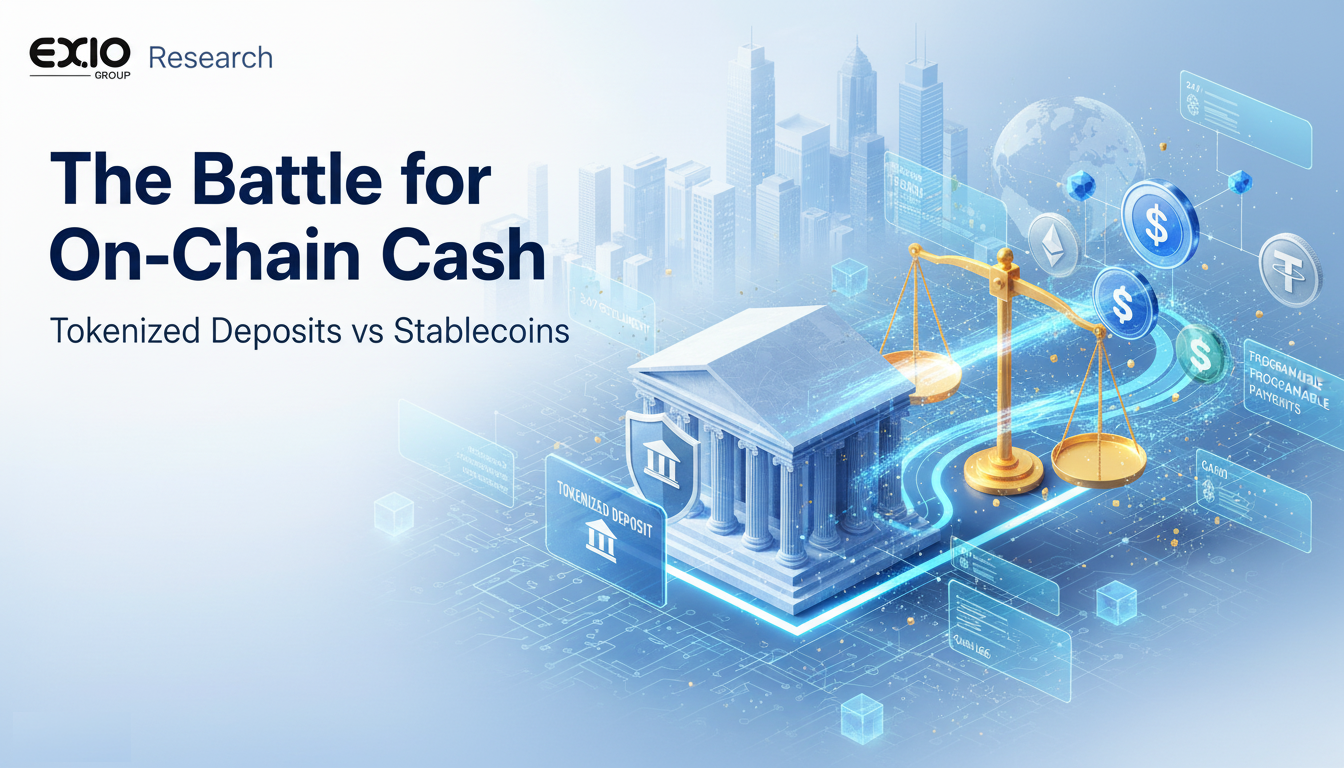
After the Stablecoin dispute, banks wanted to use Tokenized Deposits to reclaim on-chain cash
Abstract
The CLARITY Act controversy has brought a question to the forefront: if stablecoin could become an on-chain payment, settlement, and revenue share, Will the banking system lose its right to define ‘cash’?
This is exactly why the tokenized deposit value must be included in the header. It’s not just RWA’s cash leg, nor just a bank’s ‘blockchain experiment’ technique; If it can be used as a payment medium, it is more like an institutional counterattack by the old banking system against stablecoins: to replace stablecoins Proven 24/7 flowing, programmable payments and on-chain settlement trials, now re-released Bank deposits, bank liabilities, and supervised account systems.
A few days later, when several new news stories were placed together, one can observe the same line: according to CoinDesk [1] [2], Abra is ready to pass. It went public on Nasdaq through a SPAC, positioning itself as a platform for asset tokenization and wealth management; Securitize took a step toward listing on the NYSE after its SPAC merger registration statement took effect; At the same time, major banks such as JPMorgan, Bank of America, and Citi are also promoting shared tokenized deposit networks[4], and the Hong Kong Monetary Authority’s Project Ensemble is also involved Sandbox testing has been launched around tokenized assets and settlement of tokenized deposits[5]。
If the keyword for institutional entry in the previous round was ETFs, then the keywords to be observed in the next round might be tokenized yield, on chain lending, tokenized deposits, and standardized distribution; The most conflicting issue is whether banks will use tokenized deposits to reclaim the payments and funds that Stabilization is taking away Checkout portal.
1. After the CLARITY Act debate, the question became: Who defines on-chain cash?
The debate surrounding the CLARITY Act, stablecoin yields, and market structure is not essentially an isolated crypto regulation Rather than redefining control over ‘on-chain cash,’ The issuer of WendingCoin hopes to make the US dollar the default settlement tool in the open network; Trading platforms and DeFi require it for quoting, collateralization, and liquidity; Bank banks do not want payments, deposits, and corporate treasury relationships to be moved off the bank’s balance sheet.
Therefore, the strategic meaning of tokenized deposit is even greater than “banks also doing tokenization.” It answers the core question of banking: if users prefer stable coin speed and programmability, can banks provide a version that still belongs to the bank’s deposit, bank liabilities, and supervised account system?
This is why the perspective of the Hong Kong Project Ensemble is so important [5]. Hong Kong is not just about stablecoin issuance; it is testing whether tokenized deposits can support payments and settlements of tokenized assets. In other words, what Hong Kong is experimenting with is not single-point on-chain assets, but rather ” Asset-side + silver bank cash legs” market foundation and construction.
2. Wall Street wants to buy not just coins, but “on-chain financial products.”
CoinDesk reported [1] that Abra CEO Bill Barhydt believes Wall Street’s next crypto focus will shift toward tokenization rather than The revolve continues to revolve around Bitcoin prices. The Abra program has passed a SPAC merger with New Providence Acquisition Corp. III, with an estimated transaction value of approximately $750 million; If Jinzhan Shunli is adopted, the company plans to list on Nasdaq under the name Abra Financial Inc., with the stock code being ABRX。 The related listing process still depends on regulatory management, transactions, and market conditions, and should not be interpreted as a definite outcome.
Abra’s positioning is also changing. It is not just a trading and custody platform, but aims to become an asset tokenization and wealth management platform: targeting high-net-worth and ultra-high-value clients Net worth clients and institutions, offering digital asset investment strategies, yield-generating products, staking, and collateralized lending.
The point here isn’t “another crypto company going public,” but rather that the story told when it goes public has changed.
The 2018 crypto banking narrative was about integrating trading, yields, lending, and payments into one app. The institutional crypto narrative in 2026 will be more like the traditional chain upgrade of wealth management: customers don’t just askHow to buy BTC/ETH, but the question is whether the asset can generate returns, can be collateralized, put into a legitimate account, and can be usedThe consultant is handed over to the Investment Committee Committee.
3. Tokenized yield may be closer to the product language familiar to institutions
According to CoinDesk[1], one of the core products Abra is currently emphasizing is USDAF: a USD-denominated yield-bearing currencyAsset-to-Purchase. The company also plans to launch BTCAF, a yield-based product based on Bitcoin, targeting advisors and retail investors outside the United States.
The logic behind this is straightforward: institutional investors may not be willing to use “bullish on a certain token” to interpret their allocations, but they are more likely to understand “cash management and collateral borrowing.” loans, yield curves, risk disclosures, and asset stratification.”
This is one of the key reasons why tokenized yield is attracting attention. It translates crypto from a highly volatile asset class into the familiar product language of traditional finance
- US dollar assets can be made into tokenized products with yield mechanisms;
- BTC, ETH, and SOL can be used as collateral to enter the lending system;
- Customer relationships can be managed through RIA, the Wealth Management Platform, and compliant distribution channels;
- On-chain settlement offers speed and composability, but the frontend narrative remains “asset management.”
Traditional financial institutions have not fully embraced the permissionless DeFi model, but are more inclined to selectively absorb its efficiency advantages: incorporating some DeFi mechanisms into traditional finance Sales, auditing, and supervision.
4. Securitize is being listed and is being priced, indicating that the construction of the foundation is also being priced in the open market
Another more foundational construction signal comes from Securitize.
CoinDesk reported [2] that the SEC announced the effective registration statement related to the merger of Securitize and Cantor Equity Partners II. The shareholder vote is expected to take place on June 29; If approved, the merged company is expected to trade on the NYSE under the ticker SECZ. Here, “Registration Declaration Effective” should not be understood as regulatory authority action to companies, securities, trading, or commercial enterprises endorsement of the model.
The importance of Securitize lies in the fact that it is not selling a new coin, but rather providing underlying tools for traditional assets to be on-chain. It is a key foundation behind BlackRock BUIDL’s tokenized currency market and U.S. Treasury fund productsThe provider also provides tokenization, transfer-agent, and trading technical support to institutions such as Apollo, KKR, Hamilton Lane, and VanEck. Previously, Securitize was reported to be involved in helping NYSE build a tokenized securities platform.
Companies entering the public market mean more than just financing. It may allow tokenization infrastructure to more directly accept secondary market pricing: revenue quality, customer settlement Structure, AUM growth, regulatory costs, and asset issuance speed—all of these become opportunities for investors to compare and compare Signing.
This could drive the market to pay more attention to the financial presentations of related companies, rather than just the conceptual narrative.
5. This round of tokenization is not about “crypto defeating banks,” but about banks and brokerages absorbing on-chain capabilities
In the past, many crypto narratives joyfully talked about “de-intermediation.” But this round of tokenization is more like “re-brokering”: assets still require issuance, transfer agents, custodians, and compliance disclosure, distribution channels, and investment advisors are just beginning to use on-chain systems for underlying settlement and share recording。
This explains why institutions like BlackRock, Franklin Templeton, JPMorgan, and Fidelity are all paying attention to tokenized assets. They don’t necessarily embrace the full value perspective of unlicensed DeFi, but they selectively absorb the area The three abilities brought by the blockchain are:
1. Faster settlement: Share issuance, transfer, and redemption can reduce intermediaries;
2. Enhanced programmability: Yields, limits, white lists, and qualified investor rules can be embedded into the product process;
3. Wider distribution: Assets can enter more wallets, platforms, and wealth management channels within the boundaries of the rules.
So, the most noteworthy aspect of this narrative isn’t whether traditional finance finally believes in crypto, but ‘which aspects of crypto are being transformed by traditional finance.’ to build their own foundation and construction.”
6. Banks promote tokenized deposits, stating that they may be an “institutional weapon” against stabilized coins
This article also needs to add an even more crucial clue: banks are pushing tokenized deposits [4]。 If tokenized deposits are not only used for interbank settlements but also serve as a payment medium, then they are more than just the “cash” of RWAs and may become an institutional weapon for the old banking system to counter stabilized currency.
According to CoinDesk, major U.S. banks such as JPMorgan, Bank of America, and Citi plan to promote shared use through The Clearing House The Tokenized Deposit Network aims to bring bank deposits closer to the system of regulated banks Stablecoins offer 24/7 transfer, programmable payments, and institutional settlement capabilities. Hong Kong is also exploring similar directions: one of the key focuses of the Hong Kong Monetary Authority’s Project Ensemble Sandbox[5] is to support tokenized asset transactions through tokenized deposits testing the real world’s assets, cash legs, and banking systems. Can a runnable closed loop be formed?
This is not the same business model as Abra or Securitize, but they all point to the same market structure problem: if assets can be used tokenized, so who issues and is responsible for settling the “money” for these assets, who controls the entrance?
Stablecoin has proven one thing: the market needs a chain that can be moved 24/7, cross-platform transferred, and used for transactions and payments cash is on top. For banks, the real pressure is not the market value of a single stablecoin, but enterprise treasury, cross-border payments, and transactions Settlement and personal wallets have become accustomed to holding ‘instantly liquid US dollars’ outside the banking system. Once this habit forms, banks lose not just handling fees, but deposit relationships, customer entry points, and cash the right to define gold standards.
Therefore, the logic behind the defensive counterattack of tokenized deposits is clear: banks do not deny the efficiency of stablecoins but rather try to offer a system that “does not leave the banking system.” The on-chain cash version retains bank deposits as legal and account liabilities for banks, as well as the same legal and account relationships. Experience using stablecoins for longer, faster settlement, and stronger programmability design, as well as atomic settlement capabilities for tokenized assets.
In the context of RWA and tokenized funds, the asset side can be government bonds, funds, private credit, stocks, or BTC yield-generating products; However, trading, redemption, collateral, and settlement all require an on-chain cash tool available. Here you will find three paths:
- Stablecoins: More suitable for open networks, crypto trading, cross-border payments, and on-chain liquidity;
- Tokenized deposits: More suitable for bank customers, corporate treasuries, interbank payments, and regulated institutions settlement, and possibly payment media within the banking system;
- Tokenized money market funds / yield products: More closely related to asset management products, addressing cash management and yield expression but not equivalent to deposits.
Therefore, the meaning behind banks promoting tokenized deposits is not just that “banks are also going on chain.” More precisely, it is the bank’s response to stablecoins regarding deposit relationships, payment gateways, and on-chain issues a provocative battle with cash standards. Hong Kong’s Observation Value is also here: it’s not just about stablecoin trading, but about testing silver. After bank deposit tokenization, can it become a payment and settlement medium in the tokenized asset market?
This will elevate the competition for tokenization from “who can put assets on chain” to who can simultaneously control the asset side, cash side, and the legitimate distribution side.” Without cash legs, RWAs are merely on-chain asset records; With available cash legs, tokenized finance is closer to a complete market foundation.
7. Why is this important for the RWA sector?
The Securitize event and the Abra event together point to a transformation: RWA is no longer just a technical experiment to “put bonds or funds on-chain,” but is entering the public market Commercial and industrial closed loops of market, wealth management, and income-generating products.
CoinDesk cited RWA.xyz data [3], showing that the tokenized asset market nearly tripled in one year, reaching over $30 billion. Citi once projected that tokenized assets could reach $5.5 trillion by 2030; A joint report by Boston Consulting Group and Ripple estimated that by 2033, the market could reach $18.9 trillion.
These predictions don’t necessarily mean they will be realized, but they make one thing clear: tokenization has evolved from the self-narrative of the crypto native community Strategic forecasting and capital-based market stories for entering large financial institutions.
The next stage of competition may not be just about “who can launch more tokenized treasuries,” but who can control the following four entry points:
- Cash legs: stablecoins、tokenized deposits、tokenized money market funds and other on-chain cash instruments, the core question is who becomes the payment/settlement medium;
- Asset leg: government bonds, private lending, funds, stocks, BTC yield-type products;
- Pawn legs: How digital assets like BTC/ETH/SOL enter compliant lending;
- Distribution legs: RIA, brokerages, exchanges, wealth management platforms, and institutional custody channels.
Whether these aspects can be integrated may become an important dimension for judging the maturity of RWA platform business models.
8. The risk is also here: income-driven products require more trust than price narratives
Tokenized yield sounds more stable than speculative coin prices, but it is not inherently low risk, nor is it equivalent to deposits or risk-free returns. Where do the returns come from? How is collateral valued? How is liquidation executed? How redemption is arranged; on-chain and off-chain right show to respond to these benefits will become a core issue.
Especially when assets like BTC, ETH, SOL, and others are used for collateral lending, the systematic risk does not disappear; it simply shifts from “price volatility risk” to “collateral volatility.” + liquidity mismatch + platform credit + smart contracting + compliant structure.”。 High returns often come with higher or more complex risks.
Therefore, the long-term competitiveness of tokenization does not depend on who has a higher APY, but on who can allocate income sources, asset rights, and risk the quarantine and redemption mechanisms are clearly explained.
This is also why foundational construction companies like Securitize, RIA pipelines, transfer agents, custodial, and compliant frameworks have become more important. The more income-generating products resemble financial products, the more they require financial-grade governance and disclosure.
9. EX.IO Research View
This shift in the US capital crypto market narrative can be summed up in one sentence: price entry points are underway Giving way to the product entry, the real competition behind the entrance is the cash gold leg.
Bitcoin price remains important, but it increasingly resembles a market sentiment indicator; What is more likely to enter the institution’s long-term budget discussions are those that can be dissolved, distributed, mortgaged, or can be used on-chain financial products that generate revenue and can be described in the language of regulatory authorities.
Abra’s Nasdaq story, Securitize’s NYSE story, as well as major banks and the Hong Kong market driving tokenized deposits, all clearly explain the capitalization of the local market The banking system is handling three separate matters: front-end wealth management, back-end asset on-chain, and receiver The prison supervisor chain shows golden legs.
If ETFs are the first entry point for institutions, then tokenized yield, on chain lending, and tokenized deposits may be the second tier. The first two mainly correspond to financing, returns, and asset management scenarios after holding the position, while the latter corresponds to the payments, deposits, and settlements that the banking system hopes to preserve count the entry. In other words, stablecoin is the user of on-chain cash Experience it and make it happen; Disputes related to the CLARITY Act have brought issues of revenue, payments, and regulatory boundaries to the forefront; Tokenized deposits are the banking system’s attempt to re-deposit this system. Entering the boundaries of their own systems.
References
[1] CoinDesk — Abra’s Bill Barhydt says Wall Street’s next crypto bet is tokenization
[2] CoinDesk — BlackRock-backed tokenization firm Securitize clears key hurdle to go public on NYSE
[3] RWA.xyz — Tokenized asset market data
[4] CoinDesk — JPMorgan, Bank of America and Citi are going on the blockchain offensive with a shared tokenized network
[5] HKMA — HKMA launches Project Ensemble Sandbox to accelerate adoption of tokenization
https://www.hkma.gov.hk/eng/news-and-media/press-releases/2024/08/20240828-3
About EXIO Group
EXIO Group is a leading global digital asset fintech group dedicated to building innovative infrastructure that connects traditional finance with the digital economy. The Group implements a multi-dimensional compliance strategy, strictly adhering to local regulatory frameworks in major global financial centers to conduct business. Our core platform integrates seamless conversion between fiat and digital assets, institutional-grade asset custody, real-world asset tokenization (RWA), and cutting-edge PayFi (Payment Integration) solutions. With strategic partnerships with leading international banks and a top team of traditional financial elites and blockchain technology experts, EXIO continues to lead industry innovation, providing secure, compliant, and forward-looking digital asset financial services to global institutional clients.
Disclaimer
This content is for general market information and educational reference only, and does not constitute investment advice, legal opinions, or compliance opinions Transaction proposals, solicitation, or recommendations. Digital asset prices are highly volatile; past data does not indicate future performance. Readers should not make transactional, product, license, or other business decisions solely based on this content. If legal, compliant, tax, or investment judgments are involved, consultation with the joint venture qualification should be consulted Professional consultants.
The listing process, market scale forecasts, and industry trend judgments mentioned in this article are all uncertain, and do not constitute any concern for any company, securities firm, or agent Predictions or commitments regarding the outcome of the coin or market. The companies, banks, products, or agreements mentioned are for market information discussion only and do not imply cooperation or endorsement between EX. IO and related parties or a referral relationship. This content does not constitute a purchase of any securities, funds, tokenized products, or income-generating products, Proposals to subscribe, hold, or sell.