EX. IO Research | Why is it a bit awkward when banks choose alliance chains: the mainstream entry in the crypto world?
The long-awaited “mainstream entry” in the crypto world has finally arrived.
But the way it came about may not be what many people imagine.
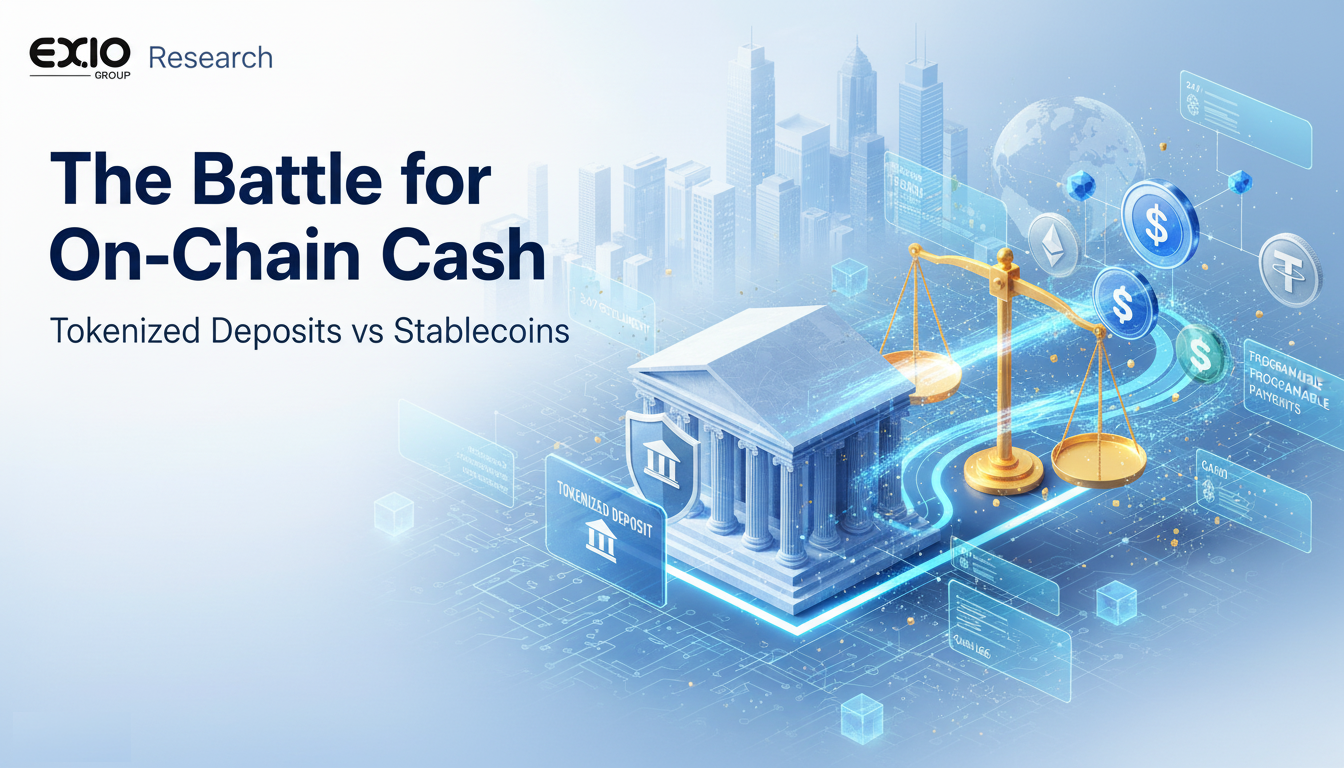
According to CoinDesk [1][2], major U.S. banks such as JPMorgan, Bank of America, and Citi plan to launch shared tokenized deposit networks through The Clearing House, expected to launch in the first half of 2027. Simply put, banks want to make deposits digital tokens that can be transferred 24/7 on blockchain networks.
This sounds like mainstream finance is finally serious about going on-chain.
The awkward part is that they are not choosing DeFi, permissionless public chains, or moving financial systems into a crypto-native world, but rather payment infrastructure jointly owned by banks, permissioned ledgers, consortium chains, and institutional networks where only transaction participants and authorized regulators can see the details.
At the same time, the DeFi world is experiencing another narrative pressure: security incidents continue to remind the market of risks in on-chain finance, and ETH and the overall crypto market are also clearly under pressure.
Thus, an even sharper question arose:
If mainstream finance ultimately uses blockchain but chooses consortium chains and controlled settlement networks, how should the crypto world’s narrative of “openness, transparency, permissionlessness” in recent years be reinterpreted?
This article does not evaluate the price performance of ETH or any digital asset, nor does it constitute advice to buy, sell, or hold any digital asset. This article discusses market structure and technology adoption paths.
1. Mainstream entries in the crypto world have only led to alliance chains
“Mainstream financial entry” has long been one of the most popular stories in the crypto market.
In the early days, this story usually looked like this:
Banks will be transformed by DeFi, Wall Street will connect to open public blockchains, traditional assets will be tokenized, and global finance will migrate to transparent, open, permissionless networks.
This imagination is fascinating.
Because it is not just a technical narrative, but also a value narrative: old finance is closed, slow, expensive, and opaque; New finance is open, fast, affordable, and combinable. As long as the time is long enough, the latter will replace the former.
But now, the answers from big banks are less romantic.
According to CoinDesk, major U.S. banks such as JPMorgan, Bank of America, and Citi plan to establish a shared tokenized deposit network operated by The Clearing House. The Clearing House itself is a payment company jointly owned by banks.
This means banks are not saying, “We want to join DeFi.”
They are more like saying: We acknowledge blockchain’s efficiency, but we want to put that efficiency back into the banking system; We acknowledge the value of on-chain settlement, but participants, permissions, data visibility, and accountability boundaries must be controllable.
This is the awkward part: the crypto world has welcomed mainstream entrants, but mainstream finance has not brought a victory declaration of open public blockchains, but rather a banking, controlled, and regulated version of blockchain.
2. Why Consortium Chain? Because what banks buy is not faith, but certainty
Many crypto-native readers instinctively dislike consortium chains.
In the crypto context, consortium chains often mean “not open enough,” “not decentralized enough,” and “not crypto enough.”
But from the bank’s perspective, the appeal of consortium chains comes precisely from these “inadequacies.”
The question banks and institutions need to answer in settlement is not “Is this chain cool enough?”, but rather:
- Who can join the network?
- Who can see the trading data?
- Who is responsible for KYC/AML?
- How do regulators obtain the necessary information?
- Who is responsible after a mistake?
- Will sensitive clients and fund flows be publicly exposed?
Open public chains make many things public by default; Banking treats many things by default.
Open public chains emphasize permissionlessness; Banking, on the other hand, must know who each participant is.
Open public chains believe that code and market self-repair; Banking requires responsible parties, audit pathways, and regulatory interfaces.
Therefore, banks choose consortium chains not because they don’t understand DeFi, but because they realize they can’t operate like DeFi.
3. Under DeFi security pressures, banks are even less likely to directly embrace “full openness.”
Recently, the DeFi world has been anything but calm.
In public news, Radiant shut down due to failure to recover after the 2024 hack[6][7]; Meanwhile, the crypto market has been highly volatile recently, with assets like Bitcoin and Ether showing noticeable pullbacks. Similar incidents continue to remind the market that open on-chain finance still faces challenges in security, resilience, and institutional risk management.
These events do not mean DeFi has no value, nor do they mean open public blockchains have failed.
But they change the agency’s risk perception.
For retail investors, an exploit might be a “project team problem.”
For banks, an exploit is a matter of board, legal, regulatory, customer compensation, and reputational risk.
These safety incidents may make some organizations more inclined to choose permissioned rails that are controllable, auditable, and accountable. It’s not that banks don’t want on-chain efficiency, but they don’t want to expose their core payment and deposit systems to environments that can’t be explained, controlled, or held accountable.
So, while DeFi is still proving itself secure enough, banks naturally choose another path: leveraging blockchain efficiency while retaining control of the banking system.
4. ETH Pressure Makes the Problem More Glaring: Does Mainstream On-Chain Really Mean Winning for Public Chains?
Let’s clarify the boundaries first: this article does not discuss ETH prices, nor does it judge the investment value of ETH or any digital asset.
However, against the backdrop of obvious pressure on ETH and the overall crypto market, the emotional tension on this issue is even stronger [7].
When the market rises, all narratives tend to be correct: DeFi will expand, L2s will thrive, RWA will enter public blockchains, and institutions will move into open ecosystems.
When the market falls, the problem becomes even harsher:
If mainstream finance really starts going on-chain, but they choose alliance chains;
If banks really start making tokenized deposits, but cash legs remain on the banking network;
If Visa really tests private stablecoin settlements, but this happens with permissioned ledgers like Canton;
So, which part of the mainstream financial dividend has actually benefited from opening up public chains?
The answer may not be “no.”
Open public blockchains like Ethereum will continue to play important roles in DeFi, stablecoin liquidity, open developer ecosystems, and crypto-native innovation.
But the answer is no longer “all.”
Mainstream finance going on-chain may not be a story of everyone migrating to the same open network, but rather a split path: open public chains for open finance, bank alliance chains for institutional settlement, tokenized funds for yield-based cash management, and stablecoins for global liquidity.
This is where faith is being questioned.
It’s not that open public blockchains have no future, but that they may no longer have all the future.
5. Stablecoins have forced banks to adopt “on-chain deposits”
Why are banks moving now?
Because stablecoins have already made the question clear: Why can’t the US dollar move 24/7, cross-border, and with low friction?
In the crypto market, stablecoins have become the default cash instrument. Exchanges use it for quoting and settlement, DeFi uses it as collateral, market makers use it to transfer liquidity, and cross-border payment companies use it to test new channels.
CoinDesk cited a JPMorgan report [1][4] stating that although tokenized money market funds have yield advantages, they still only account for about 5% of the stablecoin universe; The report believes that stablecoins still maintain stronger liquidity advantages in crypto trading, collateral management, settlement, cross-border payments, and liquidity management.
The real power behind this is not stablecoin price stability, but their dominance of the on-chain world’s cash legs.
Once the cash leg is taken over by stablecoins, trading, collateralization, payments, clearing, and fund management all revolve around it.
For banks, this is not a change that can be observed in the long term.
Tokenized deposits are the bank’s response: if users want the speed of on-chain dollars, can banks provide a version that doesn’t leave the banking system?
6. Visa and Canton: Institutions want on-chain efficiency, not the entire internet
Cointelegraph reported that Visa is testing private stablecoin settlements with Brale and Canton Network. Canton features a permissioned ledger: only transaction participants and authorized regulators can see the specific transaction data, while also supporting atomic settlement between tokenized assets, cash-like instruments, and financial contracts.
This news is on the same line as bank tokenized deposits.
Institutions do not want blockchain.
What they want is:
- Faster settlement;
- Lower operational friction;
- Better capital management;
- Programmable financial contracts;
- But at the same time, privacy, permissions, auditing, and regulatory interfaces are retained.
In other words, what institutions want is “on-chain efficiency,” not necessarily “watching from the whole internet.”
This statement may make crypto-native readers uncomfortable, but it is very close to the real needs of banks and payment networks.
7. The next stage of RWA: not who goes on which chain, but who controls the cash leg
In the past, when discussing RWA, the market liked to ask: What assets can be listed on-chain?
U.S. Treasuries, funds, private credit, real estate, stocks, bonds—all can be answers.
But this round of bank tokenized deposits changed the problem:
Putting assets on-chain is only the first step; putting cash legs on-chain is the key to market structure.
Whether a tokenized bond makes sense depends not only on whether the bond can be on-chain, but also on:
- What cash should be used for settlement?
- Who is responsible for the redemption mechanism?
- Who can hold it?
- How are transfer restrictions enforced?
- How is secondary liquidity formed?
- How should abnormal transactions be handled?
A CoinDesk opinion article simulates tokenization as an ETF-style market structure revolution [5]. The value of ETFs is not about “repackaging assets,” but rather about creation/redemption, arbitrage mechanisms, continuous trading, and secondary liquidity that together change the market structure.
For tokenization to truly grow, a similar market structure is also needed.
And the core of market structure has never been just the chain name, but cash, redemption, market making, authority, and responsibility.
8. EX. IO Research View: This is not a technical route dispute, but a battle of trust structure
EX. IO Research believes that the most noteworthy aspect of banks’ choice of consortium chains is not that “consortium chains are back,” but that they expose underlying differences in blockchain adoption.
The crypto-native world believes: the more open, the more trustworthy.
Banks and institutional finance believe: the more controllable, the more trustworthy.
These two trust structures do not automatically merge just because they both use blockchain.
In the future, tokenized finance is likely to be more like multiple:
- Open public chains undertake open finance, DeFi, global stablecoin liquidity, and developer innovation;
- Consortium chains and permissioned rails handle bank deposits, corporate treasury, institutional settlement, and privacy-sensitive transactions;
- Tokenized funds/government bonds undertake income-type cash management;
- Stablecoins continue to bear the cash legs of the crypto-native world.
Therefore, mainstream financial institutions entering the market is not awkward.
The awkward part is that the crypto world thinks mainstream finance will follow its own script, but mainstream finance is writing a different script.
After reading this, take away three judgments
First, banks are not suddenly embracing crypto. They truly respond to stablecoins’ challenges to payment gateways, deposit relationships, and on-chain cash standards.
Second, alliance chains are not as simple as reviving old concepts. In institutional settlement scenarios, permissioned networks may be the prerequisite for banks to use blockchain.
Third, the key to RWAs will shift from “whether assets can be on-chain” to “how to close the loop between cash legs and trust structures.” Settlement cash that is not accepted by institutions, no matter how attractive the tokenized asset, is just packaging.
References
[1] CoinDesk — JPMorgan, Bank of America, Citi to start blockchain offensive with shared tokenized network
[2] Cointelegraph — JPMorgan, Citi-backed Clearing House plans tokenized deposit network in 2027: WSJ
https://cointelegraph.com/news/jpmorgan-citi-bank-of-america-launch-tokenized-deposit-system-2027
[3] Cointelegraph — Visa tests private stablecoin settlement with Brale, Canton
[4] CoinDesk — Stablecoins retain the edge over tokenized money market funds, JPMorgan says
[5] CoinDesk Opinion — Why tokenization is an ETF-style market structure revolution
[6] Cointelegraph — DeFi protocol Radiant to wind down after failing to recover from 2024 hack
[7] CoinDesk — Bitcoin, ether eye worst weekly rout since FTX collapse as cryptos shed $390 billion
About EXIO Group
EXIO Group is a leading global digital asset fintech group dedicated to building innovative infrastructure that connects traditional finance with the digital economy. The Group implements a multi-dimensional compliance strategy, strictly adhering to local regulatory frameworks in major global financial centers to conduct business. Our core platform integrates seamless conversion between fiat and digital assets, institutional-grade asset custody, real-world asset tokenization (RWA), and cutting-edge PayFi (Payment Finance Integration) solutions. With strategic partnerships with leading international banks and a top-tier team that brings together traditional financial elites and blockchain technology experts, EXIO continues to lead industry innovation, providing secure, compliant, and forward-looking digital asset financial services to global institutional clients.
Disclaimer
This material is for general informational and research reference purposes only and does not constitute any investment, financial, or consultation opinion, nor does it constitute any solicitation, offer, or recommendation. The content of the materials may contain third-party information or opinions and do not represent the official position of any organization or individual. Prices of virtual assets and related products may be highly volatile. Investors should make independent judgments based on their own financial situation, investment objectives, and risk tolerance, and conduct their own research (DYOR) and consult independent professional advisors before making any investment decisions. The parties involved shall not be liable for any losses arising from the use or reliance on this material, except where applicable law does not exempt or limit them.