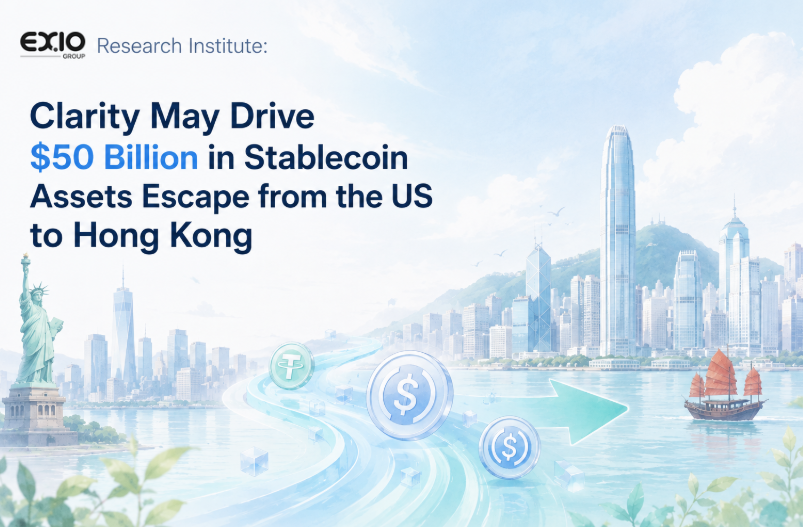
EXIO Research Institute In-Depth Analysis | CLARITY May Drive $50 Billion in Stablecoin Assets “Escape From the US to Hong Kong”
I. Introduction: Bill Passage Marks the Beginning of Capital Migration
On May 14, 2026, the U.S. Senate Banking Committee passed the CLARITY Act with a 15-9 vote, signaling a new “legislation-driven” era for U.S. digital asset regulation. However, the strict restrictions on stablecoin yields (Yield) in Section 404 of the bill are triggering a global reallocation of capital. EXIO Research Institute analysis indicates this will echo the historical precedent of the 20th-century “Regulation Q” that birthed the offshore dollar market. Based on the new rules’ limitations on stablecoins and ongoing uncertainties in U.S. legislation, we estimate that within the next 24 months, $30 billion to $50 billion in stablecoin capital will flow to regulatory-friendly financial hubs such as Hong Kong in search of compliant yields, creating major opportunities for local investors and licensed platforms.

II. Historical Logic: Stablecoins’ “Regulation Q Moment”
The core of Section 404 of the CLARITY Act is the prohibition on stablecoin issuers paying “passive interest” to holders. This policy closely mirrors the 1933 U.S. “Regulation Q,” which capped deposit interest rates. Historical experience shows that when regulation restricts asset yields, capital does not disappear—it simply shifts jurisdictions and legal forms.
- Historical Parallel: In the 1960s, Regulation Q drove U.S. companies to move dollars to London, expanding the Eurodollar market from $3 billion to $200 billion by 1980.
- Crypto Acceleration: Stablecoins offer far greater liquidity than bank deposits of that era. EXIO Research Institute predicts this round of capital adjustment will complete in 18-36 months, far faster than the 47 years it took previously.
III. Scale and Pathways: How $50 Billion Will “Leave the US for Hong Kong”
The global stablecoin market currently stands at approximately $220 billion, generating an annual yield pool of $9 billion to $11 billion. After the CLARITY Act takes effect, this yield pool will be forced to restructure. According to EXIO Research Institute’s quantitative estimates, U.S.-related stablecoin funds may flow to offshore markets via the following four main pathways in the near term, with Hong Kong as the primary destination:
- Jurisdictional Arbitrage ($15B–$25B)
Capital shifts to jurisdictions with established licensed systems that do not prohibit stablecoin yields. In Hong Kong, for example, funds can move into compliant licensed trading platforms and purchase tokenized wealth management products for sustained appreciation. - Institutionalized Tokenized Funds ($20B–$30B)
U.S. accredited investors will redirect stablecoin capital into large securities-type tokenized funds to bypass Section 404’s definition of “stablecoins” while continuing to earn yields. - Structured Activity Rewards ($10B–$15B)
U.S. crypto trading platforms will repackage yields as “activity rewards” based on trading volume, utilizing exemptions in the bill. - DeFi Grey Market ($5B–$10B)
Some decentralized protocols will serve as technical safe havens for users—albeit with higher security risks.
In summary, Pathways 1 and 2 represent the largest compliant flows and align strongly with Hong Kong’s regulatory advantages.
IV. Hong Kong’s Advantages: From “Regulatory Certainty” to “Yield Oasis”
Compared with the U.S. bill’s “yield ban,” Hong Kong’s regulatory framework demonstrates strong competitiveness:
- Policy Framework Leads, Major Players Already In
Hong Kong has implemented the Stablecoin Ordinance and, in April 2026, granted stablecoin testing or operating licenses to traditional financial giants such as Standard Chartered-backed Anchorpoint Financial and HSBC, significantly boosting institutional capital confidence. - 12–18 Month Strategic Window
The U.S. bill is still in the legislative process with uncertainties, while Hong Kong’s framework is already substantively in place. This creates a golden window for Hong Kong’s compliant licensed platforms to attract global capital inflows. - Mature Product Ecosystem
Major compliant platforms in Hong Kong have listed a wide range of tokenized products and support mainstream fiat currency integration. Among them, EX.IO offers the largest number and variety of compliant tokenized products, with underlying assets covering stocks, funds, bonds, gold, and other diverse categories for qualified professional investors.
V. Competitive Landscape: Who Will Win?
As capital concentrates on regulated platforms with institutional-grade security standards, the market will see a clear “survival of the fittest”:
- Compliant Licensed Platforms (e.g., EX.IO): Section 404 allows compliant intermediaries to distribute wealth management yields. Funds will flow from grey-market platforms to regulated custody and trading institutions.
- Payment Network Giants: Their business relies on transaction fees rather than reserve yields, maintaining strength under the new rules.
- Tokenized Asset Issuers: With retail stablecoin yields restricted, institutional demand for mainstream tokenized products will surge significantly.
VI. Conclusion: Shift in Global Digital Asset Gravity
While the CLARITY Act brings legal certainty to the U.S. market, its overly stringent yield restrictions are pushing the stablecoin market toward a “two-tier structure”—pure payment tools within the U.S., while yield-generation and wealth management functions concentrate in offshore centers.
For Hong Kong, this is not only a policy lead but also an opportunity to convert “regulatory certainty” into “market depth.” Hong Kong should upgrade from a “licensing center” to a “business implementation center,” leveraging the potential $50 billion capital inflow to solidify its position as a global international digital asset hub.
About EXIO Group
EXIO Group is a leading global digital asset financial technology group dedicated to building innovative infrastructure that connects traditional finance with the digital economy. The Group implements a multi-dimensional compliance strategy and strictly adheres to local regulatory frameworks across major global financial centers. Our core platform integrates seamless fiat-to-digital asset conversion, institutional-grade asset custody, Real World Asset (RWA) tokenization, and cutting-edge PayFi (Payment Finance Integration) solutions. Through strategic partnerships with top-tier international banks and a world-class team of traditional finance elites and blockchain technology experts, EXIO continues to lead industry innovation and provides global institutional clients with secure, compliant, and forward-looking digital asset financial services.
Disclaimer:
This material is provided for general information and research reference purposes only. It does not constitute any investment, financial, legal, or tax advice, nor any solicitation, offer, or recommendation. The content may include third-party data or views that do not represent the official position of any institution or individual. Virtual asset and related product prices can be highly volatile. Investors should make independent judgments based on their own financial situation, investment objectives, and risk tolerance, conduct their own research (DYOR), and consult independent professional advisors before making any investment decisions. Neither party shall be liable for any losses arising from the use of or reliance on this material, except to the extent that applicable law prohibits or restricts such exclusion or limitation.