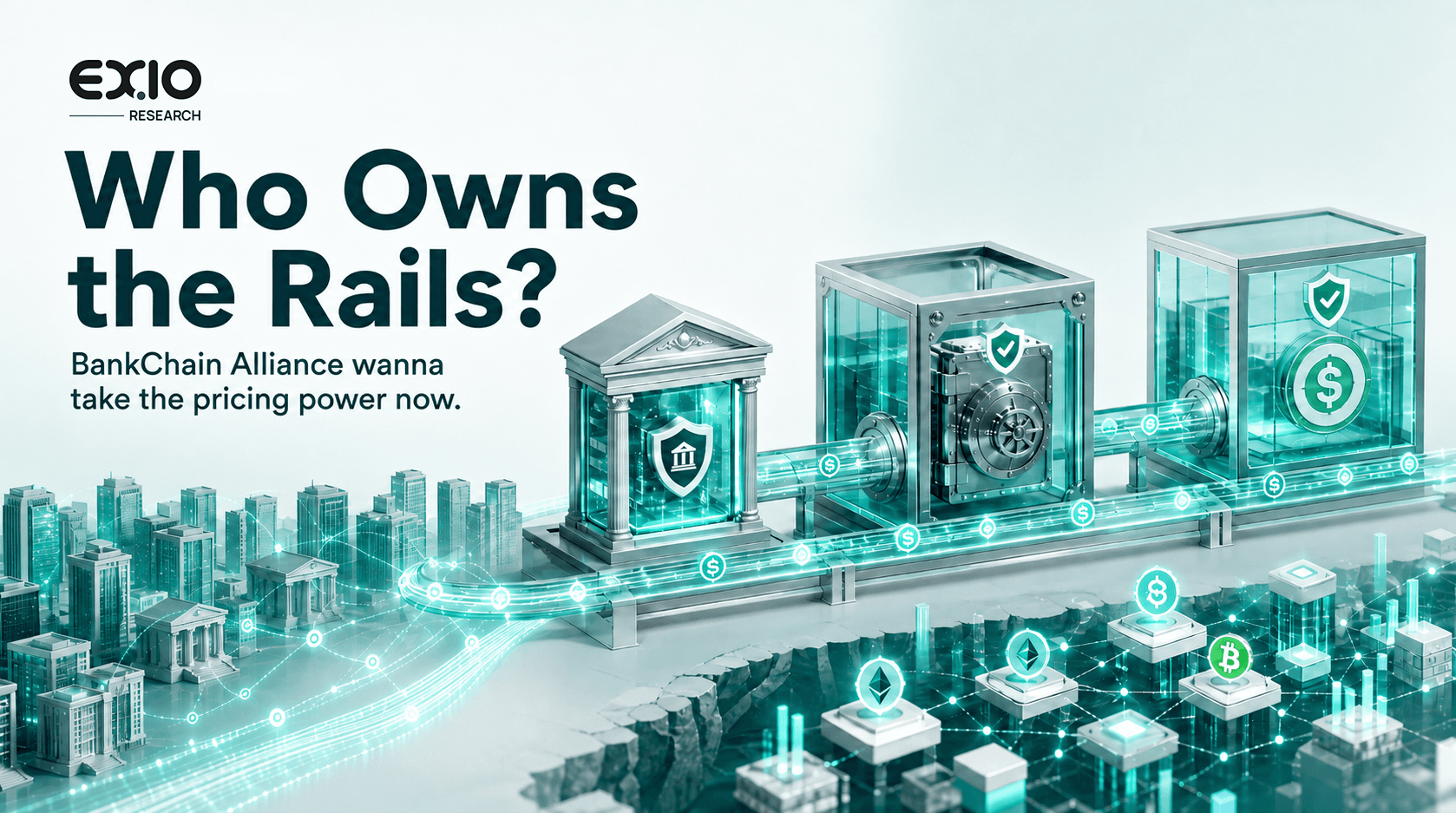
The Fight for Control of the Rails Enters the Second Half: Banks vs. Crypto — Who Gets the Last Laugh?
EX.IO Research · 26 August 2026
Three months ago we published a piece titled When Banks Choose Consortium Chains: Why Crypto’s Long-Awaited Mainstream Arrival Feels Awkward. The thesis then was this: when JPMorgan, Bank of America and Citi push a tokenized deposit network through The Clearing House, banks are conceding the efficiency of blockchain — while keeping control inside the banking system. Crypto waited for mainstream to show up. What arrived was a bank-owned, permissioned, supervisable version of the chain.
Three months on, that judgment has not aged. It has accelerated.
On 25–26 August 2026, four developments landed almost on the same day:
- Thirty-nine U.S. state bankers’ associations jointly formed the BankChain Alliance, planning to launch in 2027 a nationwide blockchain network owned and governed by the banking industry — for stablecoins, payments and tokenized deposits.
- Market maker Citadel Securities endorsed LayerZero’s trading infrastructure, while U.S. securities clearing hub DTCC and NYSE parent ICE moved in parallel to explore institutional-grade applications.
- Crypto custodian ZeroHash filed a second OCC trust-bank application after an earlier rejection. Meanwhile Copper’s custody business — once valued at $2.5 billion — is being shopped with an asking price of about $500 million, and bids are coming in well below that.
- USD1, issued by licensed trust bank BitGo Bank & Trust (under the World Liberty banner), went live natively on the Canton Network.
Read together, the signal is unambiguous: the main battlefield in tokenization has shifted from who lists the asset first to who controls the rails — the settlement layer, the custody layer, and the license layer.
This is not another “banks are coming” headline. It is a handover of pricing power.
The June Thesis, and What Changed by August
A reminder of the core argument in our June analysis:
Banks did not choose consortium chains because they failed to understand DeFi. They chose them because they understood they cannot operate like DeFi. Banks need determinate answers to questions DeFi leaves open: who may join, who can see the data, who owns KYC/AML, and who is liable when something breaks.
The appeal of a consortium chain is precisely what crypto often dismisses as “not open enough, not decentralized enough, not crypto enough.”
That logic has not changed. The level of the participants has.
In June the protagonists were a handful of G-SIB banks — JPMorgan, BofA, Citi — advancing through The Clearing House, a payments utility they jointly own.
In August the protagonist is the banking industry’s lobbying apparatus: 39 state bankers’ associations, speaking for thousands of community banks. BankChain Alliance is not a pilot among a few large banks. It is the industry, as an industry, trying to institutionalize control of the chain in its own hands.
The distinction matters:
- A large-bank pilot can remain a strategic option for a few players;
- A chain built by state bankers’ associations rewrites the default option for the entire banking system. Community banks no longer have to decide, one by one, whether to go on-chain. Their associations walk them into a bank-owned network.
From “large-bank pilot” to “industry infrastructure”: that is the first upgrade in the fight for the rails.
Clearing Houses and Market Makers Enter: The Second Layer of the Rails Fight
If BankChain Alliance is the banks’ self-built rail, then LayerZero × Citadel Securities, DTCC and ICE are the market-infrastructure version of the same move.
What each of the three represents:
- DTCC: the rail layer of U.S. securities settlement, processing securities transactions measured in the hundreds of trillions of dollars. Reports that it is exploring institutional on-chain applications mean the clearing step for tokenized securities is being pre-empted by the incumbent clearing house.
- ICE: parent of the New York Stock Exchange, and the traditional force that combines exchange and clearing in one stack.
- Citadel Securities: one of the world’s largest market makers. Its endorsement of LayerZero’s trading infrastructure means market-making — the function that determines liquidity — is also migrating toward institution-held rails.
Stacked together, the implication is this: from listing the underlying through settlement, clearing and market-making, the entire value chain of tokenized securities is being claimed, link by link, by traditional-finance hubs.
Crypto used to treat the act of “going on-chain” as the source of value in tokenization. It is now clearer that the parts that actually command a premium — settlement finality, clearing efficiency, market-making liquidity, and the regulatory interface — are precisely the parts traditional finance already holds.
Is Custody Being Repriced?
This is the harshest of the four stories.
ZeroHash, after a rejection, is knocking on the OCC’s door a second time for a trust-bank charter. Why try again? Because custody is being repriced — away from “who has the better tech and the stronger on-chain stack,” and toward “who holds the license and can offer bank-grade custody.”
Copper is the cautionary case. According to CoinDesk, the crypto custodian was once valued at $2.5 billion. Cantor Fitzgerald is now marketing the business at an asking price of about $500 million — and buyers are bidding well below that. The same custody franchise has lost more than 80% of its valuation. Why? Because custody’s moat is no longer a technology moat. It is a license moat.
Bank-grade custody means a regulatory backstop, a clear liability entity, a complete audit trail, and someone who can be held to account when things go wrong. Those are exactly the attributes crypto-native custodians find hardest to assemble. They have the technology; they do not have the bank charter. Banks have the charter, and they are closing the technology gap.
ZeroHash’s second OCC filing is the crypto-native players saying the quiet part out loud: at this table, the license is worth more than the tech.
Stablecoin Issuance Is Converging on Licensed Trust Banks
The fourth item is USD1 going live natively on Canton.
What matters is not “another stablecoin on another chain.” It is who issues it.
Per Cointelegraph, USD1 — a roughly $4.05 billion market cap, the sixth-largest stablecoin — is issued by BitGo Bank & Trust. The licensed trust bank manages USD1 reserves and handles mint and redeem. World Liberty Financial, the Trump-family-linked crypto venture, is the brand and operator.
That structure is another footnote to the license moat: even a politically connected crypto project chose to place the core financial functions — issuance, reserves, minting and redemption — with a licensed trust bank.
Then look at the network. Canton is described by its operator as a public blockchain built for institutional finance. Its real selling point is privacy and permissioning — so USD1 can settle atomically in the same transaction as tokenized assets, while preserving the access and visibility boundaries institutions require.
In other words, USD1’s cash leg sits on a network whose first design principle is institutional control.
That confirms a line we buried in the June piece: the crux of RWA is not whether an asset can go on-chain. It is how the cash leg and the trust structure close the loop.
When stablecoin issuance converges on licensed trust banks, and when the cash leg lands on an institutionally permissioned network, “the banking of stablecoins” is no longer an industry slogan. It is a fact that can be checked, transaction by transaction.
This Is Not “Banks vs. Crypto.” It Is Who Defines the Rails
Putting the four items together, EX.IO Research’s judgment is:
The decisive move in tokenization has shifted from who lists the asset first to who controls the rails — settlement, custody, and licenses. Those three layers are being claimed, systematically, by traditional-finance banks, clearing houses, market makers and the licensing regime.
That does not mean crypto has lost.
More precisely, the division of labor is hardening:
- Open public chains continue to carry open finance, DeFi, global stablecoin liquidity and developer innovation;
- Bank consortium chains and institutional networks carry bank deposits, corporate treasury, institutional settlement and privacy-sensitive flow;
- Tokenized funds carry yield-bearing cash management;
- Regulated custody carries licensed, accountable safekeeping of assets.
What is being rewritten is the right to define the rails.
Three months ago we said banks were writing a different script. Three months later the script is on the page — and the cast has expanded to the entire banking industry, the clearing houses and the market makers.
For market participants, the question is no longer whether an asset goes on-chain. It is which chain it goes on, who controls that chain, and whose license stands behind it.
From the analysis above, three core judgments follow:
- The fight for the rails has entered the industry-infrastructure phase. The upgrade from large-bank pilots to a chain built by 39 state bankers’ associations means the banking system is turning “own the rails” into the default option.
- Custody is being revalued through licensing. ZeroHash’s second OCC filing and Copper’s valuation collapse show that custody’s moat is migrating from technology to license.
- Stablecoin issuance is converging on licensed trust banks. USD1 issued by BitGo Bank & Trust confirms that the cash leg plus a closed trust structure is the real key to tokenized finance — and the key to that loop is the license standing behind it.
Rails are often the whole game. We have long argued that Web2 + Web3 can still open a better path — including putting more assets on-chain. But as banks accelerate the build-out of their own consortium networks, Web3 is at risk of losing the critical rails. What comes next, and how crypto plays to its remaining advantages, may depend on whether the industry can produce the next real narrative — and the next real success case — that the market will actually follow.
Sources
Based on public media reporting. Project timelines, commercial terms and implementation status are subject to change.
CoinDesk — U.S. state banking associations plan to launch their own nationwide blockchain network (BankChain Alliance). Link
BankNews — Dozens of state associations unite to create common blockchain network. Link
CoinDesk — LayerZero unveils trading infrastructure for crypto and tokenized markets, with Citadel Securities backing. Link
CoinDesk — Zerohash back for second effort at OCC trust bank charter. Link
CoinDesk — Crypto custody firm Copper has potential buyers, but offers are way below its $500M asking price (original: “Once valued at $2.5 billion”). Link
Cointelegraph — World Liberty Financial launches USD1 natively on Canton Network (issued by BitGo Bank & Trust; Canton described as a public blockchain designed for institutional finance). Link
Disclaimer
This content is provided for general market information and educational reference only. It does not constitute investment advice, legal opinion, compliance advice, trading advice, solicitation or a recommendation. Digital-asset prices are volatile. Past data is not indicative of future performance. Readers should not rely solely on this content to make trading, product, licensing or other commercial decisions. For legal, compliance, tax or investment judgments, consult a qualified professional adviser.
This article does not assess the price performance of ETH, BTC or any digital asset, and does not constitute a recommendation to buy, sell or hold any digital asset.
This article does not represent that EX.IO will launch, apply for, offer or support any particular tokenized deposit, RWA, custody, payments, securities or banking-related product or service. Discussion of third-party institutional plans does not constitute an endorsement of those products, their security, compliance status or future implementation.
This content is based on public sources and may contain errors, omissions or time lags. Statements about future plans, expectations or trends are forward-looking and subject to uncertainty; actual outcomes may differ materially. This content is not an advertisement, solicitation or offer in respect of any regulated activity, including securities, collective investment schemes or virtual-asset-related services.