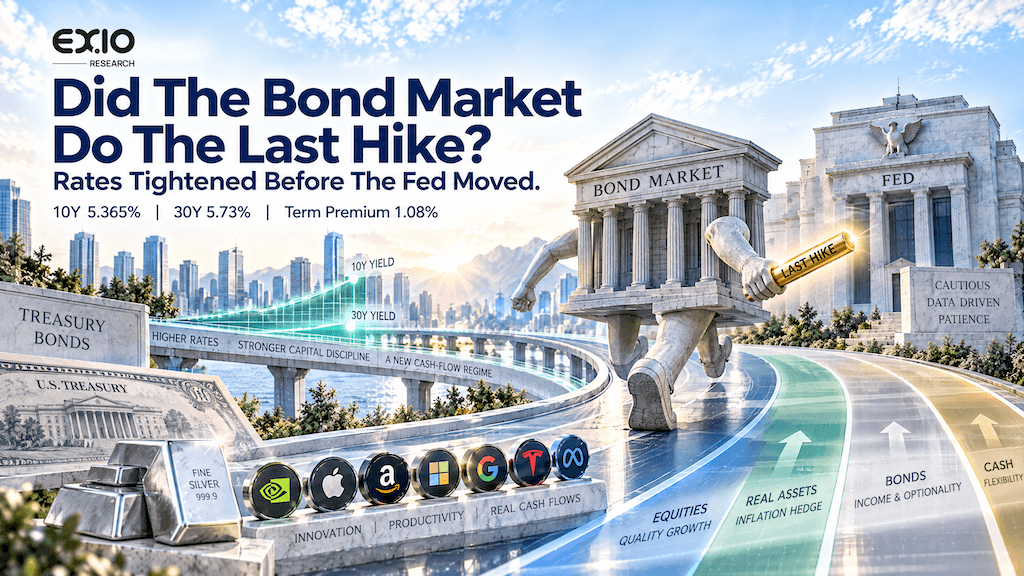
Has the Bond Market Done the Fed’s Last Hike of the Year? Mapping Major Assets in the New Regime
EX.IO Research | 14 October 2026
The 10-year Treasury yield has spent three weeks above 5% — unable to push higher, unwilling to fall. A whisper is spreading through the market: is this the signal that the Fed is about to stop?
Most people’s first reaction is disbelief. The Fed only just raised rates by 25 basis points on 16 September, taking the policy rate to 3.75%–4.00%. Chair Warsh’s Jackson Hole remarks still ring in the air, and core PCE remains stuck at 3.7%.
This hardly looks like a Fed about to stop.
But our view is that this seemingly naive market intuition may be closer to the truth than most serious analysis. The causality has simply been told backwards. It is not that “yields have peaked, so the Fed will stop.” It is that the bond market has already finished the tightening for the Fed — and that is why the Fed may not need to hike again this year.
As for what this means for major assets in the new regime, the conclusion first: short-dated Treasuries and cash-like assets keep collecting a reliable 4% or so, while long bonds have “a floor but no ceiling.” US equities have AI-supported earnings but a 5% discount rate pressing on valuations, leaving little room for index-level trends and widening single-stock dispersion. Gold and Bitcoin stay under real-rate pressure in the short run, though the “credit repricing” logic that supports their floors is intact. And stablecoins and tokenized Treasuries backed by short-dated paper are among the few structural winners of a high-rate world. We unpack each layer below.
To understand all this, we first need to revisit what the bond market has actually done over the past two months.
Behind the surge in yields
On 27 August — the day before Warsh took the podium at Jackson Hole — the 10-year yield was still at 4.67%. Three weeks later, on 15 September, the eve of the FOMC meeting, it had reached 5.00%. In other words, by the time the Fed raised its hand to hike on 16 September, the long end had already run the full course for it. That 12–0 unanimous hike was less a central-bank decision than a ratification of what the market had already priced.
This “market moves first” drama had in fact played out once before in August. On 19 August, the Treasury announced it would at least double buybacks of 10- to 30-year bonds to take pressure off the long end. Yields behaved for a few sessions, then turned back up, recovering all lost ground within eight trading days and setting a new high. J.P. Morgan poured cold water at the time: with the fiscal deficit still around 6% of GDP, such opportunistic debt management treats the symptom, not the cause, and may even push the term premium higher. Two months on, that warning has come true — the New York Fed’s Kim–Wright model puts the 10-year term premium at 1.08%, a percentile not seen in five years.
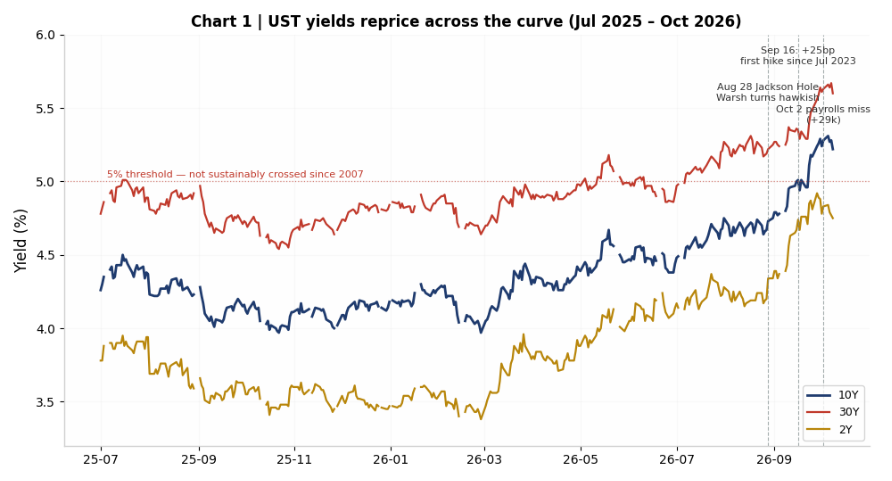
Chart 1 | UST yields reprice across the curve (Jul 2025 – Oct 2026). Source: FRED, EX.IO Research
By 7 October, the 10-year had touched 5.365% intraday and the 30-year 5.73%, both the highest since 2002. And this is not America’s story alone: the UK 30-year gilt broke above 6%, the France–Germany spread widened to its most extreme since 2012, and the Bloomberg Global Aggregate Treasury index yield reached its highest since 2000.
This is a systemic repricing of the global discount rate — and US Treasuries are the epicentre.
What a sustainable 5% really means
To judge whether “stabilising at a high level” is a signal that hikes are over, one cannot look at the level alone — the 10-year yield has to be taken apart. A nominal yield has roughly three layers: expectations for the future policy path, inflation compensation, and the term premium — the extra return investors demand for holding duration.
FRED data offer a remarkably clean decomposition. From the start of the year to 8 October, the 10-year nominal yield rose from 4.19% to 5.22% — up 103bp. The 10-year TIPS real yield rose from 1.94% to 2.87%, contributing 93bp; the term premium rose from 0.58% to 1.08%, contributing another 50bp; while the breakeven inflation rate, the measure of inflation expectations, merely drifted from 2.25% to 2.35%, anchored near the 2% target as it has been for a decade.
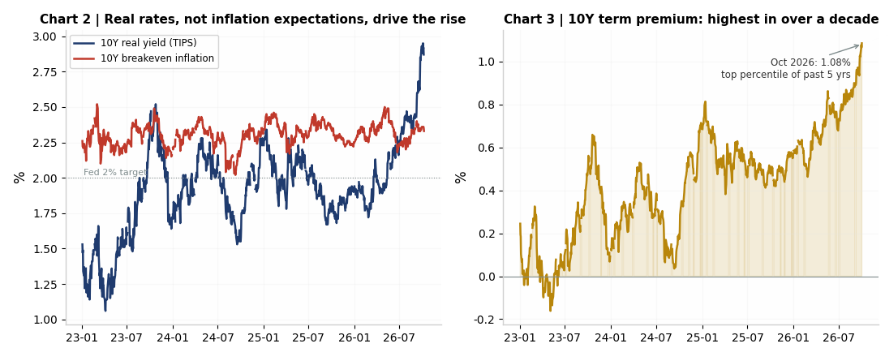
Charts 2 & 3 | Decomposing the yield rise and the term premium. Source: FRED, New York Fed Kim–Wright model, EX.IO Research
This structure says something crucial: the market is not pricing “inflation is about to run away.” It is pricing two other things — a structural rise in the neutral real rate, and the fact that holding US long bonds has itself become more expensive. The former comes from economic resilience, as the AI capex boom lifts returns on capital and financing demand; the latter comes from the fiscal side — a $1.9 trillion annual deficit, a total debt stock past $40 trillion, and $1.17 trillion of interest paid in the first ten months of this fiscal year.
And that is precisely the foundation of the “no more hikes needed” call. Consider the Fed’s position: financial conditions have already been tightened by the bond market — a 5% risk-free rate and a near-2.9% real yield form the most restrictive combination for the economy since 2008 — while inflation expectations have not moved at all, meaning the central bank’s credibility is intact. It no longer needs to prove itself with one more hike.
What the market has done for the central bank, the central bank may no longer need to redo with its own policy tools — doing so would only backfire.
The déjà vu of 2023
The bond market deciding for the central bank is not without precedent. The most recent episode was just three years ago.
In April 2023, the 10-year yield was still at a low of 3.25%; by October, it had broken through 5%. Then-Dallas Fed President Lorie Logan, a noted hawk, said something that sounded abrupt at the time: the rise in long-term yields “may mean less need for further rate increases.” Timiraos — the so-called “new Fed wire service” — later estimated that the tightening effect of that long-end surge was equivalent to three 25bp hikes. The rest is history: the Fed never hiked again after July 2023, and the cycle peaked right there. The bond market had, quite literally, “done the last hike” for the central bank.
Going further back: in the 1994 bond massacre, after Greenspan’s surprise hike, the 10-year went from 5% to 8% within a year, and the term “bond vigilantes” entered the mainstream vocabulary. In 2013, Bernanke’s single remark about “considering tapering” sent yields up a full percentage point within weeks, forcing the Fed to delay the taper by half a year.
The pattern has always been consistent: when the long end tightens itself at this speed and this magnitude, the central bank’s optimal choice is usually to stop and observe — not to add another blow on the market’s back.
Today’s situation mirrors October 2023 with startling precision: the same 5% 10-year, the same rise led by real rates and term premium, the same anchored inflation expectations. If anything is different, it is that this time the “bond market doing the work” is even more thorough — the 1.08% term premium is higher than it was in October 2023.
The jobs data provided an off-ramp
Of course, a mechanism alone is not enough — a dignified off-ramp is also needed. On 2 October, the off-ramp arrived.
September nonfarm payrolls added only 29,000 jobs, less than a third of the consensus of 84,000–90,000, and the unemployment rate rose to 4.2%. After the release, futures pricing for a hike at the 28 October meeting collapsed from around 70% to below 20%. More telling was the reaction of the institutions: Huatai, RBC and TD all pushed their forecasts for a “second hike” from October to December — a delay, but with visibly softened language. Goldman Sachs put it bluntly: a hike in October is essentially off the table, and “the probability is high that the FOMC ultimately concludes no further hikes are needed.”
The labour market’s “low hiring, low firing” state hands the Fed a two-sided narrative: with employment cooling and financial conditions already tightened to restrictive levels by the bond market, “wait and see” is no longer weakness but prudence. When Warsh said at Jackson Hole that financial conditions were “hard to describe as restrictive,” that was the old ledger of late August; the 10-year has since risen more than fifty basis points above where it was when he spoke — the market has corrected that sentence itself.
At this point, the statement must be made complete. “May not hike again” is not “will not hike again.” The risk list ahead is not short: Brent crude is still above $100; if the September CPI released on 14 October surprises to the upside, the 28 October meeting immediately turns back into a real debate; nine officials on the dot plot still expect at least one more hike this year, and market pricing for a December hike still hovers around 60%. Bank of America is even forecasting three hikes in 2026.
In particular, if the inflation data diverge meaningfully from market expectations, the judgment made in this note may have to be substantially rewritten.
But even so, the balance of probabilities has tilted. The bond market has delivered the equivalent of several hikes’ worth of tightening with a 5% long end; the jobs data have handed over the reason to pause; anchored inflation expectations have removed the burden of “proving resolve.” With those three pieces in place, staying on hold this year has moved from a dovish fantasy to the base case.
This is an entirely different matter from “the Fed has failed on inflation.” Precisely because the market believes it will fight inflation, it can afford not to hike.
A new logic for asset pricing
If this judgment holds, the logic of asset markets has to change with it.
The most intuitive layer is opportunity cost. With a 5% risk-free rate and real yields near 2.9%, the hurdle for holding any non-yielding asset is back at a level a generation of investors has never seen. Bitcoin has retraced nearly 50% at its deepest from its October 2025 all-time high of $125,689 and now struggles in the $82,000–86,000 range; gold has fallen from $4,657 to $4,194 under hike expectations. Yet in late September, yields and Bitcoin rose together for more than a week — rates are a headwind, not an on-off switch. What really determines direction is the nature of the rise: a repricing driven by growth and real rates is one that risk assets can digest; a disorder driven by debt panic is the systemic trouble.
A deeper layer: “a pause in hikes” and “a peak in rates” are two different propositions. A 1.08% term premium means that even if the Fed leaves the policy rate untouched for the rest of the year, the long end may not fall meaningfully — as long as fiscal supply pressure persists, the floor under long rates stays padded. J.P. Morgan has already raised its end-2026 target for the 10-year to 4.85%. For digital assets, this means the discount-rate pressure is chronic; but “the most hawkish moment has passed” is itself often the precondition for high-beta assets to bottom.
Structural winners are also emerging: stablecoin issuers whose reserves sit in short-dated Treasuries are enjoying the interest dividend of high rates — Circle, for example, earns roughly 95% of its revenue from reserve interest.
As for how to verify all this, three dates suffice: the September CPI on 14 October, which decides whether the 28 October meeting is a formality or a real debate; the October payrolls in early November, which test whether 29,000 was seasonal distortion or trend weakening; and the 9 December FOMC with its new dot plot, which will tell us whether the central bank signs the script the market has already written.
Back to the market intuition at the start. Bond traders watching a yield that refuses to rise above 5% vaguely sense that the hiking story is over. That feeling is right — but the reason lies not in “the peak,” but in “the work done on the Fed’s behalf.”
The bond market has laid the foundation of tightening; what the Fed needs to do this year may simply be to stand on top of it — and add nothing.
Translated into positioning, the potential paths of major assets in the new regime can be summarised as follows. Cash and short-dated bonds are no longer “trash” but assets with a genuine return above 4%, and the willingness to park money will be stronger than at any time in the past fifteen years. Capital-gain trades in long bonds await signals from fiscal supply or recession, not from the central bank’s tone. Equities must earn their returns from earnings rather than multiple expansion, and the gap between companies with real cash flow in the AI capex chain and companies selling stories will keep widening. Every rate-panic squat in gold and Bitcoin looks more like a posture adjustment within the credit-repricing logic than the end of a trend. For the first time, the question of ranking assets has changed from “which rises fastest” to “whose cash flow is real” — and that is the true question the bond market leaves to the final two months of 2026 by “doing the Fed’s last hike for it.”
Sources
Figures and views in this note are drawn from the St. Louis Fed’s FRED database, the New York Fed’s Kim–Wright term premium model, the US Treasury, CME FedWatch, and public research by J.P. Morgan, Goldman Sachs, Bank of America, Barclays, Huatai, RBC and TD Securities, as well as public reporting by Caixin, Wallstreetcn, 21st Century Business Herald, JRJ, CLS, Odaily and MarsBit, as of 12 October 2026, and should be read against their original publications.
Further reading
Research: https://www.ex.io/insights
EX.IO platform: https://www.ex.io/zh-HK
Products: https://www.ex.io/rwa-market
Important notice
This note is prepared by EX.IO Research from public information and is forward-looking analysis under hypothetical scenarios. It is for general information only and does not constitute investment advice, an offer, or a solicitation. Virtual assets and tokenized products involve high risk; prices may rise or fall, and investors may lose their entire principal. Related products are offered only to qualified professional investors. Please read the product documents and risk disclosures, and consult a licensed professional, before investing.