Gold Tokens in 2026: Why Bring Gold On-Chain? — Mapping the Global Ecosystem and the Logic of “One Gram of Gold”
For five thousand years, gold has been the “ultimate store of value”—dependent not on the creditworthiness of any government, bank or company, but on physical scarcity and millennia of shared belief. Yet an uncomfortable fact remains: the asset with the strongest consensus has some of the oldest financial infrastructure.
Fiat money went digital long ago: electronic payments, SWIFT and mobile payments allow US dollars to settle worldwide in a second. Gold, meanwhile, remains stuck in the twentieth century: limited trading hours, T+2 settlement, a price tag in the tens of thousands for a single ounce, and cross-border movement involving vaults, armoured vehicles, customs clearance and insurance.
Gold tokens aim to give “humanity’s hardest asset” a digital settlement layer—transforming it from a physical object that must be moved from place to place into a programmable asset that can be traded 24/7, used as collateral for borrowing, transferred instantly across borders and, subject to the applicable conditions, redeemed for real gold bars.
This is not “just another gold ETF”. An ETF provides securitised exposure to the gold price; a gold token represents on-chain ownership backed 1:1 by physical gold. This article uses an ecosystem map to explain how it works, a comparison table to examine the global players, and an entire section to address the fundamental question: why issue gold tokens, and what do they actually solve?
1. The Complete Gold Token Ecosystem at a Glance
A gold token is not simply “a coin”. It is a complete set of rails connecting gold mines to investors’ wallets. The ecosystem consists of seven layers, alongside two cross-cutting tracks: compliance and gold verification.
① Upstream physical gold → ② Custody vaults → ③ Issuer (backing/minting) → ④ Token (1 token = a fixed weight in grams/ounces)
→ ⑤ Blockchain network (settlement) → ⑥ Distribution and uses (trading/lending/payments) → ⑦ Investors/holders
Cross-cutting tracks: regulatory oversight—NYDFS/SFC/HKMA/MAS—and independent gold verification/audits/redemption rights.
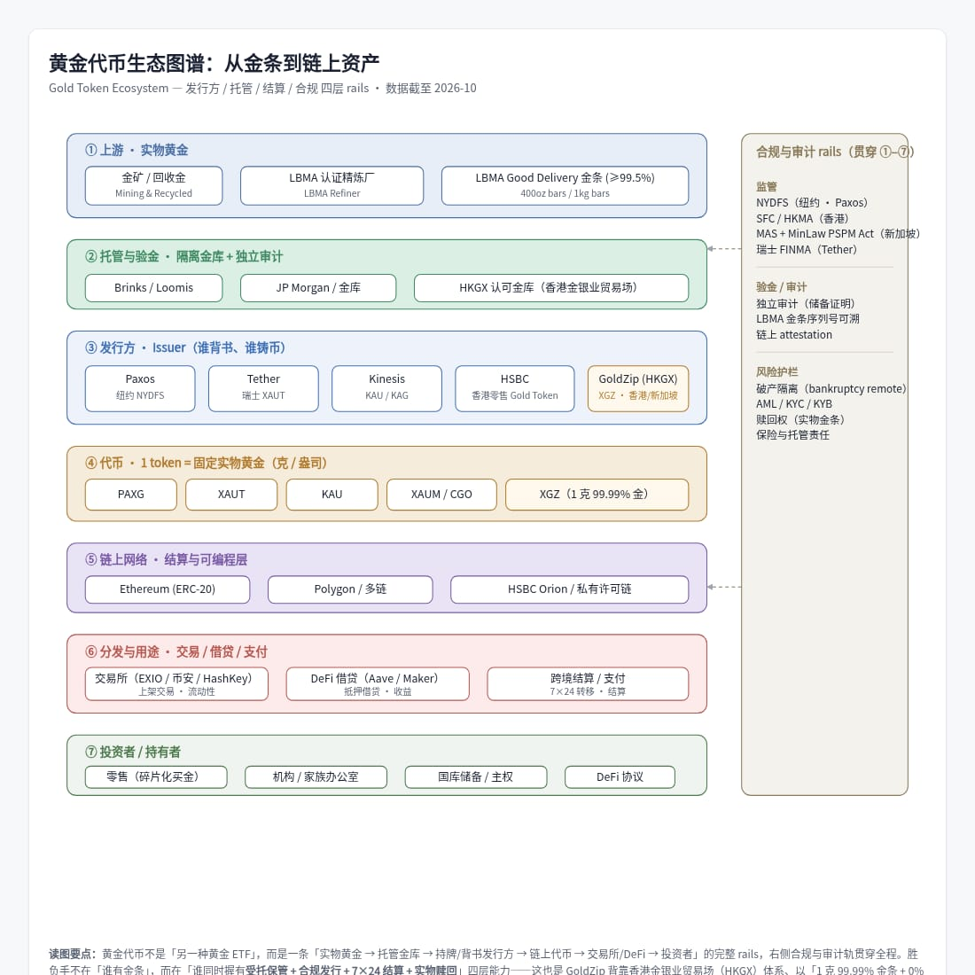
How to read the map: The decisive advantage is not “who holds the gold bars”, but “who can combine fiduciary custody, compliant issuance, 24/7 settlement and physical redemption”. Below, GoldZip (XGZ), issued by a member company of the Hong Kong Gold Exchange (HKGX) group, serves as an example of the “gram-denominated + Asian + exchange-affiliated” model, alongside established ounce-denominated players.
2. The Global Gold Token Landscape: A Comparative Overview
As of October 2026, the combined circulating market capitalisation of gold tokens worldwide stood at approximately US$5.4 billion. Two established ounce-denominated players dominate the market: Tether Gold (XAUT) is approximately 1.8 times the size of Paxos (PAXG), making it the largest gold token at present. However, gram-denominated products and Asian bank- and exchange-affiliated offerings are gaining ground rapidly.
The table below presents a sample of the top six by market capitalisation and new Asian entrants; it is not exhaustive.
| Token | Issuer | Backing unit | Custody | Blockchain | Approx. market cap | Fees | Physical redemption | Regulatory/compliance description |
| XAUT | Tether | 1 token = 1 ounce | Swiss vaults | Multichain | US$3.23bn | — | Available; high threshold | No dedicated token-level regulatory licensing framework |
| PAXG | Paxos | 1 token = 1 ounce | Brink’s and others | Ethereum | US$1.77bn | Low | Available; professional-access requirements | Issuer subject to NYDFS trust supervision in New York |
| KAU | Kinesis | 1 KAU = 1 gram | Vaults across multiple countries | Kinesis blockchain | US$350m | Yield fee | Available | Vault audits across multiple jurisdictions |
| XAUM | Matrixdock | 1 token = 1 ounce | Singapore | Ethereum | US$68m | Low | Available | Singapore entity |
| HSBC Gold Token | HSBC | Physical gold bars | HSBC | HSBC Orion | US$2.5bn in cumulative turnover* | — | Available for retail purchase | HSBC, a licensed bank in Hong Kong |
| CGO | Comtech Gold | 1 CGO = 1 gram | Dubai vaults | Multichain | US$3.06m | — | Available | Dubai |
| XGZ (GoldZip) | GoldZip, an HKGX group member | 1 XGZ = 1 gram of 99.99% pure gold | Brink’s + HKGX-approved vaults | Ethereum | US$5.07m† | 0% | 1,000 XGZ = one 1 kg gold bar | Classified by a third party as “Non-Regulated”; not a legal determination |
* The HSBC Gold Token figure represents retail trading turnover: approximately 390,000 transactions and US$2.5 billion cumulatively through the end of August 2026. This differs from the circulating market capitalisation figures used for the other tokens and is included solely for market-positioning reference.
† XGZ’s market capitalisation varies slightly by source: RWA.xyz reports US$5.07 million, while CoinGecko reports US$5.01 million. The table uses the RWA.xyz figure.
Three Structural Observations
- Western players dominate ounce-denominated tokens, but entry barriers remain high. Each unit of PAXG/XAUT represents one ounce, worth approximately US$3,990. This is less accessible to retail investors, while physical redemption entails professional-access requirements or large minimum quantities. These products resemble “institutional tools” more than “gold for the mass market”.
- Gram-denominated tokens present an opportunity for Asia. KAU, CGO and XGZ each reduce the unit to one gram, worth approximately US$128, moving gold tokens from “institutional tools” towards “smaller-denomination holdings”. This aligns with retail gold-buying traditions across Hong Kong, China, India and Southeast Asia.
- Banks and exchange-affiliated players are entering the market. HSBC Gold Token represents “a bank balance sheet + retail distribution”, while GoldZip represents “an exchange ecosystem + custody + zero fees”. Both are moving gold tokens beyond “a niche crypto asset” towards “mainstream financial infrastructure”.
3. The Central Question: Why Issue Gold Tokens, and What Do They Solve?
The Starting Point: Gold Is Financial History’s Largest “Undigitised Asset”
Gold is the store of value backed by humanity’s strongest five-thousand-year consensus, without relying on any issuer’s creditworthiness. Yet its financial infrastructure has fallen behind:
- The fiat layer: Long since digitised through electronic payments, SWIFT and mobile payments, with US dollars settling worldwide in a second.
- The gold layer: Still rooted in the twentieth century. London’s LBMA OTC market, New York’s COMEX, the Shanghai Gold Exchange and Hong Kong’s HKGX operate separately, with defined trading hours and T+2 settlement. Cross-border movement requires vaults, armoured vehicles, customs clearance and insurance.
Gold has the “asset”, but lacks the “settlement layer”. That is the fundamental rationale for gold tokens: giving humanity’s hardest asset a digital settlement layer.
Why It Needs to Happen: Gold’s Three Structural Bottlenecks
Bottleneck 1 | Too Expensive and Out of Reach: Accessibility
An ounce of gold costs approximately US$3,990, while a one-kilogram bar costs around US$128,000. Physical gold presents high entry barriers for retail buyers; paper gold introduces counterparty risk; and ETFs are constrained by geography and time zones. Gold is among the major asset classes that are hardest to get into investors’ hands.
→ Tokenisation reduces the unit to one gram—approximately US$128—or even smaller, enables 24/7 trading and supports cross-border on-chain transfers. It turns gold from “an asset in a privileged few’s safes” into “a digital asset accessible to many”.
However, primary-market eligibility and redemption thresholds vary significantly across tokens, with some subscriptions restricted to institutions or members. Retail investors typically buy through secondary markets.
Bottleneck 2 | Locked Away and Earning Nothing: Programmability
Physical gold sitting in a safe is a “dormant asset”: it generates no cash flow, cannot be pledged as collateral and cannot enter modern financial protocols. Global above-ground gold stocks total approximately 210,000 tonnes, according to the World Gold Council, with the vast majority simply “sleeping” in vaults.
→ Tokenisation allows gold to serve as collateral for borrowing stablecoins or fiat, participate in DeFi yield protocols and be used programmatically by smart contracts—turning “gold locked away” into “gold that can generate yield”.
Bottleneck 3 | Difficult to Verify and Dependent on Assurances: Verifiability
The authenticity, purity and ownership of physical gold depend on successive layers of assurance from vaults, assayers and insurers. This is costly and difficult to audit, while counterfeit bars and repeated pledging of the same gold have appeared throughout history.
→ Tokenisation makes reserves and bar serial numbers verifiable on-chain. Combined with independent audits, it shifts the model from “trust the institution” to “verify on-chain”—an improvement in trust that paper gold and unaudited products cannot deliver.
The Underlying Thread: Gold’s Monetary History and Three Shifts in Settlement
To understand gold tokens, it helps to revisit an underlying thread in monetary history: gold was never abandoned by the times; it was repeatedly abandoned by the settlement layer.
Gold retreated from its monetary role three times, each time as “faster circulation” overtook a “heavier asset”:
- The classical gold standard → the gold-exchange standard, in the late nineteenth century: Gold moved from “coins in direct circulation” to “reserves in vaults”, as banknotes replaced gold coins. In this first shift, settlement moved from “physical metal” to “paper claims”.
- Bretton Woods, 1944 → the Nixon shock, 1971: The US dollar was pegged to gold at US$35 per ounce, while other currencies were pegged to the dollar. In 1971, Nixon closed the gold window, fully severing fiat money’s link to gold. In this second shift, settlement moved from “gold exchange” to “purely credit-based fiat money”, while gold was demoted from “money” to “a commodity/reserve asset”.
- The digital era, 1971 to the present: Electronic payments, SWIFT, stablecoins and central bank digital currencies emerged in succession. The settlement layer became digital, but gold remained outside it because its need for physical custody and trusted assurances made it inherently ill-suited to “account-based/code-based” settlement.
The key insight: The settlement layer has undergone three shifts—from “trusting physical assets” to “trusting institutions”, and then to “trusting code”. Gold is the only asset on this evolutionary path that has failed to keep pace: it commands the strongest consensus, yet settles the slowest.
Gold tokens are, fundamentally, an exercise in catching up with these shifts. By combining on-chain tokens, independent custody and verifiable reserves, they move gold directly from “second-generation account-based settlement” to “third-generation code-based settlement”—finally allowing it to keep pace with settlement infrastructure rather than continue to be left behind.
Gold tokens are therefore not something entirely new, but a return in monetary history that is fifty years overdue. In 1971, the settlement layer abandoned gold. Fifty years later, tokenisation is bringing gold back. Stablecoins digitise “credit-based money”; gold tokens digitise “non-credit-based money”. The former is “the digitisation of money”; the latter is “a return in monetary history”.
A Deeper Question: Why Gold Is the “Ultimate Underlying Asset” for RWAs
In bringing real-world assets on-chain, fiat money, sovereign debt, equities and bonds all depend on the issuer’s credit standing: the US dollar on the Federal Reserve, sovereign debt on governments, and equities on companies. Gold alone requires no such backing. It is an asset with “built-in consensus”.
Gold tokens therefore represent the purest, hardest component of bringing assets on-chain. If even gold can settle on-chain, asset tokenisation has reached its hardest boundary. Stablecoins have already demonstrated that “fiat on-chain” works. Gold tokens aim to demonstrate that “commodities on-chain” work.
Why Now?
Three converging signals are moving this from concept to execution:
- Regulation is taking shape. Hong Kong’s HKMA stablecoin ordinance and the SFC’s virtual asset trading platform regime have been implemented in succession. The Chinese Gold and Silver Exchange Society was also corporatised into the Hong Kong Gold Exchange (HKGX) in January 2025, creating a compliant pathway for gold tokens.
- Institutions are entering the market. HSBC has launched a retail gold token, with approximately US$2.5 billion in cumulative turnover, while the HKGX ecosystem has introduced GoldZip. Banks and exchanges are moving gold tokens from “a niche crypto asset” towards “mainstream financial infrastructure”.
- Gold is in a bull market. With gold prices approaching US$4,000, macroeconomic uncertainty and safe-haven demand are driving a sharp increase in demand for “gold that can be held, settled and pledged as collateral”.
In one sentence: gold tokens are not about “issuing another form of gold”, but about “giving a five-thousand-year-old hard asset a programmable digital foundation for settlement”. They address gold’s greatest weakness in the digital era: the absence of a settlement layer.
4. Gold Tokens vs Gold ETFs vs Physical Gold Bars: They Are Not the Same
| Dimension | Physical gold bars | Gold ETFs | Gold tokens |
| Ownership | Direct ownership of physical gold | Fund shares; indirect exposure | Traceable, 1:1 on-chain ownership |
| Trading hours | Gold-market hours | Exchange hours | 24/7 |
| Settlement | Physical delivery | T+2 | Instant |
| Fractionalisation | Difficult; whole bars/ounces | Available through fund shares | Available at one-gram denominations |
| Physical redemption | — | Generally unavailable or subject to large minimums | Generally available, subject to thresholds |
| Programmability/collateral use | ❌ | ❌ | ✅ DeFi collateralised borrowing |
| Fees | Storage + insurance + spread | Management fees; GLD approximately 0.40% | 0% for GoldZip / low |
| Counterparty risk | Custodian | Fund/custodian | Issuer + custodian; gold verification required |
The key distinction: an ETF is “securitisation”—you purchase a security that tracks the gold price. A gold token is “tokenisation”—you hold redeemable ownership of physical gold. The former suits “investing in the gold price”; the latter suits “holding gold + using gold”.
Note that the issuance structures of certain gold tokens may cause them to be classified as securities. This requires case-by-case assessment; GoldZip is addressed separately in Section 5.
5. GoldZip (XGZ): A Case Study
Within the “gram-denominated + Asian + exchange-affiliated” segment, GoldZip (XGZ) offers the following example:
- One gram of 99.99% pure physical gold + 0% management fees: The unit is reduced to one gram, with a 0% management fee and a 0.10% redemption fee.
- The HKGX ecosystem + approved vault custody: GoldZip is issued by a member company of the Hong Kong Gold Exchange (HKGX) group. In January 2025, HKGX took over the spot gold and silver trading business of the Chinese Gold and Silver Exchange Society (CGSE), founded in 1910 with a history spanning more than a century. It is Hong Kong’s only spot gold and silver exchange. Its approved vaults and approved gold-bar standards support XGZ’s physical asset layer, with Brink’s serving as custodian.
- A physical redemption channel: Holders of at least 1,000 XGZ, equivalent to a one-kilogram gold bar, may redeem physical gold after completing KYC/AML procedures.
Two Points Requiring Clear Disclosure
- Regulatory status: Third-party data platform RWA.xyz classifies XGZ as “Non-Regulated”. This is a data label, not a legal opinion. Whether XGZ constitutes “securities” or a “collective investment scheme” under Hong Kong’s Securities and Futures Ordinance must be assessed case by case by qualified legal advisers under Hong Kong law. This article makes no determination.
XGZ is issued by GoldZip Company Limited, incorporated in the British Virgin Islands. The precious metals trading business of its Singapore affiliate is subject to the dealer registration regime under Singapore’s Precious Stones and Precious Metals (Prevention of Money Laundering and Terrorism Financing) Act. This registration concerns anti-money laundering compliance. It does not constitute regulatory approval of token issuance, token value or investment, nor does it confer the status of a licensed financial institution. This article makes no assessment of XGZ’s solvency or legal classification.
- Access and redemption thresholds: Primary-market subscriptions are available only to HKGX members that are institutions, non-US institutional investors and US qualified institutional buyers (QIBs), with a minimum subscription of approximately US$1,000. Physical redemption requires 1,000 XGZ, equivalent to approximately US$128,000 at current gold prices, with slight differences across data sources. Whether retail investors may purchase XGZ on secondary markets depends on each trading platform’s compliance arrangements, including the investor categories it serves, and is outside this article’s scope.
These structures suggest that “gram-denominated digital gold” is progressing, but the stage at which “anyone can mint tokens or redeem physical gold” has not yet arrived. For now, the model more closely resembles a tiered structure of “institutions depositing gold and minting tokens + eligible investors holding them”.
6. EX.IO Research Views
The following represents an assessment of industry trends, not trading signals or investment advice, and does not constitute a recommendation of any particular token.
View 1: Gold Tokens Are Not Just Another Crypto Narrative, but an Inevitable Digital-Era Upgrade for a Five-Thousand-Year-Old Asset
Gold does not lack consensus; it lacks a settlement layer. Fiat money completed its digitisation in a decade, while gold’s digitisation has only just begun. The nature of the question has changed: it is no longer “can this be done?”, but “who will make it work first?”
As regulators, banks and exchanges enter the picture together, bringing gold on-chain has moved from a concept to a trend being put into practice.
View 2: Assess a Gold Token by Three Tests—Can It Settle, Can It Serve as Collateral, and Can It Be Redeemed?
“Settlement” means whether the token has entered mainstream trading and settlement networks. “Collateral” means whether it can secure borrowing in DeFi and institutional credit markets. “Redemption” means whether it is backed 1:1 by physical gold and can be exchanged for that gold at any time.
Only when all three conditions are met does it qualify as “digital gold”. Without any one of them, it is merely “an accounting unit carrying gold’s name”. These three tests are more important to a gold token’s ultimate outcome than “who issued it” or “how much has been issued”.
View 3: The Decisive Advantage Lies Not in Issuance, but in Four Infrastructure Layers—Custody, Compliance, Settlement and Redemption
The lesson mirrors that of stablecoins: issuance is not a scarce capability—anyone can issue a token. What is scarce is regulated custody, verifiable reserves, 24/7 settlement and frictionless redemption.
Issuers supported by bank balance sheets or exchange ecosystems are therefore inherently closer to the end state than crypto-native projects with “nothing more than a white paper”. Competition among gold tokens is fundamentally about “trust infrastructure”, not “issuing coins”.
Our assessment: From the perspective of monetary history, gold is the only asset with “built-in consensus and no need for credit backing”. Stablecoins have already demonstrated that “fiat on-chain” works. Gold tokens aim to demonstrate that “commodities on-chain” work—and, in doing so, complete a settlement-layer transition from which gold has been absent for fifty years.
Over the next five to ten years, the gold market will split into two worlds: gold that stays off-chain and gold that moves on-chain. The latter will capture the former’s liquidity premium.
This is not a prediction about the price movement of any particular token. It is a judgement about the direction of financial infrastructure. In 1971, the settlement layer abandoned gold; fifty years later, tokenisation is bringing it back. Whoever makes that return work will control the gateway to the hardest asset of the RWA era.
References
- RWA.xyz — GoldZip Gold (XGZ) asset profile: Custody, fees, redemption, AUM and issuance structure.
- Hong Kong Gold Exchange — GoldZip: Official HKGX page.
- GoldZip official website: One XGZ represents one gram of 99.99% pure gold; HKGX group membership.
- CoinGecko — GoldZip Gold (XGZ): Market data.
- HSBC press release, Notes to Editors: Approximately 390,000 HSBC Gold Token transactions and US$2.5 billion in cumulative turnover through the end of August 2026.
- World Gold Council — How much gold has been mined: Approximately 210,000 tonnes of global above-ground gold stocks.
Data sources: Market capitalisations for XAUT, PAXG, KAU, XAUM and CGO are drawn from a real-time CoinGecko API snapshot dated 25 October 2026. GoldZip issuance, custody, redemption and AUM data are sourced from RWA.xyz and the official HKGX page.
Disclaimer
This content is provided solely for general market information and educational purposes. It does not constitute investment advice, legal advice, compliance advice, trading advice, solicitation or a recommendation. Any products, institutions or regulatory developments mentioned are presented solely as factual descriptions and industry observations, and do not constitute an opinion or rating on the relevant securities, tokens or institutions.
This article contains forward-looking statements and industry assessments based on currently available information. Regulatory, market and technological conditions may change materially, and actual outcomes may differ significantly from those described. Such statements do not constitute predictions or guarantees of future results. Gold and digital asset prices can be highly volatile, and historical data is not indicative of future performance. Gold tokens involve issuer and custodian counterparty risk, risks associated with redemption terms, and liquidity risk. Readers should not make trading, product or business decisions solely on the basis of this content. Qualified professional advisers should be consulted on legal, compliance, tax or investment matters.
EX.IO is a licensed virtual asset trading platform regulated by the Securities and Futures Commission (SFC) and engages in virtual asset distribution and custody services. It has direct commercial interests in business activities related to the gold tokens and tokenised precious metals discussed in this article. Readers should be aware that the views expressed may be influenced by this position. This article does not constitute a recommendation or endorsement of GoldZip (XGZ) or any particular token. XGZ-related data is drawn from third parties, including RWA.xyz, HKGX and CoinGecko, and has not been independently verified.