CLARITY Act: Final Sprint in 2026! First Time in Crypto Legislation History — Morality Written into the Rules of the Game
EX.IO Research
The U.S. CLARITY Act, widely regarded as a global bellwether for crypto market regulation, had gone quiet since passing the House of Representatives. Recently, however, senior officials — including President Trump and Treasury Secretary Scott Bessent — have been speaking out actively to push the bill through the Senate quickly. Bessent went so far as to say that lawmakers have entered the “final sprint” on the Clarity bill, urging Congress to pass it before the recess.
The remarks sent the bill’s passage odds on Polymarket jumping from 32% to 43%, while BTC broke above $66,000. But one detail has been overlooked by every news flash: if passed, the CLARITY Act could become the first piece of legislation in crypto industry history to write ethics constraints on public officials into formal legal text. White House officials claim the Trump administration has agreed to “the most comprehensive and far-reaching ethics provisions in history” — yet no one has seen the draft. Democratic senators say that handing enforcement power to the executive branch itself would be “not serious.”
This article does not predict the vote outcome — we analyze the underlying logic of this legislation: how to assemble 60 votes, why the ethics provision is the final hurdle, and what would actually change for the industry if it passes.
And if it fails — what happens in 2027?
01 What’s the Score? The 60-Vote Math and the 3-Week Countdown
Let’s use one graphic to see clearly the challenges the Clarity Act currently faces:
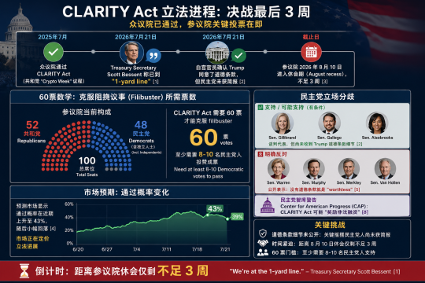
Figure: Key milestones of the CLARITY Act legislative process, Senate vote math and market-implied passage odds (original graphic, in Chinese)
(Note: Prediction market platforms are not licensed for gaming in multiple jurisdictions, including Hong Kong. The data above reflects only the expectations of some market participants and does not constitute an endorsement or promotion of such platforms.)
The key uncertainty: the text of the ethics provisions has not been made public. No text = no vote = no 60 votes.
02 The Ethics Provision: Web3 Asked for the First Time to Obey “Rules Beyond the Rules of the Game”
2.1 What exactly is the ethics provision?
According to reports by CoinDesk, Cointelegraph and The Hill [2][5][9], the ethics provisions contained in the CLARITY Act aim to:
• Prohibit senior government officials (including the President) from holding personal commercial interests in the crypto industry — a direct response to recent disclosures of senior officials’ crypto assets [10]
• The specific scope of restrictions is unknown (does it include memecoins? Affiliated family businesses? Crypto-related businesses of social media platforms?)
• The enforcement mechanism is unknown (which agency enforces it?)
2.2 Why does this provision matter so much?
Throughout crypto’s history, rulemaking has revolved around technical regulation: What is a security? What is a commodity? How do exchanges register? How should stablecoins be reserved?
The CLARITY Act’s ethics provision raises an entirely new question: can the people who make the rules also be players in the game?
Traditional finance has precedents (SEC officials are subject to strict holdings disclosure and recusal rules). But the crypto industry has never had similar constraints — from the ICO era to DeFi summer to the memecoin frenzy, conflicts of interest involving project teams, investors, and even regulators themselves have never been formally written into law.
The CLARITY Act changes that. It brings “ethics” — a concept the crypto industry has long regarded as external, unrelated to code and consensus — into the formal text of the rules of the game.
2.3 Who enforces it?
Senator Alsobrooks’ challenge cuts to the heart of the matter [2]: if enforcement of the ethics provision is handed to the DOJ, and the DOJ’s leadership is appointed and confirmed by the President, would “the executive branch enforcing ethics constraints on the executive branch” exist only on paper?
This is the core paradox facing the ethics provision: no matter how well the provisions are drafted, the independence of the enforcer is the real guarantee.
(Note: The discussion above is not directed at any specific public official, but analyzes a general question of institutional design.)
03 If It Passes: Real Changes for the Industry
The CLARITY Act is not “crypto legalization” — it is “crypto finally having laws to follow.” The difference:
3.1 For exchanges
• A clear registration path: divided authority between the SEC and the CFTC (digital commodities to the CFTC, digital securities to the SEC)
• Rising compliance costs: exchanges will need formal registration, KYC/AML upgrades, and capital adequacy requirements
• But certainty > cost: Coinbase shares jumped after Bessent’s remarks [6] — the market is pricing in “clear rules,” not “loose rules”
3.2 For DeFi
• The developer protection clause is another flashpoint [5]
• If retained: DeFi protocol developers would be shielded from securities-law liability (similar to the logic of Section 230)
• If removed: DeFi innovation could accelerate its exodus to non-U.S. jurisdictions
3.3 For token issuance
• Tokenized assets (RWA) would gain clear legal status
• Memecoins may face the greatest regulatory uncertainty — the ethics provision could directly restrict tokens affiliated with public officials
3.4 For stablecoins
• The CLARITY Act complements the GENIUS Act: the former governs market structure, the latter governs stablecoin issuance
• But one year after the GENIUS Act was signed, four federal agencies have issued zero final rules [7] — having laws to follow ≠ immediate enforcement
04 If It Fails: Two Paths
Path A: The SEC continues “regulation by enforcement”
A continuation of the Gensler-era path: case-by-case enforcement with no industry-wide rules — Coinbase, Kraken and Binance.US keep fighting jurisdictional wars in court. Advantage: no 60 votes needed. Disadvantage: no certainty, and innovation keeps flowing offshore.
Path B: Start over in 2027
Resubmission in the 116th Congress (2027-2028) — if the 2026 midterm elections change the Senate landscape, the political calculus will be entirely different. But: the crypto industry’s window of political capital may already have closed.
The key point: the window is real. This is not “if it doesn’t pass now, it never will” — but every delay accumulates costs.
05 EX.IO’s View: Rules Beyond the Rules Are the Real Paradigm Shift
The CLARITY Act’s most underrated legacy is not that “crypto finally has laws” — it is that, for the first time, it pulls the crypto industry into the ethical framework of traditional finance.
The crypto industry was born from the rubble of the 2008 financial crisis, and its core narrative has always been “trustlessness” — no need to trust any centralized entity, only code. The CLARITY Act’s ethics provision is a direct response to that narrative: you may choose not to trust intermediaries, but you must abide by the ethical rules set by society.
For Asian markets, this means three things:
1. Export of regulatory standards: if the U.S. passes crypto legislation that includes ethics provisions, Hong Kong, Singapore and Japan will face pressure to follow — or pressure to compete through differentiation.
2. An explosion in demand for compliance infrastructure: from KYC to conflict-of-interest disclosure, from transaction monitoring to ethics compliance training — an entirely new compliance services ecosystem will be catalyzed.
3. Hong Kong’s window: the U.S. legislative transition period may open a window for jurisdictions with clear regulatory frameworks. Hong Kong — which already has a VATP licensing regime and an HKMA stablecoin sandbox — is relatively mature within Asia and offers a clearer operating framework for compliant businesses. The U.S. transition period after the CLARITY Act passes may further highlight the appeal of jurisdictions with established regulatory frameworks, though the specific impact will depend on multiple variables.
Notes
1. Bloomberg, “Bitcoin Rallies After Bessent Says Clarity Act at ‘1-Yard Line’,” Jul 21, 2026. https://www.bloomberg.com/news/articles/2026-07-21/bitcoin-rallies-after-bessent-says-clarity-act-at-1-yard-line
2. CoinDesk, “White House pushes Senate Democrats to take ‘historic’ crypto Clarity Act ethics deal,” Jul 21, 2026. https://www.coindesk.com/policy/2026/07/21/white-house-pushes-senate-democrats-to-take-historic-crypto-clarity-act-ethics-deal
3. Bitcoin Foundation, “The Clarity Act August 10 Final Deadline,” Jul 2026. https://bitcoinfoundation.org/clarity-act-august-deadline
4. CoinDesk, “Clarity odds jump to 43% on Polymarket after unverified reports Trump agreed to ethics deal,” Jul 21, 2026. via Google News: https://news.google.com/search?q=Clarity+odds+43%25+Polymarket
5. Cointelegraph, “White House Agrees to Ethics Provisions in Market Structure Bill,” Jul 21, 2026. https://cointelegraph.com/news/white-house-ethics-provisions-crypto-market-structure-bill
6. Barron’s, “Coinbase Stock Is Rallying. Can Donald Trump’s Ethics Compromise Save the Clarity Act?”, Jul 21, 2026. via Google News: https://news.google.com/search?q=Barron%27s+Coinbase+Clarity+Act+ethics
7. CoinDesk, “The GENIUS Act Turns 1: State of Crypto,” Jul 19, 2026. https://www.coindesk.com/policy/2026/07/19/the-genius-act-turns-1-state-of-crypto
8. Forbes, “Crypto’s Bipartisan Clarity Push Faces A Final Obstacle Course,” Jul 21, 2026. via Google News: https://news.google.com/search?q=Forbes+Clarity+Act+obstacle+course
9. The Hill, “White House agrees to ethics provision in crypto bill,” Jul 21, 2026. via Google News: https://news.google.com/search?q=The+Hill+White+House+ethics+provision+crypto
10. Reuters, “Trump reports over $1.4 billion in income from crypto ventures,” Jul 2026. via Google News: https://news.google.com/search?q=Reuters+Trump+1.4+billion+crypto+income
11. PYMNTS, “Ethics Battle Freezes Clarity Act Ahead of Senate Recess,” Jul 21, 2026. via Google News: https://news.google.com/search?q=PYMNTS+CLARITY+Act+ethics+battle
12. Axios, “What’s behind the Clarity Act hold up,” Jul 2026. via Google News: https://news.google.com/search?q=Axios+Clarity+Act+hold+up
Disclaimer
EX.IO Group is a leading full-lifecycle digital asset solutions group, headquartered in Hong Kong and expanding globally. EX.IO Limited, a member of the group, is a leading licensed and compliant digital asset trading platform in Hong Kong. To comply with laws and regulations, the group and the platform currently do not provide services to residents of mainland China. This material is for reference only and does not constitute any solicitation, offer or recommendation of any product or service, nor does it constitute investment, tax or legal advice. The group and the platform make no express or implied representations or warranties as to the timeliness, accuracy or completeness of the information in this material.