Dual Mandate: How Hong Kong’s First Five-Year Plan and 2026 Policy Address Unlock the Next Phase of Digital Asset Regulation
— EX.IO Research on the latest Policy Address and Hong Kong’s inaugural five-year plan (2026–2030)
On 16 September 2026, the Chief Executive delivered a new Policy Address and, in parallel, published Hong Kong’s first five-year plan (2026–2030). Read together, the two documents send a clear signal: the city’s digital asset industry has completed Phase One — initial legislation and institution-building — and has formally entered Phase Two: application, scale and market development. Four threads will shape the next five years: regulated stablecoins trading on licensed platforms; a broad rollout of tokenised products; regular issuance of digital bonds; and 24/7 tokenisation infrastructure.
Two blueprints, one through-line: a policy snapshot
This is Hong Kong’s first five-year plan. At its core is “Finance+” — using financial services to support the real economy. The plan explicitly calls for the prudent advancement of a central bank digital currency (CBDC), stablecoins, tokenised deposits, tokenised bonds and tokenised securities, and for the Hong Kong Monetary Authority’s Ensemble project to push tokenisation from pilot to live use. The Policy Address then breaks those directions into a concrete to-do list:
| Area | Core measure | What it means |
| Licensing regime (para. 49) | Refine the virtual-asset licensing regime and issue detailed regulatory guidance | A clearer, more complete compliance path |
| Tokenised products (para. 49) | Promote the issuance and trading of tokenised gold and other real-world assets on licensed platforms | Compliant listing of tokenised products is now explicitly welcomed at policy level |
| Stablecoins (para. 49) | Facilitate trading of regulated stablecoins on licensed platforms and their use to settle tokenised money-market funds | Stablecoins move from “issuable” to “usable” |
| Digital infrastructure (para. 50) | Complete EnsembleTX arrangements for CBDC settlement and 24/7 operations by year-end | The always-on rails for a compliant on-chain financial market |
| Digital bonds (para. 35) | Issue digital bonds on a regular basis; pilot tokenisation of more than HK$1.3 trillion of Exchange Fund Bills by year-end | The government leads by putting the bond market on-chain |
| Digital trade (para. 99) | Work with the Mainland on tokenised-deposit trade finance; complete a pilot transaction by year-end | Cross-border use cases start to take shape |
One figure in the Policy Address deserves particular attention: digital bonds issued in Hong Kong from 2025 through the first half of 2026 accounted for roughly 50% of global issuance. In selected segments of digital assets, Hong Kong is no longer a follower. It is already a leader.
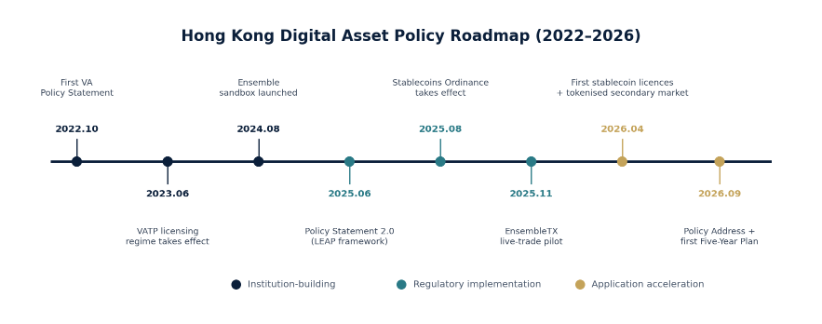
Figure 1. Hong Kong digital asset policy roadmap, 2022–2026
From a single licence to end-to-end supervision
The policy cadence of the past four years has been unusually clear: the 2022 policy statement set the direction; the VATP (virtual asset trading platform) licensing regime took effect in June 2023 and established the rules; the Stablecoins Ordinance came into force in 2025 and completed a critical missing piece. Licensed VATPs now number around 13, and a market structure is taking shape.
This Policy Address calls for “refining the virtual asset licensing regime and formulating detailed regulatory guidance,” with the practical focus on trading and custody. The Financial Services and the Treasury Bureau and the Securities and Futures Commission last year completed a consultation on a licensing regime for digital asset trading and custody service providers; a bill is targeted for introduction to the Legislative Council this year. The market expects the full chain — trading platforms, over-the-counter (OTC) dealing and custody — to be brought under a “same activity, same risk, same rules” framework.
For ordinary investors, the word “licensed” will carry more weight: buying, holding or exchanging digital assets OTC will sit under explicit standards and identifiable accountability. For the industry, the grey zone shrinks. Compliant operators will no longer have to compete with unlicensed players. That is the core logic of “regulation in service of development.”
Stablecoins in real use: from “issuable” to “usable”
Stablecoins are the most concrete — and most closely watched — piece of this policy cycle. Hong Kong’s Stablecoins Ordinance took effect in August 2025, the world’s first systematic regulatory framework dedicated to fiat-referenced stablecoins. On 10 April this year, the HKMA granted the first two licences from 36 applications: HSBC, and Anchorpoint Financial Limited, a joint venture of Standard Chartered Bank (Hong Kong), HKT and Animoca Brands. A 5.6% approval rate underlines the principle: quality over quantity.
Issuance licences, however, are only the first half of the story. The real novelty in paragraph 49 is the push to let regulated stablecoins trade on licensed platforms and be used to settle tokenised money-market funds. Until now, a licensed stablecoin has resembled a banknote printed with nowhere to spend it. The government now intends to open circulation channels — so it can be bought and sold on licensed venues and used to subscribe for and settle tokenised funds. Combined with EnsembleTX’s year-end target of CBDC settlement and 24/7 operations, Hong Kong is assembling a three-layer on-chain settlement stack: regulated stablecoins, tokenised deposits and the e-HKD. The upside is material.
Tokenisation / RWA: the new centre of gravity
If stablecoins are the water, tokenised products are the ships — rising water lifts every hull. Policy support for tokenisation in this cycle is unusually direct. The Policy Address explicitly promotes the issuance and trading of tokenised gold and other real-world assets on licensed platforms. The government itself will issue digital bonds on a regular basis and plans, by year-end, to pilot the tokenisation of more than HK$1.3 trillion of Exchange Fund Bills, so that banks can mobilise that collateral around the clock.
The market has not waited. As of March this year, 13 tokenised products had been offered to the public in Hong Kong, with assets under management in tokenised class shares of about HK$10.7 billion. From April, the SFC has also allowed secondary-market trading of tokenised authorised products on licensed VATPs. Globally, on-chain RWA has grown roughly fourfold in a year to USD 31.4 billion. Institutional forecasts for 2030 range from McKinsey’s USD 2–4 trillion to BCG’s USD 16 trillion. The exact number is less important than the direction: moving traditional assets on-chain is the next common destination of global finance. Hong Kong’s chosen method is “government first, infrastructure first.”
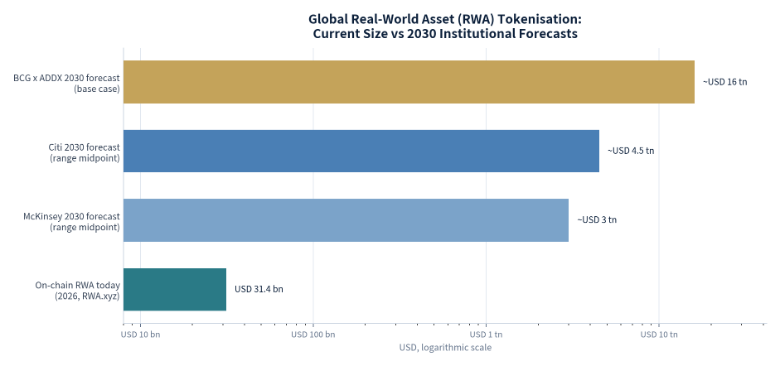
Figure 2. Global RWA tokenisation market size and 2030 institutional forecasts (log scale)
What the high-level plan really says: digital assets are now inside the financial blueprint
Where the Policy Address is an annual task list, the first five-year plan answers a different question: what does Hong Kong intend to become? Three passages sit close to digital assets. First, reinforce the city’s status as an international financial centre and deepen the linkage among equity, bond, asset-management and wealth-management markets. Second, consolidate Hong Kong as a leading cross-border wealth management hub serving global sovereign funds and family offices. Third, use gold as the entry point to a commodities trading ecosystem — including a gold trading and clearing system and coordinated warehouse infrastructure. Last year’s Policy Address had already proposed a Hong Kong gold central clearing system, gold storage exceeding 2,000 tonnes within three years, and explicit support for tokenised gold investment products.
Put together, the logic is straightforward. Digital assets in Hong Kong are no longer a standalone “new industry.” They are the technical thread connecting four pillars — equities, bonds, wealth management and commodities. Tokenisation speeds asset mobility; stablecoins and tokenised deposits keep settlement running around the clock. Together they serve the overarching “Finance+” objective of empowering the real economy.
A defined, visible and fast-growing chapter is now opening
For the industry, policy certainty is already converting into commercial opportunity. Take EX.IO, a licensed Hong Kong virtual asset trading platform and an affiliate of EX.IO Research. As Hong Kong’s first licensed platform with a brokerage heritage, principally backed by Sina’s Huasheng Group, EX.IO has, since receiving its licence in December 2024, obtained approvals for OTC dealing, distribution of tokenised and non-tokenised securities, and standalone custody. It has listed more than 30 tokenised products with underlying exposure across gold, silver, equities and bonds. Last month, tokenised-product sales rose 200% year on year and trading volume grew 800% — a direct illustration of a licensed platform turning the policy blueprint into live products.
Looking one to two years ahead, EX.IO Research sees the industry evolving along three lines. First, as regulated stablecoins land on licensed platforms, stablecoin trading pairs and tokenised-fund settlement will become a new growth engine. Second, gold and commodities tokenisation will be Hong Kong’s distinctive competitive track, aligned with the gold central clearing system and the commodities ecosystem. Third, regular digital-bond issuance and the tokenisation of Exchange Fund Bills will supply the market with a deep pool of high-quality on-chain collateral, while the Mainland trade-finance pilot opens a cross-border horizon.
In Hong Kong, policy has drawn the new map. What comes next is active engagement between industry and policymakers — so that the blueprint is implemented, scaled and put to work.
Disclaimer
This article is for general information only and does not constitute investment advice, an offer or a solicitation. Virtual asset prices are highly volatile and investors may lose their entire principal. Data cited are drawn from public policy documents and public media reports. EX.IO Research has sought, but does not warrant, their accuracy or completeness.
More research: https://www.ex.io/insights
About EX.IO: https://www.ex.io
RWA market: https://www.ex.io/rwa-market