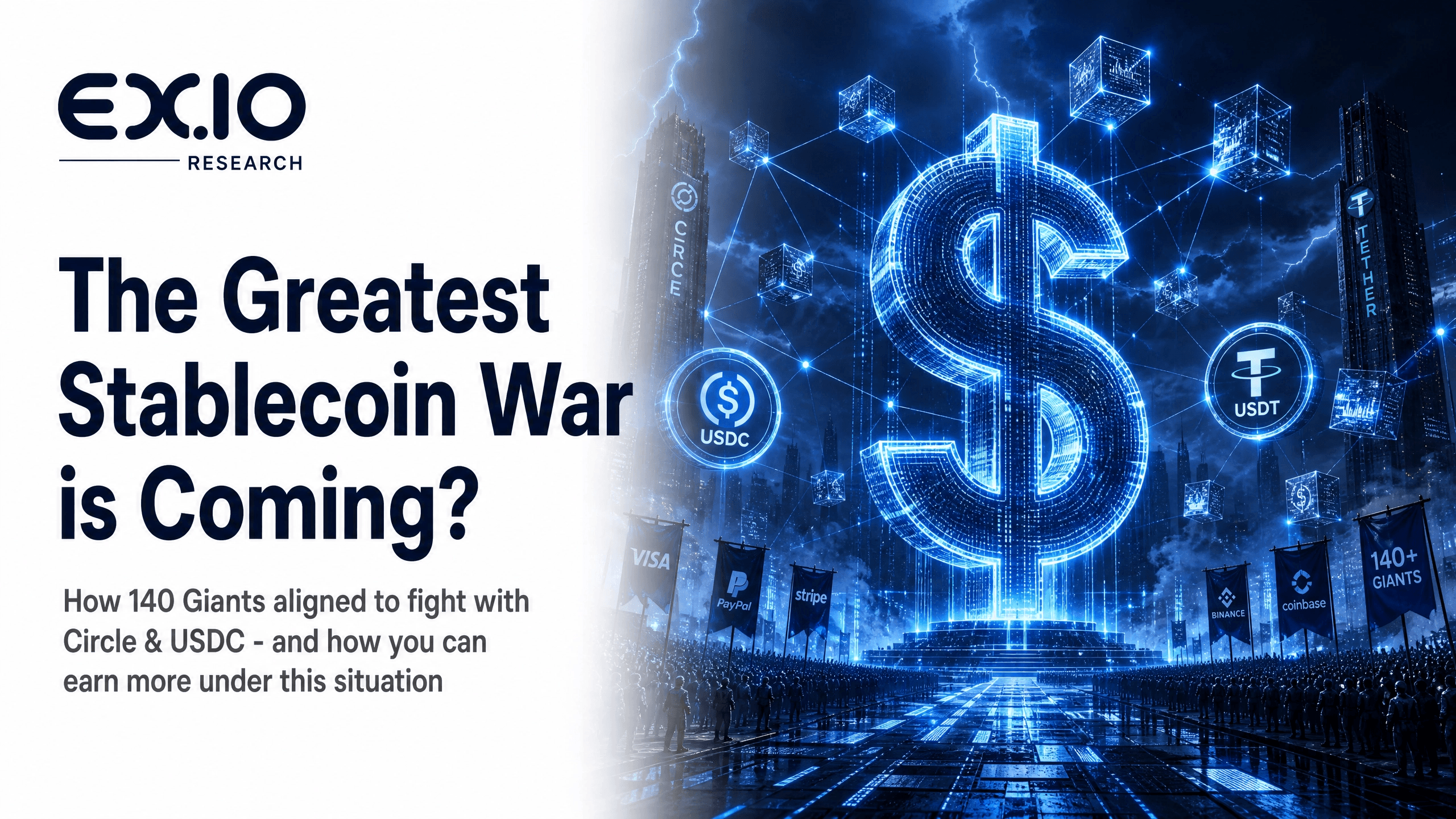
Circle’s stock price plunges 16% overnight: The Stablecoin landscape is changing, but will ordinary people gain digital dollar compound interest with a new strategy?
EX.IO Research | July 2, 2026
1. A hypothesis: If tomorrow your “digital dollar” suddenly changes ownership
Imagine this scenario:
You open your usual payment app and suddenly find an option next to your balance—”OUSD”. You click in and find it promises: zero fee transfers, instant arrivals, and …… Your balance can actually automatically generate interest.
Not the 0.5% mosquito meat, but close to the US Treasury yield (currently around 4-5%). And this isn’t a product from any bank, but from Visa, Mastercard, Stripe, BlackRock, Coinbase, Google, Shopify…… 140 companies you use every day have jointly launched it.
Will you switch between them?
This is the major event that will happen on June 30, 2026. However, this time, the main focus isn’t on a single payment app, but on the global stablecoin market—the “digital dollar underworld” that processes trillions of dollars daily but you may never have heard of.
2. Circle’s ‘darkest hour’: allies collectively betray, stock plunges 16% in a single day
Jeremy Allaire, CEO of Circle, may have had a sleepless night.
Just the day before, his company, Circle Internet Group (NYSE: CRCL), had just hit an all-time high of $77. As the issuer of USDC (the world’s second largest stablecoin with a market cap of about $60 billion), Circle acts as the “Federal Reserve” of the digital dollar world—for every USDC issued, there is a real $1 in assets backed by $1 billion, and Circle earns interest from these assets, generating annual income exceeding $1 billion.
But after the close on June 30, 2026, everything changed.
Coinbase—Circle’s largest USDC distribution channel, which took about $908 million in revenue from Circle in 2024—suddenly announced its joining a new organization called “Open Standard” and launched a competing stablecoin, Open USD (OUSD).
Even more ironically, Coinbase CEO Brian Armstrong publicly stated months ago that “USDC is the best stablecoin,” but then turned around and became a founding member of the competition.
And that’s not even the most ruthless part.
Visa、Mastercard、Stripe、BlackRock、American Express、Discover、BNY、DBS、Standard Chartered、BBVA、Google、Shopify、IBM、DoorDash、Ripple、Solana、MetaMask、Aave、Fireblocks……
More than 140 companies, including payment giants, banks, tech platforms, crypto-native companies, and asset management giants, collectively “defected.”
After the news broke, Circle’s stock price plunged more than 16% in a single day, plunging from $75.96 to $62.63, wiping out billions of dollars in market value. This is Circle’s largest single-day drop since its IPO in June 2025.
Allaire responded urgently on social media, proposing USDC’s “triple moat”—developer network effect, liquidity advantages, and deep policy compliance. But the market clearly believes more in the story of “140 giants joining forces.”
3. OUSD’s “Android Moments”: Why Is This Time Different?
This is not the first time someone has challenged USDC’s dominance.
In 2023, PayPal launched PYUSD. In 2024, Paxos launched USDG (with participation from Mastercard, Robinhood, and Kraken). But these were just “minor skirmishes”—attempts by a single company or dozens of firms that never truly challenged USDC’s position.
OUSD is different. Its design philosophy recalls the moment in 2008 when the Android Alliance faced off against Apple.
First, zero-fee minting and redemption. Traditional stablecoins often charge institutional users to mint and redeem them, whereas OUSD is completely free and has no cap on issuance. Large payment companies and banks can enter and exit at zero cost.
Second, shared benefits—this is a true revolution. Under the traditional model, Circle uses users’ deposited dollars to purchase U.S. Treasury bonds, and the interest earned is almost entirely owned by itself. Meanwhile, OUSD allocates all reserve earnings (after deducting a small management fee) to ecosystem partners.
Imagine this: Stripe used to only earn fees by promoting USDC, but now promoting OUSD also allows you to share in the underlying reserve revenue. For payment networks like Visa and Mastercard, this means potentially earning hundreds of millions more annually.
Third, alliance governance. OUSD is not controlled by a single company but operated by an independent entity, with a board composed of partners. This avoids the risk of concentration where “Circle dominates alone.”
But there is a huge historical shadow here—Libra (Diem).
In 2019, Facebook partnered with Visa, Mastercard, PayPal, and 28 other companies to launch Libra, with the same vision as “global digital payment infrastructure.” And what happened? Regulatory pressure, internal coordination issues, and partners gradually withdrawing, leading to a complete shutdown in 2022.
Will OUSD repeat the same mistakes?
Economist Christian Catalini (who participated in the Libra project) wrote in Forbes that OUSD “revived Libra’s vision of a unified open protocol.” But he also warned: “When all parties need to cooperate first and then compete fiercely, coordinated governance is not easy. “
Lorenzo Valente, Research Director at ARK Invest, raised three cold start questions:
1. Cold start liquidity: Without mature trading pairs, institutions cannot enter or exit on a large scale;
2. Governance frictions: 140 stakeholders, decision-making efficiency is questionable;
3. Insufficient resources: The low-fee model may not provide sufficient ecological incentive funds.
4. Impact on ordinary people: Your “digital dollar” is undergoing a silent revolution
You might think, the stablecoin war has nothing to do with you—I don’t trade cryptocurrencies.
But think about it:
If you work cross-border, your salary may be transferred via USDC or OUSD, as it’s 100 times faster and 100 times cheaper than traditional banks.
If you are involved in cross-border e-commerce, you might use USDC to receive payments, as it avoids 3-5% credit card fees and several days of settlement delays.
If you invest in global markets, you might trade 24/7 through stablecoins, since traditional stock markets are only open on weekdays.
If you live overseas, your family may send you money via stablecoins, as it’s 90% cheaper than traditional remittances.
Stablecoins are not ‘speculators’ toys’; they are quietly infiltrating the capillaries of global payments.
The launch of OUSD means this penetration is accelerating.
If OUSD succeeds, scenarios like this may occur in the future:
– When you receive payments on Stripe, settlement is automatically made in OUSD, and the balance automatically generates 4-5% annualized returns;
– When you make purchases with your Visa card, OUSD will be automatically converted to local currency in the backend with zero handling fees;
– When you invest in BlackRock’s fund, the underlying asset may be OUSD instead of traditional USD.
Your ‘digital dollar’ experience may undergo a qualitative transformation within the next 12 months.
5. Compliance: The true core of the new era of crypto narratives
In this battle among the giants, there is a key variable that many people overlook: compliance.
Among the members of the OUSD alliance, licensed financial institutions such as DBS (DBS Bank) and OCBC (OCBC Bank) are prominently included. This indicates that when traditional financial giants choose partners, compliance and qualifications are the first hurdle.
Looking back at the development trajectory of the crypto industry, from the ICO frenzy in 2017, to the FTX collapse in 2022, and then ETF approvals and institutional entrances in 2024-2025, a clear thread emerges: without compliance, there is no scale; Without compliance, there is no trust; Without compliance, there is no future.
Circle’s ability to build a moat on USDC is largely due to its global compliance layout—it is the only large-scale global stablecoin that covers both the European (MiCA-compliant) and Japanese markets simultaneously. Circle continues to invest in the global banking system, reserve management, and nearly 24/7 liquidity infrastructure—all of which are the “trust premiums” brought by compliance.
The launch of OUSD precisely proves the value of compliant infrastructure—140 giants are willing to join an alliance rather than issuing stablecoins individually, precisely because they need a trustworthy, compliant, and auditable underlying infrastructure.
This is precisely the core shift in the new era crypto narrative: from “decentralized idealism” to “compliant institutional adoption.”
In this narrative, licensed operations, transparent reserves, regulatory communication, and investor protection are no longer burdens but core competencies.
6. Conclusion: The era of compliance pioneers has arrived
The end of the stablecoin war may not be a single stablecoin company “dominating the world,” but rather the standardization and openness of the entire industry’s infrastructure.
But regardless of the outcome, one trend is irreversible: compliance is becoming the “new moat” for the crypto industry.
For investors and institutions, the key question is no longer “choose USDC or OUSD,” but how to find a compliant, secure, and transparent entry point in a world where multiple stablecoins coexist and regulations are increasingly strict.
For industry participants, this means:
– Licensing qualifications are no longer “optional” but “admission tickets”;
– Transparent reserves and audits are no longer “bonus points” but “bottom-line requirements”;
– Regulatory communication is no longer a “cost center,” but a “strategic investment.”
In this new era, the advantages of compliance pioneers are amplifying. As global payment giants begin to compete for a say in stablecoin infrastructure, jurisdictions with clear regulatory frameworks and mature institutional networks will become key nodes in the next decade.
Change is happening, whether you’re ready or not.
References:
– Fortune: “Stripe, Visa and over 140 other businesses to launch stablecoin to rival Tether and Circle” (2026-06-30)
– Investing.com: Circle Internet (CRCL) stock price data (2026-06-30)
– MarketBeat: Circle Internet Group (CRCL) Stock Price Analysis (2026-07-01)
– Crypto Briefing: “Circle CEO responds to OUSD announcement as stablecoin competition heats up” (2026-07-01)
– TechTimes: “Open USD Stablecoin Targets Circle’s Reserve Yield With 140-Partner Coalition” (2026-06-30)
– CoinEx: “Circle CEO Responds to OUSD Competition Concerns” (2026-07-01)
– The Block: “Circle shares sink 16% after Open USD reveal, analysts say fears are ‘overblown'” (2026-06-30)
– TradingKey: “Stablecoin Market Shakes Up” (2026-07-01)
– Tokenization Insight: “140 global businesses sign up to use new stablecoin OUSD” (2026-06-30)
Disclaimer:
This material is for general informational and research reference purposes only and does not constitute any investment, financial, legal, or tax advice, nor does it constitute any solicitation, offer, or recommendation. The material may contain third-party information or viewpoints, and does not represent the official position of any organization or individual. Prices of virtual assets and related products may be highly volatile. Investors should make independent judgments based on their own financial situation, investment objectives, and risk tolerance, and conduct their own research (DYOR) and consult independent professional advisors before making any investment decisions. The parties involved shall not be liable for any losses arising from the use or reliance on this material, except where applicable law cannot exclude or limit them.