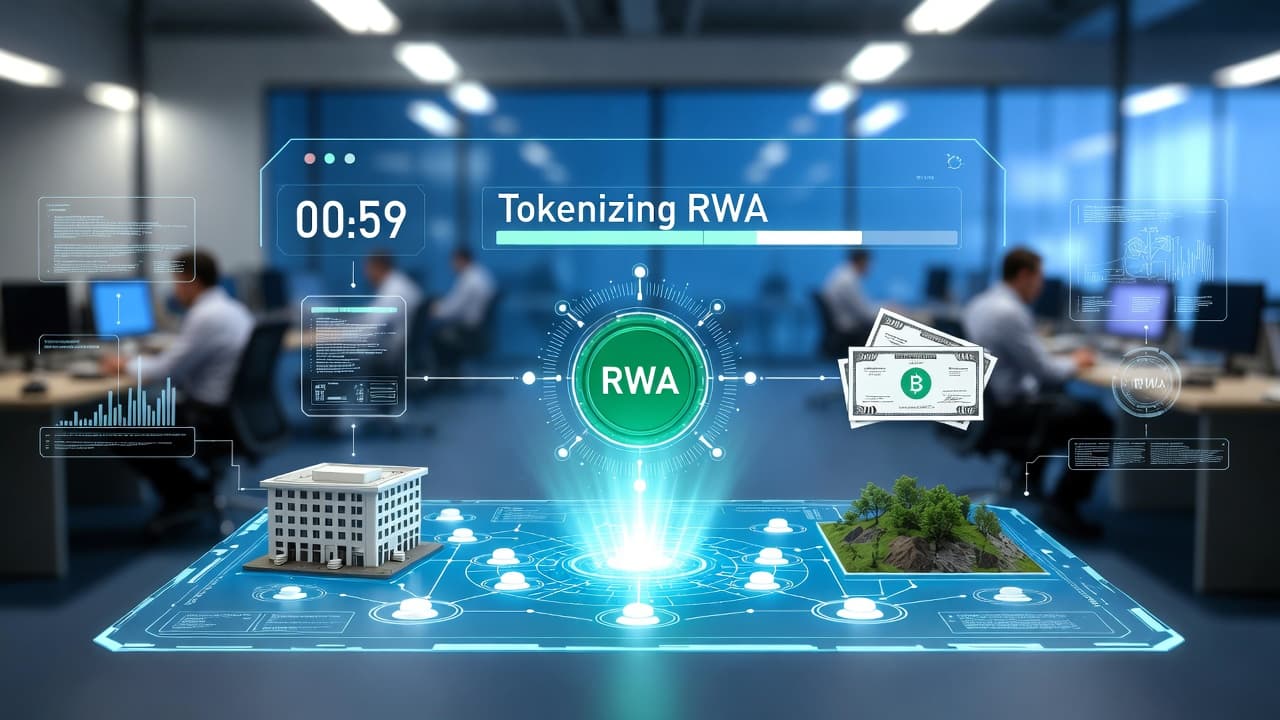
RWA Tokenisation: A Tool for Capturing Asset Opportunities Across Emerging and Developed Markets
For several years, the problem facing investors has not been a shortage of assets. It has been a shortage of channels.
Developed-market instruments such as US Treasuries and money market funds are liquid and clearly priced, yet a cross-border allocation still runs through account opening, custody, settlement and time zones. At the other end, consumer credit and SME loans in Asia and Latin America have not lacked return. They have stayed locked on the balance sheets of local originators. An offshore investor who wants exposure often stops at the legal wrapper, the movement of funds, and the administration of a multi-year life.
RWA tokenisation — tokenisation of real-world assets — is aimed at that gap. It does not change the legal or credit logic of the asset itself. It turns a share, an income right or a note claim into a digital record that can be subscribed for, and transferred, within a compliant framework. For someone who wants to look at developed and emerging markets at the same time, it is a new tool, not a new asset class.
What tokenisation is actually doing
Putting a real asset “on-chain” does not turn a building, a loan contract or a fund unit into a cryptocurrency. In practice, the structure usually has three layers.
The first layer is the underlying asset. It may be a Treasury bill or a money market fund already priced in a developed market, or a pool of consumer loans from an emerging market. The asset continues to operate under the rules of its home jurisdiction: borrowers repay, the manager handles the asset after origination, and the custodian keeps the books.
The second layer is the legal vehicle. A trust, a fund or a special purpose vehicle commonly holds the asset and issues shares, notes or beneficial interests. The token represents that right. It is not a direct proprietary claim over a particular loan. Under Hong Kong common law, an on-chain record does not yet replace the statutory register of title for real estate or loans, which is why compliant projects almost always follow the path of off-chain holding and on-chain recording.
Only the third layer is the token. Issuance information, the register of holders and part of the cash-flow allocation record go on-chain. Investors subscribe in US dollars or in a compliant stablecoin. The technology does not rewrite securities law. If the token is an interest in a collective investment scheme, or a debenture, under the Securities and Futures Ordinance, it remains a security, and the steps that require a licence still require a licence.
Tokenisation therefore changes friction, not the risk character of the asset. Credit risk, interest-rate risk, currency risk and emerging-market recovery risk all remain. What falls away are the old problems of repeated account opening, minimum subscriptions that are too high, and secondary transfer that is barely workable.
Why the point of landing is so often Hong Kong
Several jurisdictions are writing rules for tokenised assets. The place of offering still decides how quickly a product can reach eligible investors.
Hong Kong’s advantage is not lighter regulation. It is that the framework can already hold a full chain. Securities regulation is mature, and tokenised bonds — including government bonds — have already been offered. SFC licensing, the virtual asset trading platform (VATP) regime and investor-classification requirements give issuers, distributors and custodians the same predictable language. What an institution has to assess is not whether the token counts as innovation. It is whether the right being subscribed for, the exit path and the dispute forum sit inside rules that can be read.
A workable cross-border model follows. Origination stays in the source market. Offering and distribution sit in a market that can meet global eligible capital. A local broker or originator sources the underlying assets. An offshore vehicle holds them and issues notes or shares. A licensed platform generates the token that represents that right, and handles subscription, the register and later transfer. One end finds assets. The other meets capital. The join is a legal structure, not a verbal assurance.
That is why the same tool can serve both kinds of market. Developed-market assets need a finer entry threshold and a clearer holding record. Emerging-market assets need a compliant exit that an offshore professional investor can accept. The token is only the interface. Behind it there must be licensed offering, distribution and custody.
Developed and emerging markets are not a choice of one
If RWA is read only as “putting US Treasuries on-chain”, half the use of the tool is missed. The hard part of a global allocation is bringing assets of different character into one framework that can actually be executed.
On the developed-market side, money market funds, short-dated bonds and blue-chip-related products are valued for transparency and liquidity. They suit the ballast of a portfolio. On the emerging-market side, private credit is valued for cash flow that is less correlated with public markets. The ticket has been high, the information local, and the life long. It has been difficult to place as a satellite allocation in the account of a Hong Kong or international professional investor.
Tokenisation puts both sides into the same operating language. An eligible investor completes a suitability assessment on a licensed platform, subscribes in US dollars, and holds a token representing a fund share or a note. Redemption and disclosure still follow the product documents. The markets differ. The path can be the same. For an asset manager, it is a new distribution rail. For an investor, it is a way to look beyond a single market without stepping outside the compliance boundary.
Products already offered for subscription: CPCF and the KN private-credit pair
A concept is best tested against products that have already been made available for subscription.
EX.IO, a virtual asset trading platform licensed by the Hong Kong Securities and Futures Commission, continues to offer tokenised securities products for subscription by eligible investors. CPCF is a tokenised private-credit product newly offered on the platform. It places private credit — a category that used to sit in a closed room — into a licensed distribution setting where the product documents can be read and a subscription can be made.
Private credit itself is not new. It is debt financing provided by non-bank institutions and not offered on a public market. What is new is that a share can be held, under the rules, through a token, rather than existing only in a side-pocket arrangement among a few family offices.
On the same logic, TFCA and TFCD — issued by KN Group, with Ivy Pro Limited (licensed by the SFC for Type 1, Type 4 and Type 9 regulated activities) as asset manager — have been made available for subscription by professional investors on EX.IO. Both correspond to Class C shares of Tidebound Capital Private Credit Fund 1. The underlying assets are consumer loans in emerging markets in Asia and Latin America, with credit screening assisted by artificial-intelligence risk controls, and a 12.5% subordinated cushion provided by a related party. TFCA is accumulating: the accrued interest is received in one amount on redemption. TFCD is distributing: a distribution may be received monthly after subscription. Subscription and redemption are in US dollars, the minimum subscription is USD 100,000, and the tokens are deployed on Ethereum mainnet.
Read together, CPCF and the KN products matter more than the story of any single product. Emerging-market credit no longer has to enter a portfolio by flying to the source market and opening an account. It can be wrapped, then offered through a licensed distributor, and a professional investor can decide whether to subscribe according to his or her own risk tolerance. A subordinated cushion can improve the order of payment. It does not remove borrower default, currency risk or emerging-market recovery risk.
One step further: a full chain with Oria for emerging-market credit
Offering products that already exist answers the question of what can be subscribed for today. A continuing supply of assets needs the source and the channel to lock together.
In September 2026, EX.IO Group and Oria, a real-world-asset investment platform, announced a strategic cooperation with a specific direction: consumer-finance credit that Oria has already originated in Latin America as the underlying, with EX.IO Group working on the offering, distribution and custody of the related RWA tokens, so that investors in eligible jurisdictions have a chance to reach this kind of asset on a regulated path. Oria has originated and serviced more than USD 2 billion of credit assets in emerging markets. Within a month of the platform going live, assets under management rose to nearly USD 3 million.
Those figures are not a promise of return. They say that the supply side already has assets that can be operated, rather than a roadshow page alone.
The cooperation is not an intention starting from zero. As a first proof, Oria has opened an institutional account on EX.IO and completed a first subscription, in a US-dollar stablecoin, for a tokenised product — running the path from stablecoin funding, through conversion on a licensed platform, to subscription for a tokenised product. That subscription was for TKUSD, the tokenised Class T shares of the Taikang Kaitai US Dollar Money Market Fund. A developed-market money market fund subscription was used to test the channel. Only after the channel is tested does the discussion turn to making Latin American credit a new tokenised supply. The direction also runs both ways: new emerging-market assets can be tokenised outward, and tokenised products already offered can enter the allocation on the Oria side.
This sits with the platform’s own pace. EX.IO, the Hong Kong-licensed virtual asset trading platform under EX.IO Group, has made more than 30 tokenised products available for subscription. In September 2026, sales of the relevant tokenised products rose about 200% year on year, and trading volume over the same period rose about 800%. The group also has a record of mainnet issuance, including EXCB-25, backed by convertible acceptance notes. The figures say only that distribution and transfer are already happening. They are not a forecast of the performance of any product.
Once the tool is in place
RWA tokenisation will not turn an emerging market into a developed market, and it will not turn credit into a deposit. It does something more limited, and therefore more useful: it gathers rights that were hard to move across markets into one interface that a licensed institution can execute.
Developed markets supply a base that can be priced. Emerging markets supply differentiated cash flow. Hong Kong supplies rules and licences. The token supplies the form of the record and of the subscription. CPCF, KN Group’s TFCA and TFCD, and the full-chain cooperation between EX.IO and Oria on Latin American consumer finance are three faces of an interface that has started to work — a private-credit product already offered for subscription, an emerging-market loan fund with a licensed manager and a subordinated structure, and a supply arrangement that moves from a stablecoin subscription test toward a joint offering.
For a reader still making sense of this, the thing worth keeping is not a ticker. It is the order. Look first at the legal right the token represents. Then at which market the underlying asset sits in, who originated it, and who sits in the subordinated layer. Only then at which licensed platform the subscription is made. If the order is right, a multi-market allocation does not remain a slogan.
Frequently asked questions
These answers only restate the structure and facts already set out in this article. They are a reading aid. They are not a product introduction and not an offer to subscribe. Rights, fees, redemption and risk are governed by the product documents and by the suitability assessment of the licensed institution.
Does tokenisation turn a building or a loan contract into a cryptocurrency?
No. The usual structure has three layers. The underlying asset keeps operating under the rules of its home jurisdiction. A trust, fund or special purpose vehicle holds the asset and issues shares, notes or beneficial interests. The token records that right. It is not a direct proprietary claim over a particular loan. Under Hong Kong common law, an on-chain record does not yet replace the statutory register of title for real estate or loans. If the token is an interest in a collective investment scheme, or a debenture, under the Securities and Futures Ordinance, it remains a security, and the steps that require a licence still require a licence.
Does tokenisation reduce credit, interest-rate or currency risk?
No. Tokenisation changes friction, not the risk character of the asset. Credit risk, interest-rate risk, currency risk and emerging-market recovery risk all remain. What is reduced are the old problems of repeated account opening, minimum subscriptions that are too high, and secondary transfer that is barely workable.
Why do offering and distribution so often sit in Hong Kong, rather than in the source market?
Hong Kong’s advantage is not lighter regulation. Securities regulation, experience with tokenised bond offerings, SFC licensing, the virtual asset trading platform regime and investor classification can already hold a fairly complete chain. The workable cross-border model leaves origination in the source market, places offering and distribution in a market that can meet global eligible capital, and joins the two with a legal structure rather than a verbal assurance.
Do developed-market and emerging-market assets pose the same problem for tokenisation?
The path can be the same. The friction is not. Developed-market assets are usually already clearly priced, so tokenisation mainly lowers the entry threshold and improves the holding record. The difficulty with emerging-market private credit is the legal wrapper, the movement of funds and the administration of a long life. What is needed is a compliant exit that an offshore professional investor can accept. The token is only the interface. Behind it there must be licensed offering, distribution and custody.
How do CPCF, TFCA and TFCD relate?
All three are private-credit-related products used in this article as examples of products already made available for subscription. They are not the same product. CPCF is a tokenised private-credit product newly offered on EX.IO for subscription by eligible investors. TFCA and TFCD are issued by KN Group, with Ivy Pro Limited — licensed by the SFC for Type 1, Type 4 and Type 9 regulated activities — as asset manager. They correspond to Class C shares of Tidebound Capital Private Credit Fund 1, with underlying consumer loans in emerging markets in Asia and Latin America. Rights, fees and risks are set out in each product’s documents. This article is not a product proposal.
What is the difference between TFCA and TFCD?
As described in this article, TFCA is accumulating: the accrued interest is received in one amount on redemption. TFCD is distributing: a distribution may be received monthly after subscription. Both are subscribed for and redeemed in US dollars, with a minimum subscription of USD 100,000, and the tokens are deployed on Ethereum mainnet. A monthly distribution is not a guarantee of return, and it does not remove borrower default, currency risk or recovery risk.
Does the 12.5% subordinated layer mean the principal is protected?
No. The 12.5% subordinated capital provided by a related party is a cushion that can improve the order of payment. It is not a promise of principal or return. It does not remove borrower default, currency risk or emerging-market recovery risk.
How far has the cooperation with Oria been tested?
In September 2026, EX.IO Group and Oria announced a strategic cooperation directed at consumer-finance credit that Oria has already originated in Latin America, with EX.IO Group working on the offering, distribution and custody of the related RWA tokens. As a first proof, Oria has opened an institutional account on EX.IO and completed a first subscription, in a US-dollar stablecoin, for a tokenised product. That subscription was for TKUSD, the tokenised Class T shares of the Taikang Kaitai US Dollar Money Market Fund, and was used to run the path from stablecoin funding, through conversion on a licensed platform, to subscription. Testing the channel, and making Latin American credit a new tokenised supply, are two steps in sequence. They should not be collapsed into one.
How should the “sales up about 200%, trading volume up about 800%” figures be read?
They describe the distribution and transfer pace of relevant tokenised products on EX.IO in September 2026. They say that subscription and trading are already happening. They are not a forecast of the performance of any product, and they cannot be extended into future sales or returns. Oria’s “more than USD 2 billion of credit assets originated and serviced” and “assets under management of nearly USD 3 million within a month of launch” are supply-side facts, not a promise of return.
If a reader keeps only one thing, what should it be?
Look first at the legal right the token represents. Then at which market the underlying asset sits in, who originated it, and who sits in the subordinated layer. Only then at which licensed platform the subscription is made. If the order is right, a multi-market allocation does not remain a slogan. Product documents, suitability and the reader’s own risk tolerance still come before any ticker or short name.
Disclaimer
This article is for educational purposes only. It is not investment advice, a solicitation or a product proposal. Prices of cryptoassets and related tokenised products can move sharply, and an investor may lose the entire principal. Past performance is not a guide to future performance. Products, cooperations and figures mentioned here are illustrative. They are not a recommendation or endorsement by EX.IO of any third party, and they are not an offer to subscribe. Before making any investment decision, assess your own experience, financial position, objectives and risk tolerance, read the relevant product documents, and seek independent professional advice.
Further reading